OpenClaw’s Latest Subagent Routing Fix Shows Multi-Agent Products Still Live or Die on Boring Return-Path Logic

Multi-agent software is marketed like a cognition story. In production, it is much closer to a routing story. The impressive part is not that one agent can spawn another. The impressive part is whether the result comes back to the right human, in the right thread, under the right identity, without the child session smearing its own context across the return path.
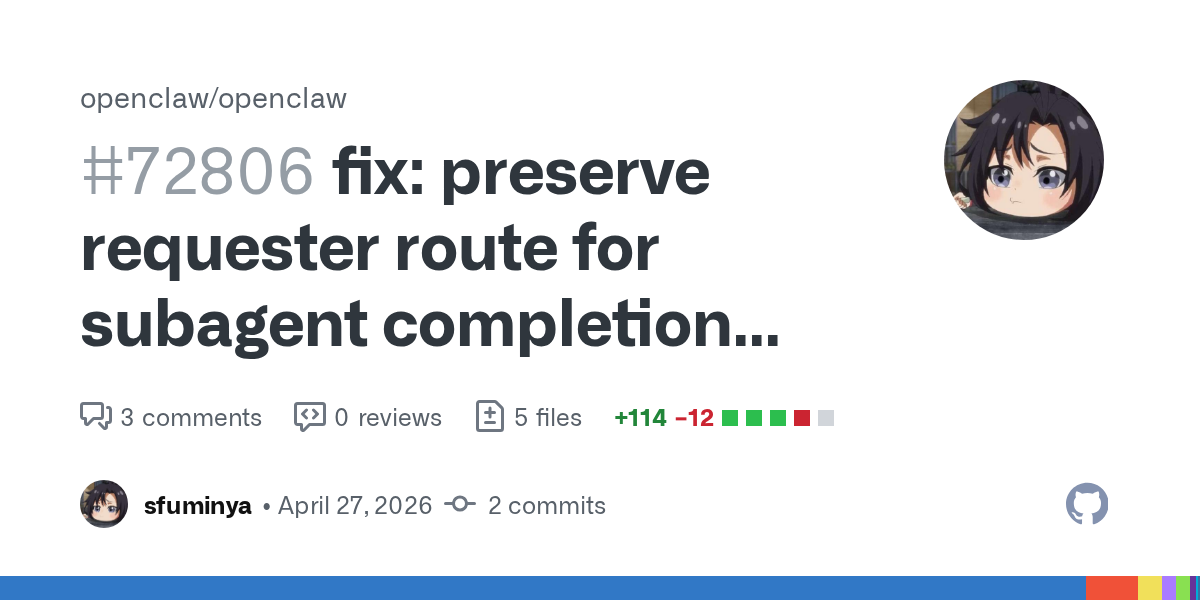
OpenClaw PR #72806, opened at 2026-04-27T12:40:48Z, is a good example of why this matters. The change is tiny, just 18 additions and 12 deletions across three files. But the bug it fixes is not tiny at all. According to the PR, subagent completion announcements could leak into the child agent's bound external window or account instead of returning cleanly to the original requester session. That is not a cosmetic placement bug. That is a broken contract in the one place multi-agent systems absolutely cannot afford confusion: the handoff back to the person who asked for the work.
The spawn is the easy part
OpenClaw's description of the failure is specific enough to be useful. One root cause sat in subagent-spawn.ts, where requesterOrigin was stored from child-side delivery context instead of preserving the original requester route. The second sat in subagent-announce-delivery.ts, which resolved completion-delivery bindings against params.childSessionKey and permitted non-fail-closed fallback, letting delivery prefer the child session's binding. The fix separates requesterOrigin from childSessionOrigin, resolves completion delivery against params.requesterSessionKey, and sets failClosed: true.
That sounds like implementation detail. It is also the whole game. In any delegated workflow, the child runtime is allowed to own execution context. It is not allowed to redefine the human return path. The minute those concepts blur, the platform can appear perfectly healthy to maintainers while the actual user sees the result arrive in the wrong Telegram DM, the wrong external window, or not at all.
This is part of a pattern, not a one-off
The linked history makes the point sharper. Issue #70574, filed on April 23, documented an earlier version of the same class of mistake: child completions routing to the child agent's Telegram DM instead of the parent session because the child binding overwrote the parent requesterAccountId. PR #70607 then tried to address that specific path with a one-character condition change. PR #71064 followed on April 24 with a thread-bound completion fallback so results would not disappear when the announce-agent bridge produced no visible output.
If you step back, this is not embarrassing churn. It is what product maturity looks like when real users stop treating multi-agent orchestration as a demo and start stressing it as messaging infrastructure. The system is being forced to answer boring questions that demos skip: which account owns the return, which thread owns the completion, what happens when bindings disagree, and what does fail-safe delivery actually mean?
Distributed messaging with LLMs attached
The reason these bugs keep surfacing across the industry is simple. Multi-agent software is often presented as a reasoning breakthrough when its user-facing failure modes look a lot more like distributed systems and message-bus bugs. Identity preservation, thread affinity, account scoping, fallback semantics, delivery guarantees, and failure isolation are not side quests. They are the substrate.
That is why the most important word in this PR may be failClosed. In security, fail-closed means stop rather than permit unsafe behavior on ambiguity. In orchestration, the same instinct matters. If the system cannot confidently resolve the requester route, it should not casually send the completion wherever context happens to be available. Silent misdelivery is worse than visible non-delivery because it creates false confidence.
There is a broader product thesis here too. Agent orchestration will only feel trustworthy when the platform treats parent identity and child execution as separate invariants. The child may use different tools, run in a different runtime, or bind to a different channel for its own work. None of that should ever be allowed to rewrite who receives the answer. If that sounds obvious, good. Obvious invariants are exactly the ones platforms tend to violate during rapid feature growth.
What builders should test, not just assume
For practitioners evaluating any multi-agent platform, the lesson is blunt: test the return path harder than the spawn path. Everyone demos delegation. Fewer people aggressively verify where the answer lands, whose identity it carries, which thread it attaches to, and what fallback behavior looks like when the first delivery route is missing or stale.
OpenClaw's recent issue and PR chain is useful public evidence that these details are where trust is won or lost. If you are building on top of the platform, create test cases that deliberately mix requester bindings, child bindings, thread contexts, and account contexts. Run them on your real channels, not only in mocks. Confirm that the system fails loudly when routing confidence is low instead of “helpfully” guessing. And if you are designing your own orchestration layer, treat requester-route preservation as a first-class protocol concern, not an implementation convenience.
The diff here is small because the bug lives in logic, not volume. But the product lesson is large. Multi-agent systems do not primarily break at the point of intelligence. They break at the handoff. A workflow that loses its answer on the return trip is still a failed workflow, no matter how elegantly the child agent reasoned along the way.
Sources: OpenClaw PR #72806, OpenClaw issue #70574, OpenClaw PR #70607, OpenClaw PR #71064