OpenRouter’s No. 1 and No. 9 Are the Same Model

OpenRouter’s most popular model this week is also its newest top-10 entrant. That is not a paradox in model capability; it is a data-modeling problem.
Ox Alpha remains No. 1 on OpenRouter’s trailing-week usage chart with 25.2 trillion processed tokens. GLM 5.3 Flash has entered at No. 9 with another 3.3 trillion. Z.ai has now identified Ox Alpha as the anonymous preview of GLM-5.3-Flash, which means the ranking shows one underlying model twice: first under its stealth launch name, then under its released identity.
Combine those routes and the model family accounts for 28.5 trillion tokens, more than twice the 12.3 trillion recorded by runner-up DeepSeek V4 Flash 0731. That combined number is analytical context, not an official OpenRouter rank. But it is the only useful way to understand what happened: traffic is migrating between labels while the table treats the new label as a new competitor.
This matters because model leaderboards are increasingly used as shorthand for market share, quality and developer preference. OpenRouter’s table claims none of those things. It measures tokens processed, excludes private requests and counts variants separately. A trillion tokens can represent many users doing small jobs, a few agent systems chewing through repositories, or reasoning traces that would make a Victorian novelist ask for an editor.
The stealth preview was a production-scale audition
The remarkable result is not that GLM 5.3 Flash received a new name. It is that an anonymous model accumulated 25.2 trillion public-route tokens before the formal identity settled into the chart. The preview has slipped from the previous snapshot’s 27.2 trillion, but it still handles more than double the volume of the next row.
Removing the brand was a useful product experiment. Developers could evaluate tool use, latency, coding behavior and long-context performance without importing their opinions about Z.ai—or Chinese foundation models generally—into the first prompt. LocalLLaMA and OpenCode users had already tried to fingerprint Ox Alpha from its response style and latency. After the reveal, discussion moved quickly to the questions that matter in production: task-level cost, quantized serving recipes, and whether the preview inference ran on Chinese AI accelerators.
That is original launch telemetry most vendors would pay dearly to obtain. A stealth route turns a model release into a blind taste test while exposing it to messy workloads that curated benchmarks do not capture. It also has a limit: free or heavily promoted usage demonstrates workload exposure, not durable paid demand. Engineers will happily route batch work to an inexpensive endpoint; procurement may reach a different conclusion when the promotion ends.
Z.ai describes GLM-5.3-Flash as a 320-billion-parameter mixture-of-experts model with 18 billion active parameters, trained on a 30-trillion-token multimodal corpus. Its architecture combines sparse attention with linear attention and uses what the company calls Manifold-Constrained Hyper-Connections to reduce long-context serving cost. The model card claims performance above GLM-5.2 at one-tenth the price and results approaching Claude Opus 4.8 on coding and agent evaluations. Those remain vendor claims until independent teams reproduce them on their own workloads.
The reproduction settings also deserve more attention than the headline scores. Z.ai reports allowing as many as 163,840 generated tokens for Humanity’s Last Exam with tools, a one-million-token context for NL2Repo, and a 400,000-token context plus six-hour timeout for DeepSWE. Terminal-Bench 2.1 also received a six-hour timeout. Those are legitimate test configurations, but they measure a system operating with unusually generous budgets. A team buying outcomes under latency and cost constraints should not assume the same ordering will survive a tighter envelope.
A ranking of incentives, not intelligence
The rest of the weekly movement reinforces that point. GPT-5.6 Luna climbed two places, from seventh to fifth, as volume rose from 4.9 trillion to 6.04 trillion tokens. Its OpenRouter listing advertises roughly a 1.05-million-token context window, while recent promotion paired an 80% provider price reduction with an additional temporary OpenRouter discount. That can unlock genuinely useful workloads—batch classification, repository analysis and lightweight agents—that were uneconomic before. It can also buy a temporary chart position.
Claude Opus 5 rose two positions to No. 13. MiniMax M3 dropped two spots to No. 15, while its free variant entered at No. 19 with 1.12 trillion tokens and displaced Nemotron 3.5 Lightning’s free route. In every case, price, routing availability and variant labeling are entangled with capability. The table is excellent at answering “where are public tokens going this week?” It cannot answer “which model is best for my application?”
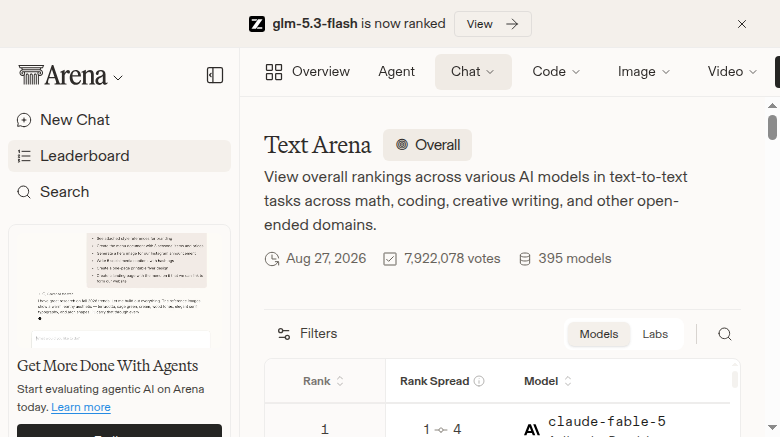
Arena AI makes the contrast useful. Its quality-oriented top 20 did not move at all: Claude Fable 5 remains first, followed by Claude Opus 4.6 High, Claude Opus 4.7 High, Muse Spark 1.2 xHigh and Claude Opus 4.6. The current rendered table did not expose reliable Elo or vote totals to the research scraper, so inventing precision would be worse than reporting the stable ordinal positions. OpenRouter’s reshuffle alongside Arena’s stasis is evidence of an adoption event, not a sudden change in model intelligence.
Normalize the names before trusting the graph
Teams operating model gateways should copy one lesson from this episode immediately: maintain a canonical model-family key separate from the route name. Normalize stealth aliases, dated checkpoints, free variants and reasoning tiers before calculating provider share or reporting week-over-week growth. Keep route-level data too, because price and configuration affect behavior, but do not let a rename masquerade as a new entrant.
For evaluation, GLM-5.3-Flash deserves a structured trial rather than a production-wide flip. Run representative repositories and tool workflows at explicit reasoning_effort settings—low, high and max are supported, with max used for leaderboard reproduction. Record wall-clock latency, input and output tokens, retry rate, tool-call validity, human acceptance and cost per completed task. “Tokens per dollar” is a procurement metric; “accepted outcomes per dollar” is an engineering metric.
Long context needs its own adversarial test. Put answerable facts at different positions, add conflicting evidence, and measure whether the model cites the right passage rather than merely producing a plausible answer. A one-million-token context setting describes capacity, not recall quality. Agent loops compound every retrieval mistake, so test multi-step jobs, not just single prompts.
Self-hosters have several supported paths, including SGLang, vLLM, TokenSpeed, Transformers, KTransformers and Unsloth. The 18-billion active-parameter figure is attractive because it reduces compute per generated token, but it does not make 320 billion parameters of weights disappear. Before committing, verify quantization quality, aggregate memory, KV-cache growth, interconnect requirements and sustained throughput on the hardware you actually own.
The same discipline applies to Luna. Re-run the cost model at the post-promotion price and compare it with today’s discounted rate. If the workload only works while a temporary subsidy is active, that is a campaign result, not an architecture decision.
Usage charts are valuable because they reveal where developers are sending real work. They become dangerous only when we ask them to judge things they never measured. This week’s ranking is best read as a lesson in identity normalization and incentives: cheap access and anonymous previews can create extraordinary adoption, while aliases can make one model look like two market events. The software team that cleans those labels and measures completed outcomes will learn more than the team that simply deploys whatever row happens to be moving upward.
Sources: OpenRouter LLM Rankings, Z.ai GLM-5.3-Flash model card, OpenRouter Ox Alpha listing, LocalLLaMA community megathread, Arena AI leaderboard