Opera Neon Goes All-In on Agentic Browsing with Native MCP Support

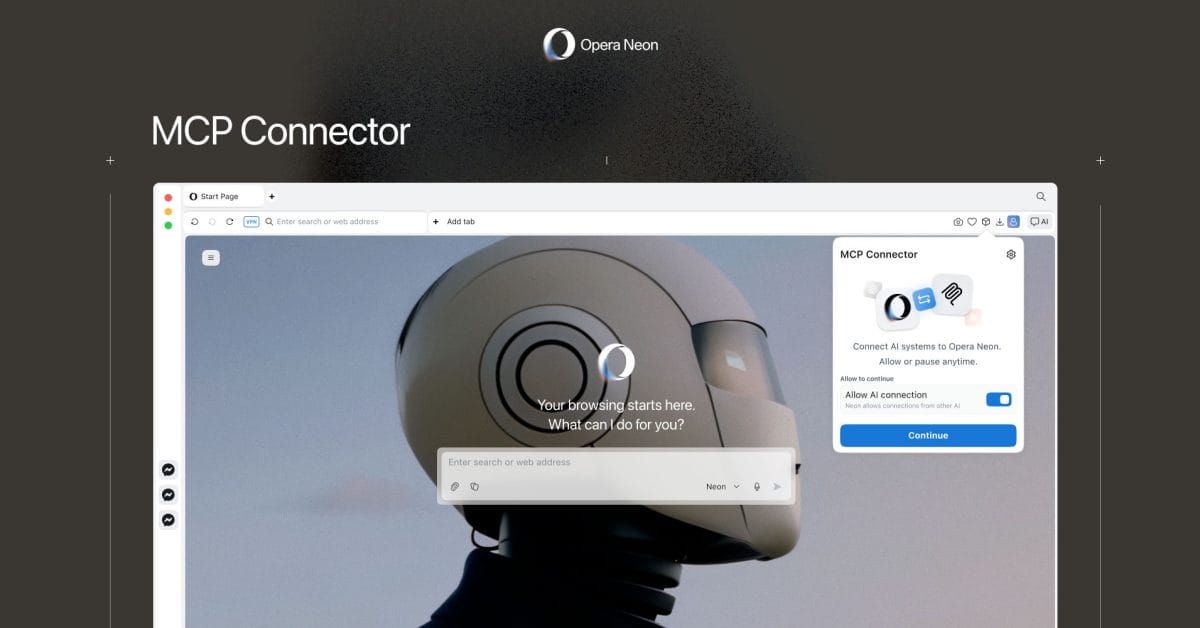
Opera Neon has taken a significant step toward making the browser a first-class citizen in the agentic AI ecosystem, rolling out native support for the Model Context Protocol (MCP) directly inside the browser. With the update, users can connect AI tools — including ChatGPT, Claude, and Gemini — to their live browsing sessions, allowing external agents to read tab content, navigate pages, and take real-time actions on behalf of the user. Services like Notion, Google Drive, Slack, GitHub, and Zapier can now be bridged through the browser as a live context source rather than requiring separate integrations.
MCP, originally developed by Anthropic and now stewarded by the Linux Foundation's Agentic AI Foundation, provides the universal standard that makes these connections possible across frameworks and providers. Opera Neon's implementation signals a broader shift in how browsers are being reconceived: not just as rendering surfaces, but as active participants in multi-agent workflows. Where browser automation has historically relied on fragile scraping or proprietary APIs, MCP gives agents a stable, permissioned channel into whatever context the user is actually working in.
The practical implications for developers and power users are substantial. Any MCP-compatible framework or agent can now tap into real-world browser context — open tabs, live page content, user sessions — without requiring bespoke integrations for each service. As MCP adoption accelerates toward mainstream, browser-native support may well become a baseline expectation rather than a differentiating feature.