Qwen Code Makes qwen serve a Real Browser Agent

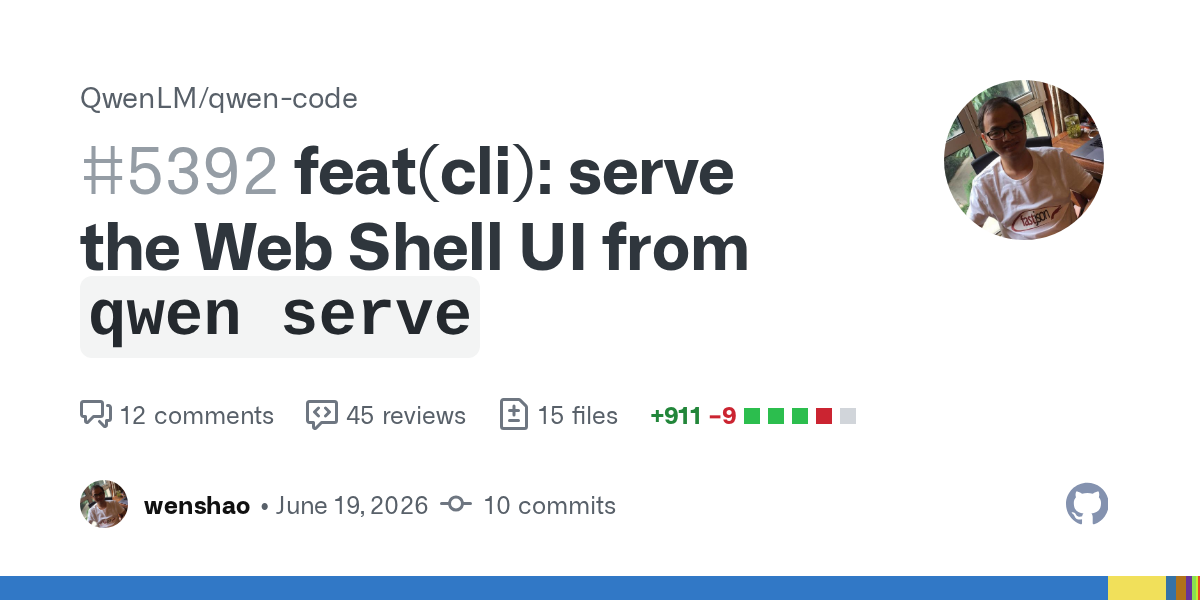
The most important thing Qwen Code shipped today is not a smarter model. It is a boring distribution decision: qwen serve can now serve the browser Web Shell itself.
That sounds like plumbing because it is plumbing. But plumbing is where coding agents either become tools people can actually run every day or remain impressive source-tree demos. PR #5392, merged on June 19, moves Qwen Code’s browser interface out of the “clone the repo, run the daemon, run Vite, hope the proxy behaves” lane and into the released binary path: one qwen command, one daemon, one port, one origin.
For a local coding agent, that is a product boundary, not a convenience flag.
The browser UI is no longer a contributor-only affordance
Before this change, the Web Shell was real but awkwardly positioned. Developers working from the Qwen Code source tree could run the development setup and use the browser UI through a Vite-backed workflow. Released builds exposed the daemon API and an inline demo, but not the actual Web Shell front end users reasonably expected after installing the tool.
PR #5392 fixes that by serving the built single-page app from the daemon’s root path. The same process that owns the daemon HTTP and SSE APIs now serves the UI that talks to them. The release also adds two flags that make the intent explicit: --open starts the listener and launches the browser at the daemon URL, while --no-web keeps the daemon API-only for users who want the control plane without the browser surface.
The change was not a two-line route handler. GitHub reports 911 additions, 9 deletions, 15 files changed, 12 issue comments, and 66 review comments. Files touched include docs/users/qwen-serve.md, packages/cli/src/commands/serve.ts, packages/cli/src/serve/runQwenServe.ts, packages/cli/src/serve/server.ts, packages/cli/src/serve/webShellStatic.ts, and Web Shell daemon configuration tests. That shape matters: packaging, docs, tests, runtime assumptions, and CLI ergonomics all had to move together.
This is the point where Qwen Code starts looking less like a terminal agent with a sidecar UI and more like a local-agent control plane.
Same-origin is the underrated security decision
The obvious win is first-run UX. Install Qwen Code, run qwen serve --open, use the browser. No source checkout. No Vite proxy. No “this works in dev but not in the thing we shipped.” That alone is worth shipping.
The more important win is that the browser UI, REST endpoints, and SSE transport now share a clearer origin boundary. Browser agent interfaces sit next to dangerous surfaces: repository files, tool execution, live session state, authentication tokens, approval flows, and streamed model output. A split development proxy can hide CORS mistakes, auth drift, and deployment-only bugs until users hit them outside the maintainer workflow.
One daemon origin does not magically make an agent safe. It does make the boundary testable. Teams evaluating local coding agents should ask a blunt question: where does the browser UI live relative to the process that can mutate my repo? If the answer is “a dev server talks to a daemon through a proxy in contributor mode,” you are not evaluating the product your developers will actually run. You are evaluating the maintainer’s happy path.
Qwen Code’s answer is now cleaner. The UI and daemon share lifecycle, origin, and release packaging. That gives maintainers fewer places to document exceptions and users fewer ways to accidentally run a half-product.
The control plane is becoming the competition
This PR also makes more sense when placed next to Qwen Code’s recent daemon work. PR #5174 added a read-only GET /daemon/status endpoint with summary and full modes reporting session counts, permission pressure, REST/SSE and ACP transport counts, rate-limit rejects, memory, limits, auth posture, and degraded workspace diagnostics. PR #5175 added mid-turn message delivery from the Web Shell into a running turn, delivered exactly once between tool batches. PR #5094 added Dynamic Workflows P4 with /workflows, workflow metadata, a WorkflowRunRegistry, and a phase-tree UI.
That is not random feature scatter. It is the outline of an agent runtime: inspect sessions, talk to a running turn, visualize workflow phases, expose daemon health, and now ship the browser surface with the daemon itself.
Claude Code, Codex, Qwen Code, OpenCode, and every internal coding agent will keep getting compared on model quality. Fair enough. But in real engineering use, the model is only one failure mode. The agent has to survive long sessions, support recovery, expose what it is doing, handle approvals, let users interrupt or redirect work, and avoid turning every UI affordance into a separate deployment story.
That is why qwen serve matters. The winning coding agent is not merely the one that writes the best five-line function in a benchmark. It is the one a team can leave running against a non-toy repository without needing a senior engineer to babysit process topology.
What engineers should do with this
If you are evaluating Qwen Code, test the released path, not the contributor path. Install the binary or package your team would actually distribute, start qwen serve, and verify the Web Shell, daemon API, SSE streams, auth expectations, and session lifecycle all behave from the same origin. Then run the boring checks: bind address, token handling, local-network exposure, browser launch behavior, and whether --no-web gives you the API-only posture you need for automation.
If you are building an agent product, copy the product lesson: development topology is not product topology. A browser UI that only works behind a dev server is a demo, even if the demo is useful. Once an agent touches files and tools, the shipped deployment path has to be the path you test, document, and secure.
The caveat is that this raises Qwen Code’s own bar. A Web Shell available wherever qwen is installed needs boringly correct defaults. Enterprise users will want explicit bind-address guidance, auth posture surfaced in status output, reverse-proxy notes, audit-friendly logs, and crisp language around what is safe to expose beyond localhost. --no-web is the right escape hatch, but it is only part of the hardening story.
Still, this is the right kind of progress. Qwen Code is collapsing a scattered local-agent experience into a coherent runtime surface. One process and one port will not win the agent race by themselves. But without that kind of boundary, everything above it becomes support debt with a nicer logo.
Sources: GitHub PR #5392, Qwen Code qwen serve docs, daemon status API PR #5174, Web Shell mid-turn delivery PR #5175, Dynamic Workflows PR #5094