Qwen Code’s Latest Runtime Fixes Are About Making Agents Fail Less Stupidly

Qwen Code’s most useful work this week is not a model launch. It is plumbing. That sounds like faint praise until you remember that coding agents do not fail in production because the demo prompt was insufficiently cinematic; they fail because a pipe blocks, a context estimate lies, a shell command floods memory, or a tool schema drifts just far enough that the model starts confidently calling an interface that no longer exists.
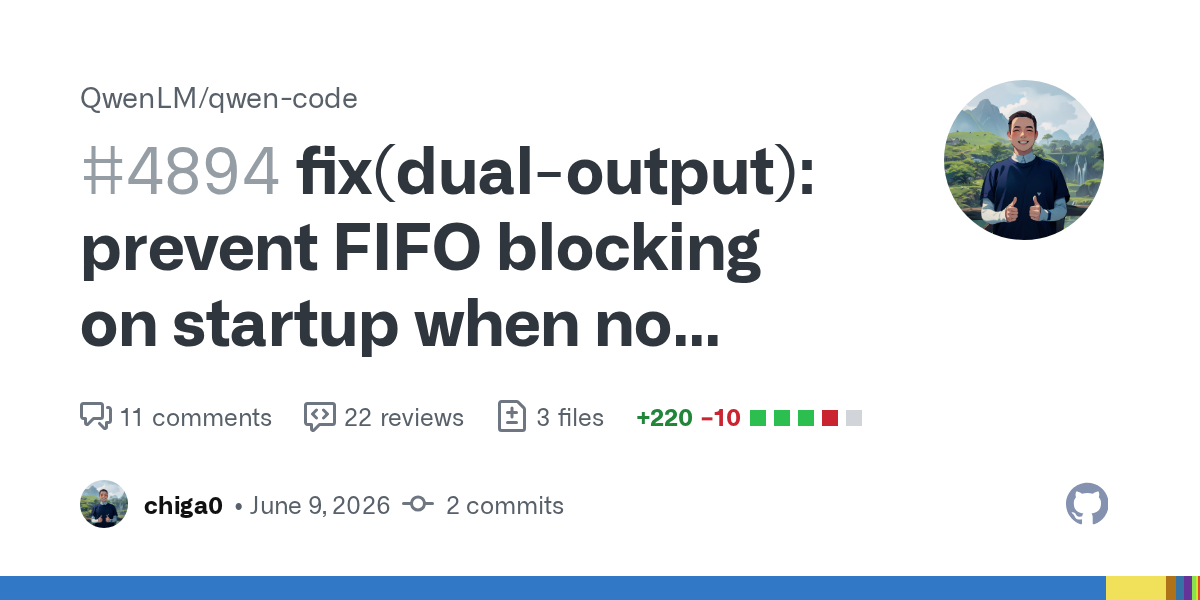
The latest Qwen Code main-branch cluster is a good example of what separates an agent runtime from an agent toy. The headline patch, PR #4894, fixes a startup deadlock in dual-output JSONL mode. When users pointed --json-file at a FIFO with no reader attached, the TUI could hang before doing anything useful. The fix opens the FIFO with O_RDWR | O_NONBLOCK rather than falling back to a blocking write stream, and adds a 1 MB high-water-mark escape hatch so an undrained bridge disables itself instead of silently growing forever.
That is a small patch with a large implication: people are treating Qwen Code as a component in larger systems. Named pipes are not marketing-demo infrastructure. They are what developers reach for when they start wiring an agent into dashboards, wrappers, log collectors, web shells, ACP bridges, and internal orchestration glue. If the agent freezes because the other side of a pipe has not connected yet, the model did not “reason poorly.” The runtime violated the operating system contract it depends on.
The bugs are boring because the product is becoming real
The surrounding fixes make the same point from different angles. PR #4525 includes response-side tokens in prompt candidate estimates, which matters because context budgets are not vibes. If an agent undercounts history and lets an oversized request proceed until a later guard rejects it, the user experiences that as arbitrary flakiness. Good token accounting is not glamorous, but every long-running coding session eventually becomes a budgeting problem.
PR #4528 hardens chat compression when provider usage metadata is missing. Instead of assuming the provider gave perfect accounting, Qwen Code can proceed through a safer fallback while rejecting inflated local token deltas that would make compression unsafe. That is the right shape. Provider APIs are uneven, local estimators are imperfect, and an agent that compresses history based on bad numbers is not optimizing context; it is corrupting its own memory with a straight face.
PR #4524 bounds foreground shell output retained in memory. The command still drains and streams output to live consumers, but the final retained rawOutput / decoded result no longer grows without bound; users get a capture-limit notice when the retained output is truncated. Anyone who has ever run a verbose test suite, a recursive grep in the wrong directory, or a misconfigured build inside an agent loop should appreciate the restraint. A single noisy command should not be able to turn a coding assistant into a memory-pressure incident.
Schema drift is an agent reliability bug
The most interesting fix may be PR #5115, which patches a failure mode around Agent Team names leaking into one-shot subagent calls. When Agent Team is disabled, Qwen Code no longer advertises the teammate-only name parameter in the Agent tool schema. If an older prompt or bundled workflow still sends name, the runtime ignores it and launches a normal one-shot subagent rather than failing immediately.
The motivating issue is a tidy little horror story. In issue #5100, a /review 5096 --comment run attempted to launch nine named review agents, failed each spawn because there was “no active team,” then hallucinated that the never-started agents were still running. It repeated the broken call pattern until the backend aborted for repetitive calls. That is not just a model mistake. It is a schema-contract failure cascading into model behavior.
This is where agent products need to be more disciplined than normal CLI tools. A human sees “this argument is invalid” and usually stops. A model may treat the error as another state to reason around, especially if the surrounding prompt suggests the agent workers should exist. Tool schemas have to be context-sensitive, feature flags have to change the advertised interface, and compatibility fallbacks have to be boringly forgiving. “The model will figure it out” is not an engineering strategy; it is how you get nine imaginary reviewers and a green-looking workflow that did nothing.
Daemon docs are not documentation theater
The biggest patch by line count is PR #4412, a 4,824-line refresh of daemon developer documentation. That sounds like paperwork until you scan the surface area: qwen serve, the ACP bridge, MCP transport pools and budget guardrails, workspace filesystem boundaries, session lifecycle, typed event schemas, capabilities, SDK daemon clients, shared UI transcript layers, adapters, configuration, error taxonomy, observability, and quickstart operations.
That list is the product roadmap hiding in the docs. Qwen Code is no longer only competing as a terminal chatbot with file-edit tools. It is becoming an integration surface that other clients and systems can build around. Once a runtime exposes typed events, daemon sessions, bridge protocols, tool transports, and capability negotiation, downstream developers need contracts they can trust. Otherwise every wrapper becomes a pile of reverse-engineered assumptions waiting for the next release to break them.
This matters in the broader Qwen-vs-Claude-Code-vs-Codex conversation because model quality is only one layer of the decision. Developers experimenting with local Qwen 3.6 or hosted Qwen Code are often willing to trade frontier-model ceiling for lower cost, locality, transparency, or simpler failure modes. But that trade only works if the harness behaves. A cheaper model behind a runtime that deadlocks on a FIFO, lies about prompt budget, keeps unbounded shell output, or lets schema drift poison subagents is not cheaper. It is deferred debugging.
The practitioner checklist is concrete. If you are evaluating Qwen Code after v0.18.0, reproduce the FIFO case with no reader and verify the TUI starts. Pipe dual-output into a slow consumer and watch whether memory remains bounded. Run a command with huge stdout and confirm live streaming continues while retained output is capped. Force missing provider usage metadata and inspect whether compression fails conservatively. Run review/subagent flows with Agent Team disabled and make sure named-worker prompts degrade instead of spiraling. If you are building around qwen serve, read the daemon docs before depending on event shapes you inferred from a log stream at 2 a.m.
The editorial read: this is exactly the kind of release-adjacent work that deserves more attention than another benchmark chart. Qwen Code’s recent patches reduce stupid failures. They do not prove the agent is ready to mutate production repos unattended, and the churn on main is a reminder to pin versions before building workflows on it. But the direction is right. The next serious coding-agent comparison should score deadlock behavior, context accounting, compression safety, shell-output bounds, schema recovery, and daemon contracts before it scores vibes.
Agents become useful when they stop surprising operators in boring ways. This Qwen Code cluster is not glamorous. LGTM.
Sources: Qwen Code PR #4894, PR #4525, PR #5115, PR #4412, PR #4528, PR #4524, issue #4727, issue #5100, Hacker News