Qwen Code’s Newest Main-Branch Work Is About Surviving Real Agent Operations

Qwen Code’s most interesting work today is not a benchmark, a model card, or another “look, it can edit files” demo. It is a cluster of main-branch patches about how an agent behaves when the world gets annoying: rate limits, dropped streams, browser refreshes, memory pressure, native computer-use drivers, and CI jobs that pretend everything passed after the model silently disappeared.
That sounds less marketable than a new model release because it is. It is also the work that decides whether a coding agent can graduate from a terminal toy into infrastructure teams leave running. The June 14 merge set around Qwen Code is a useful snapshot of where Alibaba’s agent stack is maturing: the product is starting to optimize for failure semantics, not just happy-path capability.
Retry policy is where agent maturity stops being theoretical
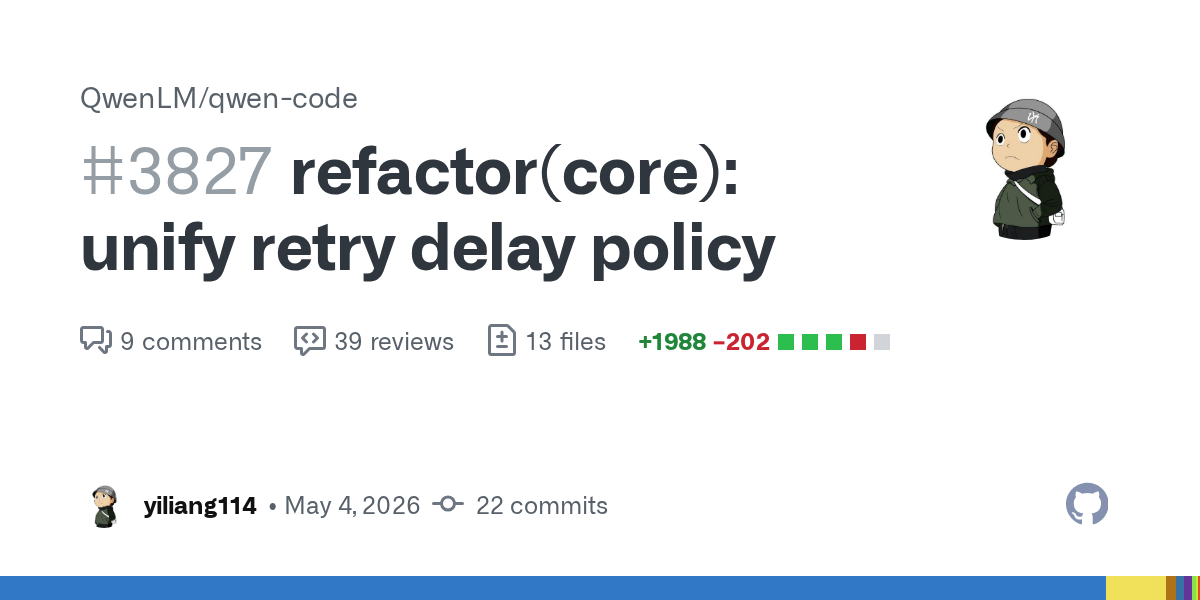
The headline patch is QwenLM/qwen-code PR #3827, merged on June 14 at 13:21 UTC. On paper, it is a refactor: “unify retry delay policy.” In practice, the 1,988-addition, 202-deletion change turns a messy operational question into explicit runtime behavior: when should the agent wait, when should it retry, when should it respect the server, and when should it stop lying to itself that persistence is resilience?
The details matter. The retry code now handles both 429 and 503 Retry-After responses, including RFC 7231-style HTTP-date values and decimal-second delays. It avoids adding jitter when a server has already instructed a wait, clamps oversized delays so timer overflow cannot turn a long backoff into a tight loop, and fast-fails abort or cancel errors even if a broader retry predicate would otherwise try again. It also excludes fail-fast provider business errors from unbounded persistent retry loops, which is exactly the right instinct for quota errors such as DashScope Throttling.AllocationQuota.
This is the kind of code nobody brags about until it is missing. Bad retry logic in an agent is not just inefficient; it is user-hostile. Too aggressive and the runtime burns quota, amplifies provider incidents, and hammers APIs already asking it to slow down. Too stubborn and a terminal sits there “recovering” from an error that will never clear. The correct behavior is boring and precise: classify errors, honor server-directed waits, preserve cancellation, log enough to debug, and fail closed when the provider is telling you the problem is permanent.
That is also why this is a comparison point for Qwen Code against Claude Code, Codex, OpenCode, OpenClaw-style routers, and local Qwen-backed stacks. The benchmark table tells you whether the model can solve a task. Retry behavior tells you whether the tool survives the afternoon.
Daemon state has to be reconstructable, not remembered by a tab
The same morning, PR #5098 landed with 401 additions across 21 files to make Qwen Code’s /goal state survive page refreshes and sync across devices. The implementation shifts goal status into structured daemon transcript events through _meta.goalStatus, instead of leaving it as frontend memory.
That may sound like UI plumbing, but it is actually agent-state architecture. If a web shell loses the active goal when the page reloads, then the goal was never part of the durable session; it was a React component’s opinion. Serious agent workflows do not live inside one uninterrupted terminal anymore. They span daemon sessions, browser shells, mobile check-ins, ACP clients, restarted processes, and background tasks that a human may inspect hours later. If the runtime cannot reconstruct what the agent thought it was doing from the transcript, the session is not operationally legible.
The practitioner takeaway is simple: when evaluating coding agents, ask where state lives. “The UI shows a plan” is not enough. Can another client reconnect and see the same goal? Does a refresh lose semantic context? Are state changes represented as durable events, or are they inferred from whatever the client remembers? The best agent interface is not the prettiest one; it is the one whose state can survive the user doing normal user things.
The memory and CI fixes are small because the failure modes are not
PR #4914 is the runtime admitting long sessions hurt. It adds 1,214 lines and hardens out-of-memory prevention: regression tests for idempotent compaction, explicit GC support enabled by default, --expose-gc wired into startup scripts, and GC invocation constrained to the critical memory-pressure tier after history and file-cache cleanup break references.
Explicit garbage collection is not a magic wand. If a coding agent is keeping too much state alive, a GC call does not absolve the architecture. But the sequencing here is the interesting part: compact history, clear file-cache references, then trigger GC only when pressure is critical. That is an operational posture, not superstition. The runtime is acknowledging that real agent sessions accumulate tool output, file context, history, and cache state until memory behavior becomes a product feature.
PR #5053 is even smaller — a 23-line CI fix — and arguably just as important. Qwen Code’s PR-review GitHub Actions job now inspects the terminal stream-json result event after qwen exits and fails the job when a model connection drops mid-review and no comment is posted. The motivating example was a run on PR #5006 where the review launched five parallel agents, hit [API Error: terminated (cause: other side closed)], exited 0, posted nothing, and still looked green.
That is not automation. That is false confidence with YAML. Agentic review systems must treat “the model vanished and produced no review” as a failure, not an empty success. Teams wiring agents into CI should copy the principle even if they do not use Qwen Code: verify the terminal event, verify the side effect, and make silent non-output fail the build. If your automation can do nothing and still pass, it is not automation; it is decorative latency.
Computer Use is now a packaging and permissioning problem
The riskiest June 14 change is PR #5051, which replaces Qwen Code’s experimental Computer Use backend with cua-driver-rs, the Rust driver from trycua/cua. The patch is large — 2,913 additions, 882 deletions, 20 files changed — and exposes a 35-tool surface through MCP over stdio. The driver is pinned to version 0.5.2, downloaded on first use into ~/.qwen/computer-use/, fetched from a Qwen asset mirror first and GitHub fallback second, and verified against SHA-256 checksums before extraction.
Those distribution details are not trivia. Once an agent can drive desktop state, “model quality” becomes only one line item in the risk budget. The real questions become: who ships the native binary, how is it verified, where does it install, how is it upgraded, what tools are exposed, what does cancellation do, what can be audited, and how do permissions compose with MCP?
The platform matrix shows the shape of the work. macOS gets darwin-{arm64,x86_64}.tar.gz packages with a wrapper directory plus CuaDriver.app. Linux gets linux-x86_64-binary.tar.gz. Windows support follows the signed upstream release path. That is the unglamorous reality of “computer use”: app bundles, extraction layouts, mirrors, checksums, native drivers, stdio lifecycle, background behavior, and permissions that need to be understandable before the agent starts clicking.
Builders should treat this as both progress and a warning label. A locally running Qwen stack can reduce cloud egress and usage bills, but local computer-use tools can still click the wrong thing, move the wrong window, approve the wrong dialog, or leak context through the wrong tool. Local does not mean safe. Open-weight does not mean governed. MCP does not mean harmless. The security model has to be explicit because the blast radius has moved from generated text into machine state.
The practical test suite for Qwen Code after v0.18.0 should therefore look less like a coding benchmark and more like an incident drill. Simulate 429 and 503 responses with Retry-After. Cancel a request during a retry sleep. Refresh the web shell after setting a goal. Reconnect from a second client. Run a memory-heavy session until compaction and critical GC behavior trigger. Break a model-powered PR review mid-run and confirm CI fails. Enable Computer Use only in a sandbox and inspect exactly which tools appear over MCP.
If Qwen Code reports state clearly, backs off predictably, preserves cancellation, fails silent review jobs, and leaves transcripts that explain what happened, then it belongs in serious coding-agent evaluations. If it only looks good when the provider is healthy, the browser tab never reloads, the model never disconnects, and the user never runs out of memory, then it is still a demo with a nicer prompt.
The editorial read: this is Qwen Code’s reliability sprint. Alibaba’s most useful Qwen story today is not that the model got smarter; it is that the agent runtime is learning to behave sanely when networks, providers, memory, browsers, native drivers, and CI jobs do what they always do eventually: fail in boring, expensive ways.
Sources: QwenLM/qwen-code PR #3827, PR #5098, PR #4914, PR #5051, PR #5053, Qwen Code v0.18.0.