Space Bunny’s 30.9T Tokens Prove Usage Is Not Quality

The most popular model on OpenRouter this week is not the model developers judged best. It is not even a model whose maker developers can identify. Space Bunny Alpha processed 30.94 trillion tokens in seven days, 32% more than second-place DeepSeek V4.1 Flash, while its vendor remains hidden behind the label “stealth.” That is a remarkable distribution win—and a poor basis for a production architecture.
The distinction matters because model leaderboards have quietly become procurement shortcuts. A model climbs a chart, screenshots spread through engineering Slack, and someone asks whether the team should switch. But OpenRouter’s ranking measures token traffic, not successful tasks, unique users, accuracy, revenue or even requests. Space Bunny’s 951% week-over-week surge is real. The conclusion that it is therefore the best model is not.
Free tokens and forced reasoning can manufacture a very large number
OpenRouter listed stealth/space-bunny-alpha on September 23. The preview accepts text, images and video, advertises a one-million-token context window and permits as many as 524,288 output tokens. Input and output currently cost nothing, and reasoning is forced on. Each of those properties makes the service attractive to experimenters; together they also inflate the exact unit OpenRouter uses for its ranking.
A free endpoint removes the budget pressure that normally makes teams trim prompts, cap completions and avoid speculative workloads. Mandatory reasoning adds tokens even when a task needs a terse answer. Community reports describe strong coding and multimodal behavior, but also a tendency to overthink simple prompts and produce more text than requested. In a ranking based on prompt plus completion tokens, verbosity is not a side effect. It is upward propulsion.
That does not make the chart misleading. OpenRouter documents the methodology: traffic is summed in daily UTC buckets, variants are counted separately, and private requests are excluded. It makes the chart easy to misread. Thirty trillion tokens may represent enormous developer adoption, a smaller group hammering a free preview with long contexts, unusually long reasoning traces, or some combination of all three. Without request counts and unique-user data, the chart cannot tell us which.
The surrounding numbers reinforce that caution. DeepSeek V4.1 Flash handled 23.50T tokens, up 24%. GLM 5.3 Flash remained third at 10.15T but fell 47%, while MiMo-V2.6-Flash jumped 412% to 9.34T. GPT-6 Luna grew 455% to 5.67T. These are marketplace flows reacting to availability, pricing, novelty and routing decisions—not a calm, longitudinal measurement of capability.
The quality board is telling a different story
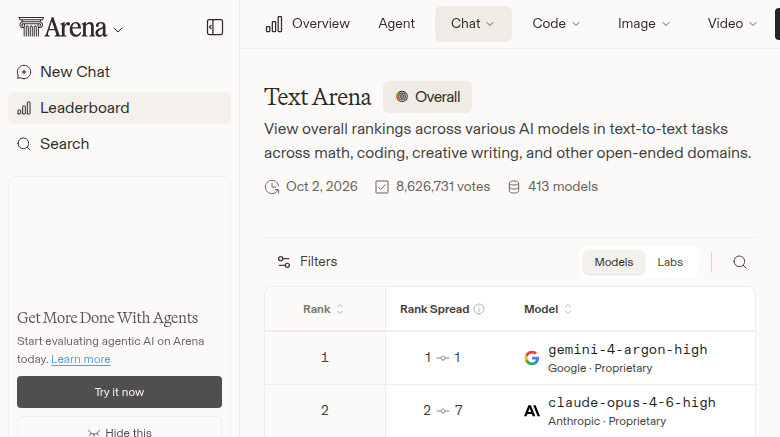
Arena’s Text leaderboard did not move. Gemini 4 Argon High remains first at 1525 Elo, followed by Claude Opus 4.6 High and Claude Fable 5 High at 1505. Anthropic occupies six of the first seven positions. On Arena WebDev, Claude Opus 5.5 Max leads at 1818, ahead of GPT-6 Astra Max at 1789 and GPT-6.1 Sol Max at 1759. Space Bunny does not appear in either top 20.
This divergence is more informative than either leaderboard alone. Arena asks evaluators which response they prefer in a comparison. OpenRouter shows where public, non-private token volume is flowing. The former can be distorted by evaluator preferences, prompt mix and closely related model variants; the latter can be distorted by price, output length, promotions and automated traffic. Neither is a substitute for an internal evaluation, but together they expose the gap between perceived quality and frictionless distribution.
There is a broader product lesson here. In software infrastructure, “free and easy to try” routinely beats “best on a benchmark” during discovery. Models are no exception. Space Bunny’s rise says that developers will enthusiastically test a capable endpoint when marginal cost falls to zero and the context ceiling is generous. It does not say those developers will keep the model when a price appears, the provider is revealed, or compliance asks who processed the data.
An anonymous counterparty is not a minor footnote
Space Bunny’s published telemetry has looked operationally credible. CellCog recorded a median output speed of 79 tokens per second, 1.61-second latency and 98.96% availability over three days, with a 3.16% tool-call error rate. Those figures are useful for deciding whether to run a trial. They do not answer the question a security review will ask first: who receives the prompts?
OpenRouter says the anonymous provider may retain prompts and completions but does not use them for training. “Not used for training” is narrower than “deleted,” and retention by an unnamed party is not a meaningful enterprise control. A team sending proprietary source, customer records, incident logs or unreleased product plans cannot evaluate jurisdiction, subprocessors, breach notification, deletion commitments or incident ownership if the counterparty has no public identity.
Independent observers have tried to fill that vacuum. CellCog cites tokenizer tests matching the MiniMax family—one with 36 of 36 comparisons and another with 50 of 50. Community investigators have proposed that the endpoint is specifically MiniMax M3.1, noting similarities to M3.1-Flash-Preview: a one-million-token context window, forced reasoning and matching reasoning-effort settings. That is plausible fingerprinting, not vendor confirmation. Procurement cannot be built on a tokenizer detective story, however entertaining the thread.
The anonymity also creates an unusual asymmetry. The provider gets real-world workloads and operational feedback at huge scale, while users get no durable promise about identity, pricing or availability. That can be a perfectly reasonable preview arrangement for sanitized experiments. It is a bad dependency for a production path.
How engineering teams should test the rabbit
Start with a representative but sanitized evaluation set. Include the boring work that dominates actual usage—small code changes, extraction, classification, tool calls and constrained output—not just heroic long-context demos. Record task success per request, p50 and p95 latency, output tokens, retry rate and tool-call correctness. “It felt smart” is not an acceptance criterion, and aggregate token share is not a metric your customers experience.
Measure efficiency explicitly. Compare successful tasks per million output tokens and per minute of wall-clock time. A zero-dollar preview can still impose costs through latency, log volume, review time and downstream tool calls. If forced reasoning produces five times the output for the same task, that behavior matters before the provider begins charging. Cap output length wherever the API permits, and test whether truncation harms completion quality.
Keep the model behind a routing layer rather than hard-coding its identifier throughout an application. Preserve at least one named-vendor fallback, normalize provider-specific parameters at the boundary, and rehearse a switch. This week alone, GLM 5.3 Flash and Hy4 preview lost 47% and 45% of volume respectively while multiple rivals gained more than 400%. A marketplace moving that quickly rewards portability.
Finally, separate an experimentation allowlist from the production allowlist. Space Bunny belongs in the first today. Promotion to the second should require a named provider, acceptable retention terms, regional-processing clarity, stable pricing and a rerun of the team’s own evaluation after disclosure. Identity can change the compliance and operational verdict even if model weights remain identical.
Space Bunny Alpha may turn out to be excellent. Its rise already proves that developers value long context, multimodality and free access enough to generate extraordinary traffic. What it does not prove is that token volume equals quality—or that a mystery endpoint deserves production data. The useful reading of this leaderboard is not “switch to number one.” It is “test what number one reveals about demand, then insist on the evidence the chart cannot provide.”
Sources: OpenRouter Rankings, Space Bunny Alpha model page, Arena AI Text Leaderboard, CellCog investigation, OpenRouter rankings API documentation