Splash Canvas Shows Why Creative AI Needs Better Interfaces, Not Bigger Prompt Boxes

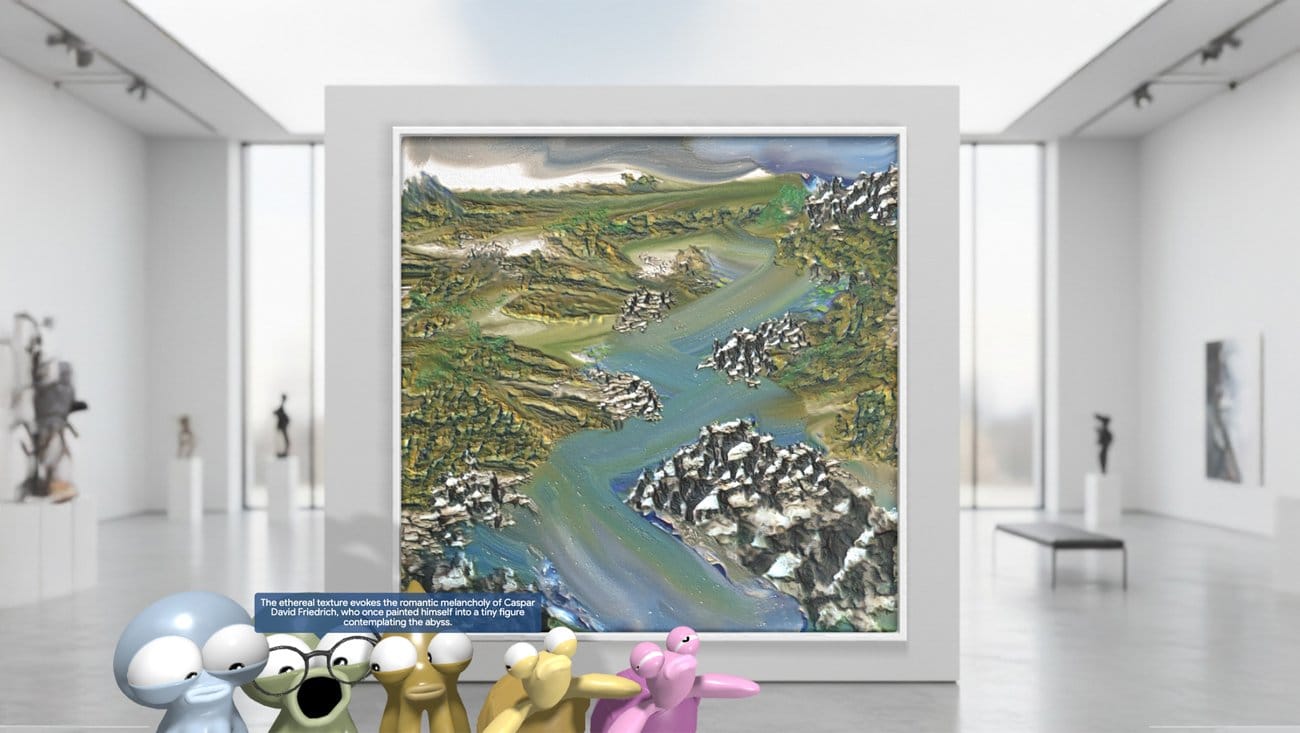
Most creative AI products still treat imagination like a support ticket: type a prompt, wait for output, negotiate with the slot machine. Google Arts & Culture’s new Splash Canvas is interesting because it refuses that default. It is small, silly, browser-native, and full of chatty sea creatures — which is exactly why it says more about useful multimodal AI than another polished demo reel of photorealistic dragons.
The experiment, created by David Li for Google Arts & Culture, turns octopuses, a squid, and turtles into painting tools. Splosh and Splish splash color, Splat drags squid ink energy across the canvas, Smudge blends your work, and Scrape erases it. The creatures also talk back, offering playful critiques and art-history commentary while you paint. Under the surface, Google says the project combines procedural painting physics, real-time machine learning, Gemini-powered dialogue, Chirp voice synthesis, neural cellular automata for paint spread and color mixing, GPU fluid simulation, and procedural audio.
That stack sounds like a lab grocery list. The product lesson is simpler: AI works best here because it is embedded into the medium instead of being stapled on top of it.
The prompt box is not the product
Splash Canvas arrives from the same lineage as Li’s Blob Opera, the 2020 Google Arts & Culture experiment where users dragged animated blobs to generate operatic harmonies. Google says those blobs have been stretched more than 100 million times across 200-plus countries. Blob Opera worked because it was not a music-generation dashboard. It gave people an instrument. Drag up for pitch, drag sideways for vowel shape, hear harmonies respond in real time. No conservatory degree, no prompt engineering, no menu of model parameters pretending to be creativity.
Splash Canvas uses the same trick for painting. You do not ask the system for “an abstract expressionist composition with blue-green emotional resonance.” You grab an octopus and make a mess. The interface is tactile before it is intelligent. That distinction matters because too many AI creative tools flatten every medium into text. Writing, image making, animation, design, music, and video all become the same miserable form field with a sparkle icon. It is efficient for model vendors. It is not how humans usually create.
The better pattern is multimodal control: direct manipulation where precision matters, generative language where personality and interpretation add value, simulation where physics needs to feel immediate, and audio or animation where feedback keeps the loop alive. Splash Canvas is not a professional tool, but it is a clean prototype of that architecture. Gemini is not the whole product. Gemini is the character layer.
Small models, simulation, and latency beat frontier-model theater
The technical composition is worth paying attention to. The live experiment page says Splash Canvas uses a novel GPU fluid simulation, Gemini-powered character dialogue synthesized via Chirp 3, and procedural audio by Chris Heinrichs. Google’s post adds that Li uses local AI — specifically neural cellular automata — to model realistic paint spreads and color mixing. In plain terms: the wet-paint feeling is not being hallucinated by a giant model in the cloud. It is produced by systems designed for fast, responsive interaction.
That is the right call. For interactive creative software, latency is not a polish issue; it is the product. A brush that waits on a round trip to a frontier model stops being a brush. A voice character can afford some generative variability. A fluid simulation cannot. If developers take one engineering lesson from Splash Canvas, it should be this: do not use an LLM where a simulator, shader, rules engine, or smaller local model gives the user tighter control and better feedback.
This is also where the project becomes more than a cute Arts & Culture toy. Production AI products increasingly need orchestration, not monolith worship. The winning stack is rarely “send everything to the biggest model.” It is typed capabilities underneath, model calls at the places where ambiguity is useful, deterministic systems where trust and responsiveness matter, and a user experience that hides the plumbing without hiding the affordances. Splash Canvas does this in miniature. Enterprise software could stand to learn from the turtle.
Personality is a UX primitive, not garnish
The sea creatures are not just decoration. They make the system legible. An octopus that splashes paint, a turtle that smudges or scrapes, and a squid with opinions give users a mental model for what each tool does. The characters also create a forgiveness layer. If a playful turtle blends something unexpectedly, the interaction reads as experimentation. If a sterile “AI design assistant” destroys the same work, it reads as failure.
That may sound fluffy, but it is serious product design. AI systems are probabilistic; users need interfaces that communicate uncertainty, scope, and intent without dumping implementation details into the UI. Character is one way to do that. Not every product should have talking sea creatures — please do not ship an enterprise procurement octopus unless you are absolutely sure — but every AI product needs a contract with the user. What can this system do? When is it improvising? When is it acting directly on my work? When should I trust it?
Splash Canvas answers those questions through metaphor. The creature is the tool. The canvas is the state. The commentary is commentary, not command. That separation is cleaner than many serious AI applications where the same assistant explains, edits, deletes, exports, and sends, often through a single chat box with unclear authority boundaries.
What builders should steal
For developers building creative tools, education products, web experiments, or agentic interfaces, the practical takeaways are concrete.
First, keep users in the loop at interaction speed. If the user is painting, editing, composing, or manipulating objects, the primary control path should feel local and immediate. Use generative models to enrich, not block, the interaction.
Second, compose systems by job. Gemini handles dialogue and personality. Chirp handles voice. GPU simulation handles fluid behavior. Neural cellular automata model the paint’s spread and mixing. Procedural audio provides sensory feedback. That division is boring in the best way: each component does something it is suited for.
Third, design forgiving affordances before you chase capability. Splash Canvas is intentionally weird, which lowers the cost of imperfection. A playful tool can surprise the user without breaking trust. A productivity tool cannot. If you are building AI into workflows where mistakes are expensive — code deployment, finance, healthcare, home automation — the equivalent of the turtle is not personality. It is preview, undo, typed actions, audit logs, and explicit confirmation.
Fourth, stop assuming “AI-native” means “chat-first.” Chat is useful when the task is conversational. Painting is not primarily conversational. Neither are many design, data, operations, or coding tasks. The interface should match the work, not the vendor demo format.
There are obvious limits here. Splash Canvas is an experiment, not Photoshop, Figma, Procreate, or a serious generative-art workflow. It does not appear to offer professional export pipelines, collaboration, rights metadata, version history, or fine-grained controls. It is not trying to. Its job is to test an interaction pattern: AI as material, companion, critic, and soundscape inside a medium that remains hands-on.
That is the part worth keeping. The industry has spent the last few years proving that generative models can produce finished artifacts. The harder, more useful question is whether AI can make the act of creating feel richer without taking the steering wheel away. Splash Canvas suggests the answer is yes, provided builders resist the laziest architecture in the room.
The future of creative AI should not be a blank text box asking for a masterpiece. It should feel more like grabbing the wrong sea creature, making a beautiful mess, and learning something from the smear.
Sources: Google Keyword, Splash Canvas on Google Arts & Culture, Blob Opera on Google Arts & Culture