Step 5’s 6.37-Trillion-Token Week Is a Distribution Story, Not a Victory Lap

Model leaderboards usually invite the wrong conclusion: somebody moved up, therefore somebody got smarter. Step 5 Preview’s jump from twelfth to eighth place on OpenRouter is more useful than that—not as a declaration of a new champion, but as evidence that distribution is now one of the decisive capabilities in the model market.
StepFun’s new model processed 6.37 trillion tokens in OpenRouter’s trailing seven-day window, enough to pass DeepSeek V4 Flash 0731 and Claude Opus 5.5. That is an extraordinary amount of routed work for a model whose OpenRouter release is listed as October 8. It is also exactly the kind of number that should make an engineering leader curious without making them reckless.
The distinction matters because OpenRouter measures token traffic, not correctness, revenue, unique users, or successful tasks. Its rankings exclude private requests, and the service marks Step 5’s week-over-week comparison as “new,” meaning there is no complete prior-week baseline. Yesterday’s snapshot showed 3.22 trillion tokens; today’s 6.37 trillion should not be read as a clean 98% one-day increase. A fresh model is filling out its first rolling seven-day window, and each new day can replace an empty one.
A fast launch into a field that was already moving
Step 5 did not climb through an idle leaderboard. Claude Opus 5.5 grew 102% week over week and still slipped one position to tenth because Step 5 passed it. Claude Sonnet 5.5 rose two places to eighteenth on 198% growth. GPT-6.1 Sol posted 243% growth yet fell one rank to nineteenth. Rank is relative: running quickly does not help when everyone else is sprinting.
The reshuffle continues above Step 5. DeepSeek V4.1 Flash remains first with 38.7 trillion tokens, more than three times the 11.6 trillion used by second-place GLM 5.3 Flash. MiMo-V2.6-Flash moved into third at 11.3 trillion, while Space Bunny Alpha fell from second to fourth as its weekly traffic declined 70%. Step 5’s arrival is impressive, but it is not close to leadership. It has roughly one-sixth of DeepSeek V4.1 Flash’s volume.
No model entered or left the top 20 in this update. The same cast simply changed positions. That makes the movement more revealing: launches no longer compete only for benchmark headlines. They compete for placement in coding tools, free trials, routing platforms, agent frameworks, and developer attention. Those channels can manufacture a production-scale trial before the market has developed a stable opinion about quality.
This is the first original takeaway from the numbers: distribution is becoming an operational benchmark. A provider that can put a model behind familiar APIs and into existing agent products can accumulate more real-world traces in a week than a technically stronger but poorly distributed competitor gathers in months. That feedback loop can improve documentation, expose tool-calling failures, and create integrations. Usage is not quality, but it can become an input to quality.
The price is compelling; the denominator is the trap
StepFun describes Step 5 Preview as a sparse mixture-of-experts model with 600 billion total parameters and 27 billion active for each token. It advertises a one-million-token context window plus text, image, and video input. OpenRouter lists tool calling, structured outputs, streaming, log probabilities, and adjustable reasoning effort. Those are the capabilities an agent workload needs, not merely a collection of benchmark-friendly features.
The listed API price—$1 per million input tokens and $2.70 per million output tokens—makes a controlled evaluation easy to justify. But cost per token is the least interesting denominator. Teams should measure cost per accepted task. A model that is half the price but retries tool calls, produces long reasoning traces, or requires a senior engineer to repair its patch can be substantially more expensive in production.
OpenRouter’s ranking itself rewards volume, so a verbose model can look more popular than a concise one completing the same number of tasks. Tokenization also differs between model families. Six trillion tokens therefore cannot tell us whether Step 5 served six times as much useful work as a one-trillion-token competitor. It tells us that an enormous amount of text passed through the model. That is evidence of reach, not efficiency.
The community reaction reflects this tension. At research time, the newest Hacker News discussion had 146 points and 38 comments, while an earlier announcement thread had 141 points and 33 comments. Practitioners repeatedly questioned deployability and vendor-selected demonstrations. One practical objection is hard to wave away: “600B-A27B” does not mean only 27 billion weights need to fit in memory. Activating 27 billion parameters per token may make hosted inference economical, but storing a 600-billion-parameter model is not a casual workstation deployment, especially on a 228GB setup.
That produces a second lesson: “open” and “local” are no longer synonyms. Even if weights become available, the license, quantization quality, memory footprint, interconnect requirements, and real serving throughput will determine who can operate them. Teams should wait for those artifacts instead of treating an architecture diagram as a deployment plan.
A million-token window still needs a retrieval test
The one-million-token context claim deserves the same skepticism. Context capacity is not retrieval accuracy. A model can accept an entire repository and still miss the one constraint that invalidates its patch. In production, more context can add latency, cost, contradictory instructions, and a larger attack surface for prompt injection.
Engineers evaluating Step 5 should place critical facts at several depths in the prompt, introduce conflicting but lower-priority instructions, and put tool output near the context boundary. Test whether the model cites the right evidence, not merely whether the API accepts the payload. For most agents, retrieval, summaries, and context pruning remain better defaults than pouring a repository into a giant window.
This suggests a third, less obvious point: launch-week token volume may disproportionately measure exploration of advertised maximums. Developers try large contexts, agent loops, and free integrations because they are available. Retention will reveal whether those experiments become workflows. The meaningful follow-up is not tomorrow’s rank; it is Step 5’s position after a full, unpromoted seven-day window and again after teams receive their first production invoices.
Run the bake-off, but keep the rollback switch
For teams considering Step 5, the responsible move is neither dismissal nor immediate migration. Replay 50 to 100 representative production tasks against it and the current incumbent. Include multi-file edits, tool-call recovery, long-context retrieval, ambiguous requirements, and tasks where the correct behavior is to stop after success. Record task completion, wall-clock latency, retries, output tokens, human correction time, and cost per accepted result.
Before sensitive traffic moves, verify retention policy, regional routing, rate limits, failure behavior, and whether provider fallbacks preserve the same privacy guarantees. Pin the model version. Keep prompts and structured outputs behind a provider-neutral layer. Capture traces so regressions can be replayed. Promotion to the default route should depend on workload data, not on a leaderboard position that can change four places in a day.
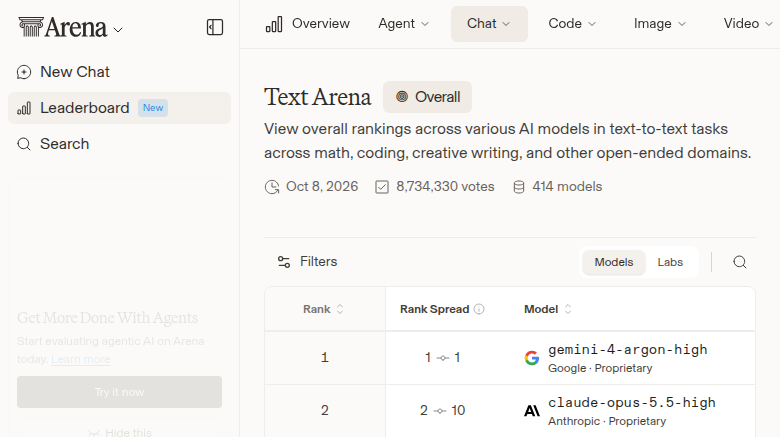
Arena’s live Text Arena page currently shows its public leaderboard, including 8,734,330 votes and 414 models as of October 8, but the mandated research scrapers did not expose the Text or Code Elo tables reliably enough for a defensible day-over-day comparison. We are not mixing Arena preference scores with OpenRouter usage ranks. They answer different questions, and pretending otherwise would create precision where none exists.
Step 5 Preview has earned an evaluation slot. It has not earned a victory lap. The real story behind 6.37 trillion tokens is that model adoption can now reach industrial scale before evidence about reliability, retention, and total task cost catches up. In this market, the leaderboard is the beginning of due diligence—not the end.
Sources: StepFun, OpenRouter weekly rankings, OpenRouter model page, Hacker News launch discussion, earlier Hacker News discussion, and Arena Text leaderboard