Tencent’s Hy4 Didn’t Win a Benchmark. It Won Traffic.

A leaderboard bronze medal usually means almost nothing. A model moves one slot, the vendor posts a victory graphic, and everyone agrees to forget that the underlying measurement may have little to do with production software. Tencent’s Hy4 preview moving to number three on OpenRouter is different—not because it proves Hy4 is the world’s third-best model, but because it shows how quickly an open model can turn competent engineering, aggressive economics, and usable distribution into real workload.
Hy4 processed 12.5 trillion tokens through OpenRouter during the week, overtaking OpenAI’s GPT-5.6 Luna at 9.72 trillion. The 2.78-trillion-token gap is substantial, especially for a model released only weeks ago. Tencent now has two models in OpenRouter’s top seven, with Hy3 holding seventh place at 4.78 trillion tokens. Meanwhile, the rest of the top four is DeepSeek V4.1 Flash at 15.8 trillion, Z.ai’s GLM 5.3 Flash at 14.1 trillion, and Luna in fourth.
That top four is more revealing than the one-place move. The market’s busiest public routing layer is no longer a procession of models from the familiar American labs. It is a mixed field in which DeepSeek, Z.ai, Tencent, and OpenAI compete less like permanent platform choices and more like interchangeable infrastructure suppliers. For engineering teams, that is the real story: model procurement is becoming a routing decision.
Tokens measure traffic, not finished work
OpenRouter’s ranking aggregates public prompt and completion tokens sent through its API. It does not include traffic sent directly to providers, and it does not measure customers, requests, revenue, latency, task success, or user satisfaction. Tokenization differs between model families, and verbose models generate more tokens for the same assignment. Hy4 also defaults to high reasoning effort; Tencent acknowledges that the preview may reason longer than necessary and over-verify its answers.
So 12.5 trillion tokens is not a quality score. In the least flattering interpretation, a model could rise by taking more tokens to accomplish the same work. But that caveat should not become an excuse to dismiss the signal. Someone still routed those workloads to Hy4. Passing Luna—a budget model built for high-volume classification, summarization, routing, and realtime jobs—means developers were willing to place a significant amount of traffic behind Tencent’s endpoint.
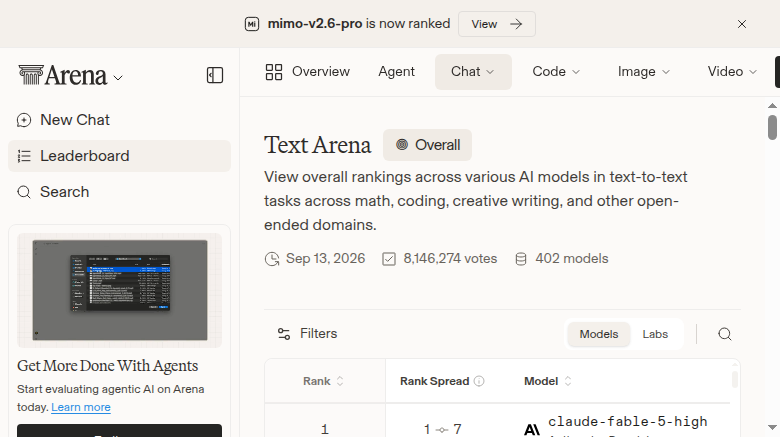
The Arena leaderboard provides a useful counterweight. Its rendered overall top 20 was unchanged this week, led by Anthropic’s Claude Fable 5, with Hy4 absent from the list. Arena and OpenRouter are answering different questions: one approximates preference through comparative voting, while the other reports routed token consumption. Neither tells a team whether a model will reliably patch its monorepo or survive a malformed tool response. Together, however, they show why a single “best model” table is becoming less useful.
A 770-billion-parameter model built to be deployable
Hy4’s headline size is intimidating: 770 billion parameters. Its mixture-of-experts architecture activates 49 billion parameters per token, using a 78-layer backbone with 256 routed experts and one shared expert. Each token activates eight routed experts plus the shared expert. That does not make Hy4 small, but it changes the serving equation considerably compared with a dense 770-billion-parameter model.
Tencent has also done the work that often separates an interesting checkpoint from usable infrastructure. Hy4 ships with Apache 2.0 weights, including an FP8 variant, and documented deployment recipes for vLLM and SGLang. The published vLLM setup uses tensor parallelism across eight GPUs, sparse FlashMLA attention, and three speculative tokens. A native 10-billion-parameter multi-token prediction layer—0.7 billion active parameters—is designed to accelerate speculative decoding. Tencent says its own inference-stack work, including operator fusion and communication optimization, delivered a 31.8% end-to-end throughput increase. That figure is vendor-reported and needs independent reproduction, but at least the claimed optimization target is the one operators care about.
The model supports a one-million-token context window and exposes reasoning controls, including a no-think mode for direct answers. Hosted pricing is equally deliberate: $0.834 per million input tokens, $2.501 per million output tokens, and $0.042 per million cached tokens through Tencent’s API. Those figures make experimentation easy. They do not make self-hosting easy. An eight-GPU reference configuration is still serious infrastructure, and most teams should start with a routed API bake-off before turning a model evaluation into a hardware procurement project.
This is the first original lesson in Hy4’s rise: open weights are valuable even when you never run them yourself. They create competitive pressure on hosted pricing, permit independent inspection, provide an exit path for regulated workloads, and make the deployment claims falsifiable. “Open” is not synonymous with “cheap to operate,” but it improves the buyer’s negotiating position.
The benchmark margin is too small to outsource your decision
Tencent’s internal blind evaluation asked 163 experts to judge 203 engineering tasks. Hy4 averaged 2.99 out of 4, compared with 2.92 for GLM 5.3 and 2.94 for Kimi K3. Against GLM, Hy4 posted 46.8% wins, 12.8% ties, and 40.4% losses. Against Kimi, it recorded 51.2% wins, 7.9% ties, and 40.9% losses.
Those are plausible, useful directional results—and nowhere near decisive enough to replace an internal evaluation. The raters were Tencent employees, the task set is not independently inspectable from the announcement, and the differences are small. A procurement decision made from those averages would be false precision wearing a spreadsheet.
Practitioners should replay representative production traces and score completed tasks, not model vibes. Measure p50 and p95 latency, total cost per successful task, tool-call validity, retry frequency, and recovery after a failed call. Test long-context retrieval at several depths rather than celebrating a one-million-token maximum. Include multi-file edits, ambiguous requirements, malformed tool output, and interrupted agent runs. Run short extraction and routing tasks in both default and no-think modes to discover whether Hy4’s extra deliberation improves accuracy or merely inflates latency and output.
The second lesson is that reasoning visibility can be operationally useful without being proof of correctness. Hacker News commenters focused on Hy4’s exposed reasoning traces, praising their coherence and debating whether compressed, terse reasoning reduces cost without degrading results. One practitioner estimated that compressed traces could be 10–20% shorter; others warned that forcing brevity after training may remove useful exploration. The right response is not to grade the eloquence of hidden work. Grade the artifact, then use the trace to debug failures.
Portability is now a reliability feature
Hy4’s quick adoption suggests a third lesson: the winning model strategy is increasingly an evaluation harness plus a router, not a lifelong vendor commitment. Teams should keep system prompts and tool schemas portable, log quality and cost at the task level, and maintain at least one tested fallback model. Model-specific features can still be worth using, but they should be adopted consciously, with the switching cost measured rather than discovered during an outage or pricing change.
That approach also prevents leaderboard tourism. Add Hy4 to the harness because its pricing, controls, weights, and serving recipes make it a credible candidate. Promote it only for workloads where it beats the incumbent on the metric that matters. A customer-support classifier may prioritize predictable latency and low completed-task cost; a coding agent may justify longer reasoning if it reduces review corrections; a regulated deployment may value auditable weights more than a few leaderboard points.
Hy4 did not win a universal benchmark this week. It won traffic, which is a more grounded achievement and an easier one to misunderstand. Tencent has shown that open weights plus production documentation and credible economics can convert into trillions of routed tokens quickly. The correct engineering response is neither dismissal nor migration fever. Test Hy4, bound its tendency to overthink, and compare finished work. This week’s bronze medal is an invitation to run an experiment—not rewrite the stack.
Sources: Tencent’s Hy4 announcement, Hy4 model card and deployment guide, OpenRouter weekly rankings, Arena AI leaderboard, Hacker News discussion