Tencent’s Hy4 Hits No. 11 in Two Days—Fast Adoption, With a Promotional Asterisk

A model can buy its way onto a usage chart long before it earns a place in your production stack. Tencent’s Hy4 preview is the latest reminder: released on August 28, it processed 1.9 trillion tokens on OpenRouter quickly enough to enter the platform’s seven-day ranking at No. 11, even though the newest complete bucket was August 29. That is an impressive distribution event. It is not an eleventh-place finish in a quality contest.
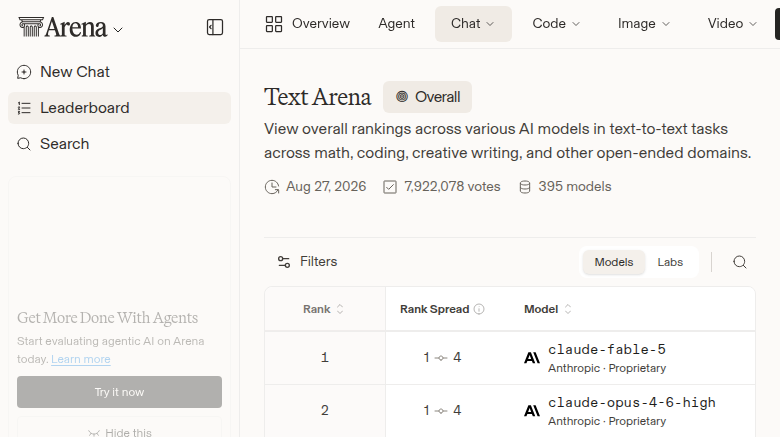
The distinction matters because LLM leaderboards increasingly mix incompatible signals. OpenRouter measures public routed tokens: prompt tokens plus completion tokens flowing through its marketplace. Arena AI measures comparative human preference. Benchmarks measure performance on a constrained task set, sometimes with vendor-selected inference settings. Hy4’s launch registered loudly on the first axis while Arena’s overall top 20 did not move at all. Engineers should read that divergence as useful evidence, not an inconvenience to average away.
Nearly two trillion tokens, with a promotional asterisk
Hy4 landed above DeepSeek V4 Pro 0423, MiniMax M3’s free route, GPT-5.6 Sol, Kimi K3, Claude Opus 5, and Claude Sonnet 5 on OpenRouter’s weekly chart. It also displaced DeepSeek V4 Pro 0813 from the top 20. For a model with roughly two complete days of eligible traffic, that is genuine trial velocity: developers were willing to point meaningful workloads at a brand-new Tencent endpoint.
But Tencent offered two weeks of free launch access, and free tokens are not neutral evidence. They reduce the cost of curiosity, encourage batch experiments, and can move traffic away from paid routes without proving that anyone intends to stay. The chart also counts tokens rather than successful requests, users, revenue, or completed tasks. A verbose reasoning model can rise faster than a concise one while doing the same amount of useful work—or less.
This is not a reason to dismiss the ranking. It is a reason to name what it measures: distribution and experimentation. Hy4 reached developers quickly because it combined launch incentives, an OpenRouter route, open weights, aggressive API pricing, and a specification designed to attract long-context and agent builders. That package has become a go-to-market strategy in its own right. The model release is no longer complete when weights appear on Hugging Face; it is complete when developers can route traffic to it in one configuration change.
“Open” still needs a datacenter
Hy4 is an Apache-2.0 mixture-of-experts model with 770 billion total parameters and 49 billion activated for each token. Its 78-layer backbone begins with one dense feed-forward layer, followed by 77 MoE layers. Each MoE layer contains 256 routed experts and one shared expert, with eight routed experts active per token. Sparse activation lowers compute per generated token relative to running every parameter, but it does not make the checkpoint small.
Tencent’s FP8 deployment recipes call for eight-way tensor parallelism in vLLM and SGLang. That is a useful reality check for teams that equate an open license with economical self-hosting. The weights improve inspectability, portability, and negotiating leverage; the official serving path still assumes datacenter-class hardware, fast interconnects, and engineers who understand distributed inference. Most organizations should begin with a hosted route, then consider self-hosting only after traffic volume, privacy requirements, or customization needs justify the operational bill.
Hosted access is priced to make that first experiment easy. OpenRouter lists Hy4 at $0.834 per million input tokens and $2.501 per million output tokens, with Tencent listing cache hits at $0.042 per million tokens. Those numbers look inexpensive beside premium closed models, but per-token price is only one term in the cost equation. A model that reasons too long, repeats tool calls, or rereads a million-token context can erase the headline discount.
Tencent acknowledges that the preview can reason longer than necessary and over-verify its work. Reasoning defaults to “high,” while callers can request no_think for direct responses. That is not a cosmetic setting. In an agent loop, unnecessary verification can compound across every plan, tool call, observation, and retry. Teams should measure total tokens per successful task, wall-clock latency, tool-call count, timeout rate, and human correction time. A cheap token that does not advance the task is still waste.
The million-token window is not a retrieval strategy
Hy4 supports a one-million-token context window and includes a native 10-billion-parameter multi-token-prediction layer for speculative decoding. Tencent also says the model autonomously optimized operator fusion and communication in its inference stack, improving end-to-end throughput by 31.8% against its baseline. The claim is intriguing, especially for a model positioned around long-running engineering work, but the announcement omits the hardware, baseline configuration, and absolute throughput. A percentage without the denominator is an invitation to reproduce, not a capacity plan.
The context window deserves the same skepticism. Repository-scale analysis, multi-document synthesis, and agents with long tool histories can benefit from more context. Dumping an entire codebase into every request is still bad systems design. Irrelevant files dilute attention, increase prefill latency, make cache invalidation more expensive, and obscure which evidence influenced the answer. Keep retrieval, dependency-aware context assembly, and explicit state summaries. Treat one million tokens as headroom for hard cases, not permission to stop curating inputs.
Tencent’s internal evaluation offers a starting hypothesis, not a verdict. In a blind assessment, 163 experts rated outputs across 203 engineering tasks. Hy4 averaged 2.99 out of 4, compared with 2.92 for GLM 5.3 and 2.94 for Kimi K3; head-to-head, Tencent reports a 46.8% win rate against GLM 5.3 and 51.2% against Kimi K3. Those are narrow margins, and the task set is not public. Vendor evidence can justify putting a model into a bake-off. It cannot substitute for one.
Approve the experiment, not the migration
A sensible evaluation is small enough to run this week and realistic enough to expose failure modes. Select 20 to 50 tasks from actual work: a cross-file change, a debugging session with misleading symptoms, a long-document question, a tool failure followed by recovery, and a routine request where latency matters more than elaborate reasoning. Pin prompts and tool definitions, apply identical timeouts, and blind the human review. Score successful completion and correction effort rather than benchmark-style partial credit.
Run Hy4 in both default high-reasoning and no_think modes. Separate cached from uncached cost, record time to first token and end-to-end time, and inspect whether the model’s extra verification catches defects or merely narrates caution. Compare a hosted Hy4 route with the incumbent under the same concurrency and retry policy. If proprietary code is involved, verify provider retention and training policies independently; OpenRouter’s public ranking excludes private activity, so its chart is not representative of sensitive enterprise workloads anyway.
There is also a watch condition the leaderboard can answer later. If Hy4 remains in the top 20 after free access expires, the launch will have converted trial into at least some durable routing demand. If it begins appearing in preference rankings and independent coding evaluations, usage and quality signals will start to converge. If traffic collapses when the subsidy ends, the debut will still have demonstrated effective distribution—but not product-market fit.
Hy4’s rapid rise says more about how models reach developers than about which model is “best.” Open weights, a permissive license, marketplace availability, and low-friction pricing can generate immediate production-shaped traffic. That is worth approving as an experiment. The production merge still needs independent evaluation, cost controls, and evidence that all those tokens completed useful work.
Sources: Tencent Hy4 preview announcement, Hy4 model card and deployment guide, OpenRouter Hy4 model page, OpenRouter rankings methodology, Arena AI leaderboard