The LLM Leaderboard Has Forked Into Quality and Throughput

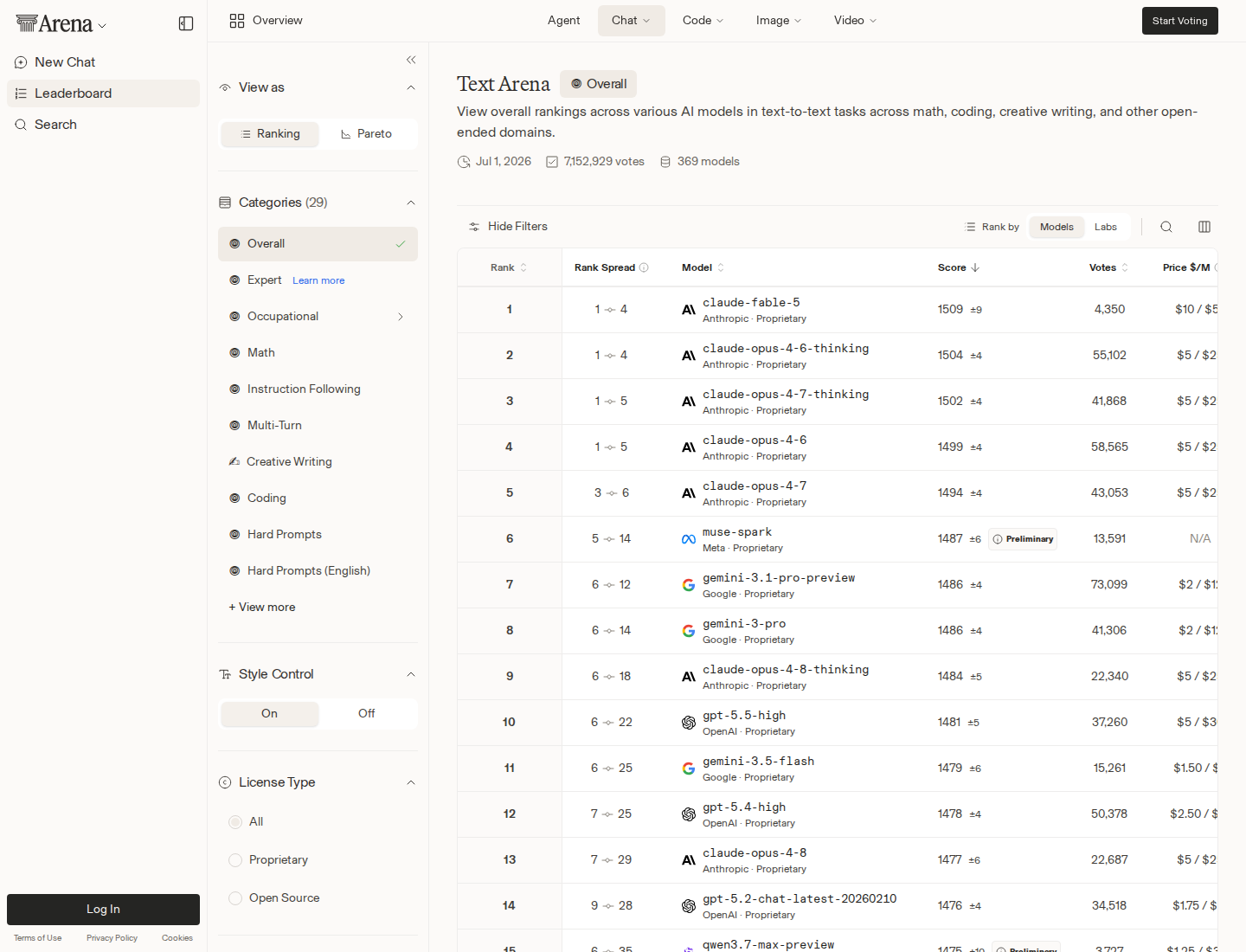
The most useful thing in this week's LLM rankings is not the model sitting at #1. It is the disagreement between the boards.
On Arena Text, Anthropic still owns the top of the judged-quality stack: claude-fable-5 leads at 1509 Elo, followed by claude-opus-4-6-thinking at 1504, claude-opus-4-7-thinking at 1502, claude-opus-4-6 at 1499, and claude-opus-4-7 at 1494. On Arena WebDev, the picture is similar: claude-fable-5 is still first, and Anthropic holds most of the oxygen near the top.
Then you look at OpenRouter's weekly usage rankings and the market suddenly looks different. The top five by routed token volume are DeepSeek V4 Flash at 5.08T weekly tokens, MiMo-V2.5 at 4.18T, MiniMax M3 at 3.70T, Hy3 preview at 3.68T, and GLM 5.2 at 2.40T. Claude Opus 4.8 is there, but at #8. GPT-5.5 is #12. Gemini 3 Flash Preview is #13.
That is not a contradiction. It is the leaderboard ecosystem growing up.
Prestige models win the taste test. Workhorse models win the bill.
Arena and OpenRouter measure different kinds of truth. Arena is closer to a controlled taste test: pairwise judgments, Elo-style scoring, and a public scoreboard that rewards models people prefer when comparing outputs. OpenRouter is closer to production behavior: which models developers actually route to when price, latency, quotas, defaults, availability, and "good enough" quality all show up in the same room.
That distinction matters because teams still talk about model choice as if there is one global answer. There usually is not. A model can be the best model to show in a benchmark-sensitive demo and still be the wrong default for a high-volume extraction pipeline. Another model can lose a judged comparison by a few preference points and still dominate production because it is fast, cheap, available, or simply less painful to run at scale.
This week's movement reinforces that split. Arena Text was mostly stable, with the notable new top-20 entry being claude-opus-4-5-20251101-thinking-32k at #20 with 1473 Elo. The biggest text-board moves were small: gemini-3.5-flash rose two places to #11, claude-opus-4-8 fell two places to #13, and grok-4.20-beta-0309-reasoning fell two places to #17. Arena WebDev added claude-sonnet-5-thinking at #6 with 1551 Elo, while claude-opus-4-8 slid four spots to #10.
Those are real changes, but they are not earthquake changes. The more interesting motion is on OpenRouter, where GLM 5.2 rose to #5 with +31% week-over-week token growth, Hy3 preview held near the top with +13%, and MiniMax M3 moved into #3 despite a -3% week-over-week dip. Meanwhile, two free variants entered the visible top 20: Nemotron 3 Ultra (free) at #14 with 892B weekly tokens and Laguna M.1 (free) at #15 with 804B weekly tokens.
If you are building software, the free-variant movement is easy to misread. It does not prove Nemotron or Laguna suddenly became better models overnight. It proves distribution and pricing can move usage rankings aggressively. Free routes lower the friction for experimentation, and experimentation at platform scale becomes token volume very quickly. That is useful signal, but it is not the same signal as judged quality.
The useful question is not "which model is best?"
The useful question is: which model is winning which workload?
BenchLM's comparison of DeepSeek V4 Flash and MiMo-V2.5 points in the same direction: the public snippet frames MiMo-V2.5 as ahead on agentic work, including Terminal-Bench 2.0, while DeepSeek V4 Flash appears stronger in coding-oriented comparisons. That is the shape of the market now. Models are no longer just competing as generic chat endpoints. They are competing as routing targets for specific jobs: coding, planning, extraction, tool use, browsing, summarization, eval generation, customer support, and background agent steps that may never be seen by a user.
Community chatter lines up with that. Recent Reddit discussion is less obsessed with crowning one model and more focused on routing taste: one commenter describes using MiniMax M3 for coding, GLM 5.2 for planning, and DeepSeek for smaller secondary tasks. Another OpenRouter discussion warns that GLM 5.2 can burn tokens quickly. That second point is exactly why usage rankings are not a simple quality proxy. A model can climb because people like it, because it is verbose, because it is cheap enough to overuse, because it is the default route in a popular workflow, or because it happens to be strong in a workload with lots of repeated calls.
The practitioner move is boring, which usually means it is right: stop choosing one default model for the whole product.
Keep a frontier model for high-ambiguity work: architecture planning, code review, failure recovery, product reasoning, security-sensitive judgment, and the moments where a bad answer costs more than the extra tokens. Use cheaper high-throughput models for extraction, classification, summarization, draft generation, test-data generation, and speculative agent steps. If your agent runs five possible plans before choosing one, all five plans do not need to come from the same model you use for final review.
More importantly, instrument the routing decision. Public boards can tell you what deserves a look; they cannot tell you your cost per successful task. Track success rate, retry rate, latency, output length, tool-call accuracy, human correction rate, and total tokens per completed workflow. A model that is 20% cheaper per token but causes twice as many retries is not cheaper. A model that looks expensive but prevents escalation to a human may be the cheapest thing in the stack.
The architecture review should move up a level
The old architecture review question was "Should we use GPT, Claude, Gemini, or an open model?" The better question is now "What is our model portfolio, and what policy decides between them?"
That sounds heavier than it needs to be. It can start as a simple routing table: one model for complex reasoning, one for coding, one for fast cheap transformations, one fallback when the primary is degraded, and one experimental slot for contenders. Add budget caps per workflow. Add eval gates before promotion. Log the prompt class and outcome. Review the routing table weekly, not religiously.
This also changes how teams should read leaderboards. Arena is still valuable because preference quality matters, especially for ambiguous tasks where humans care about taste, reasoning, and instruction following. OpenRouter is valuable because it reveals where developers are willing to spend repeated tokens after the pricing and latency math has had its say. Neither board is "the truth." Together, they are a map: one axis for evaluated quality, one axis for deployed gravity.
The map says Anthropic is still the prestige leader in judged quality, especially on Arena Text and WebDev. It also says the routed-volume market is increasingly comfortable with DeepSeek, Xiaomi, MiniMax, Tencent, and Z.ai models as daily workhorses. That is not a story about one vendor winning and another losing. It is a story about LLM usage becoming more like cloud infrastructure: premium services where correctness matters most, cheaper services where volume matters most, and a routing layer in the middle that decides what deserves which bill.
So yes, claude-fable-5 is still at the top of Arena Text. That is worth knowing. But the more actionable headline is that the rankings have forked into two markets: models that win judgments, and models that win repeated use. The teams that treat those as separate buying decisions will spend less time arguing in abstract and more time shipping systems that are cheaper, faster, and easier to change when next week's board moves again.
Sources: Arena Leaderboard, OpenRouter Rankings, OpenRouter weekly rankings API, OpenRouter model catalog API, BenchLM comparison of DeepSeek V4 Flash and MiMo-V2.5.