The LLM Usage Chart Has a New Number One—and a Pricing Asterisk

The most dangerous number on an LLM leaderboard is the one that looks easiest to understand. This week, that number is 17.1 trillion: the trailing-seven-day token volume that puts Tencent’s Hy4 preview at the top of OpenRouter’s usage chart. It is a real lead over OpenAI’s GPT-5.6 Luna at 14.2 trillion tokens. It is also not evidence that Hy4 is the best model.
That distinction matters because model procurement is becoming less like choosing a database and more like reading a cloud bill during a product launch. Usage now reflects quality, price, promotions, context size, routing defaults, and how many tokens an agent burns while thinking. Collapse those variables into one ranking and the chart becomes precise in the way a speedometer is precise when you are trying to measure fuel economy.
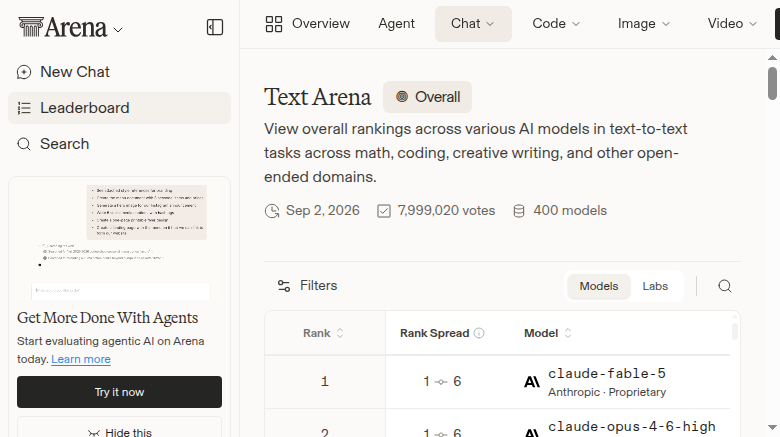
The contrast with Arena AI makes the problem unusually visible. Arena’s Text top 20 did not move: Claude Fable 5 remains first at 1507 Elo, Claude Opus 4.6 High sits two points behind, and only eight points separate first place from fifth. OpenRouter, meanwhile, reshuffled underneath a fast-growing Hy4: DeepSeek V4 Flash 0731 moved to third with 12.3 trillion tokens, MiniMax M3’s free variant rose to fifth with 5.15 trillion, Gemini 3.8 Flash entered at number 17 with 1.34 trillion, and Solar Pro 4 climbed to number 19 with 1.3 trillion.
These are not competing versions of the same truth. Arena measures what people prefer in head-to-head comparisons. OpenRouter totals prompt and completion tokens processed across the trailing seven complete UTC days, excluding private activity and counting free and paid variants separately. One chart asks, “Which answer won?” The other asks, “Where did the tokens flow?” Engineering teams need both signals, but confusing them is how a trial becomes a migration before anyone has measured whether the work actually gets done.
Hy4’s lead is an invitation to test, not a verdict
Hy4’s 17.1 trillion tokens are up from 14.7 trillion in the prior rolling window, with OpenRouter displaying 326% week-over-week growth. Tencent also launched the model with two weeks of free access in WorkBuddy and CodeBuddy, although OpenRouter usage is paid. Launch energy clearly matters, but dismissing the result as promotional noise would be equally lazy. Hy4 has an architecture and price curve that make it structurally interesting for agent workloads.
Tencent describes it as a 770-billion-parameter mixture-of-experts model with 49 billion active parameters and a context window beyond one million tokens. API pricing is $0.834 per million input tokens, $2.501 per million output tokens, and just $0.042 per million cached-input tokens. That last number is the sharp edge: repository-scale coding agents, repeated document analysis, and systems that reuse a stable instruction-and-context prefix can keep a very large working set warm without paying full input price on every turn.
The catch is output. Cheap cached context does not rescue an agent that produces long reasoning traces, retries failed tool calls, or rewrites half a repository before the tests pass. Hy4 can therefore look inexpensive per token and still be costly per accepted task. The correct denominator is not one million tokens. It is one verified patch, one reconciled account, or one support case resolved without escalation.
Tencent’s own blind evaluation offers a reason to investigate, not a reason to skip validation. In a study of 203 engineering tasks assessed by 163 experts, Hy4 averaged 2.99 out of 4.00, compared with 2.94 for Kimi K3 and 2.92 for GLM 5.3. The company also reports a 31.8% end-to-end throughput improvement from inference work including operator fusion and communication optimization. Those are concrete results, but they remain vendor evidence until independent testing reproduces them on production-shaped workloads.
“Same price” does not mean the same bill
Gemini 3.8 Flash’s debut at number 17 is the cleanest test of another leaderboard distortion. Google kept its introductory rates at $0.75 per million input tokens and $3.75 per million output tokens, matching Gemini 3.7 Flash. But Google explicitly warns that 3.8 may consume more tokens at higher reasoning effort. A pricing table says the models cost the same; the invoice may disagree.
The model posted 54.9% on HLE-Verified, while its security-focused variant reached 47.2% pass@1 on CWE-Bench, close to a leading frontier model at 47.8%. Google says the security model generated 2.6 times more correct Chrome vulnerability patches than larger commercial models and found a critical foundational vulnerability in under two hours. Those claims make 3.8 Flash worth an evaluation for security and coding pipelines. They do not tell you how often it loops, how many compilations it needs, or whether higher reasoning effort improves your particular task enough to justify the additional output.
Practitioner reports are already mixed. One Hacker News user described producing a working HTML artifact for 1.8 cents in 13 seconds; other developers have reported Rust and Tauri compilation regressions and preferred Gemini 3.7 Flash or GLM 5.3. Anecdotes are not benchmarks, but they are useful test-case generators. If your stack includes Rust, Tauri, or complex build tooling, put those exact failures into the acceptance suite instead of waiting for an aggregate score to settle the argument.
Solar Pro 4 shows how discounts bend adoption curves
Solar Pro 4’s 76% usage rise overlaps with Upstage’s 90% launch discount through September 10. At normal pricing, the model costs $0.30 per million input tokens, $1.20 per million output tokens, and $0.06 per million cache hits. Its chart movement is therefore partly a market experiment: developers are rationally testing a temporarily cheap model. Any cost comparison performed this week should be rerun after the promotion ends.
There is substance beneath the discount. Upstage reports 57.0 on Terminal-Bench v2.1, 71.0 on AA-LCR, and 23.0 on τ³-Banking. Artificial Analysis scores it at 42 on its Intelligence Index, up sharply from Solar Pro 3’s 14, but measures an average task time of 8.6 minutes versus six minutes for the previous model. Faster progress on capability has arrived with slower execution—an acceptable trade for batch research, perhaps, but a poor fit for an interactive coding loop.
Its hallucination numbers contain an even better lesson. Solar Pro 4 reduced the measured hallucination rate from 88% to 24%, but largely by answering fewer questions: it attempted 41%, down from 92% for Solar Pro 3, while accuracy stayed at 19%. That is not a trick. Abstaining is often the correct behavior in contracts, compliance, or research. But teams must decide whether refusal is reliability or failure for each workflow. A leaderboard cannot make that product decision.
Measure completed work, including the mess in the middle
The practical response is a small, production-shaped evaluation harness. Take 30 to 100 representative tasks, preserve their real tools and context, and score completion with deterministic checks wherever possible. For coding, require compilation, tests, linting, and a bounded diff. For research, verify citations and measure unsupported claims. For support, track resolution and escalation rather than prose quality.
Log the full trajectory: prompt tokens, cached tokens, completion tokens, wall-clock time, tool calls, retries, model errors, and final verification. Then calculate cost per accepted result and successful tasks per hour. Run candidates in shadow mode before changing routing defaults, cap tool loops, and retest after introductory pricing expires. For long-context models such as Hy4, separately measure cache-hit rate; otherwise the feature that makes the economics attractive remains a brochure claim inside your own system.
OpenRouter’s chart is valuable precisely because it reveals what developers are trying at scale. Arena is valuable because preference tests resist some of the economic distortions in usage data. Neither should be promoted into a universal scoreboard. Hy4 has earned a place in the test queue, Gemini 3.8 Flash deserves a controlled A/B against 3.7, and Solar Pro 4 should face a post-discount rematch. That is the disciplined reading of this week’s rankings: leaderboards nominate; your workload decides.
Sources: OpenRouter Rankings, Arena AI Text Leaderboard, Tencent Hy4 announcement, Google Gemini 3.8 Flash announcement, Upstage Solar Pro 4 announcement, Artificial Analysis