The Most Useful Agent Advice Microsoft Published This Week Is a Piece Telling People Not to Build Agents

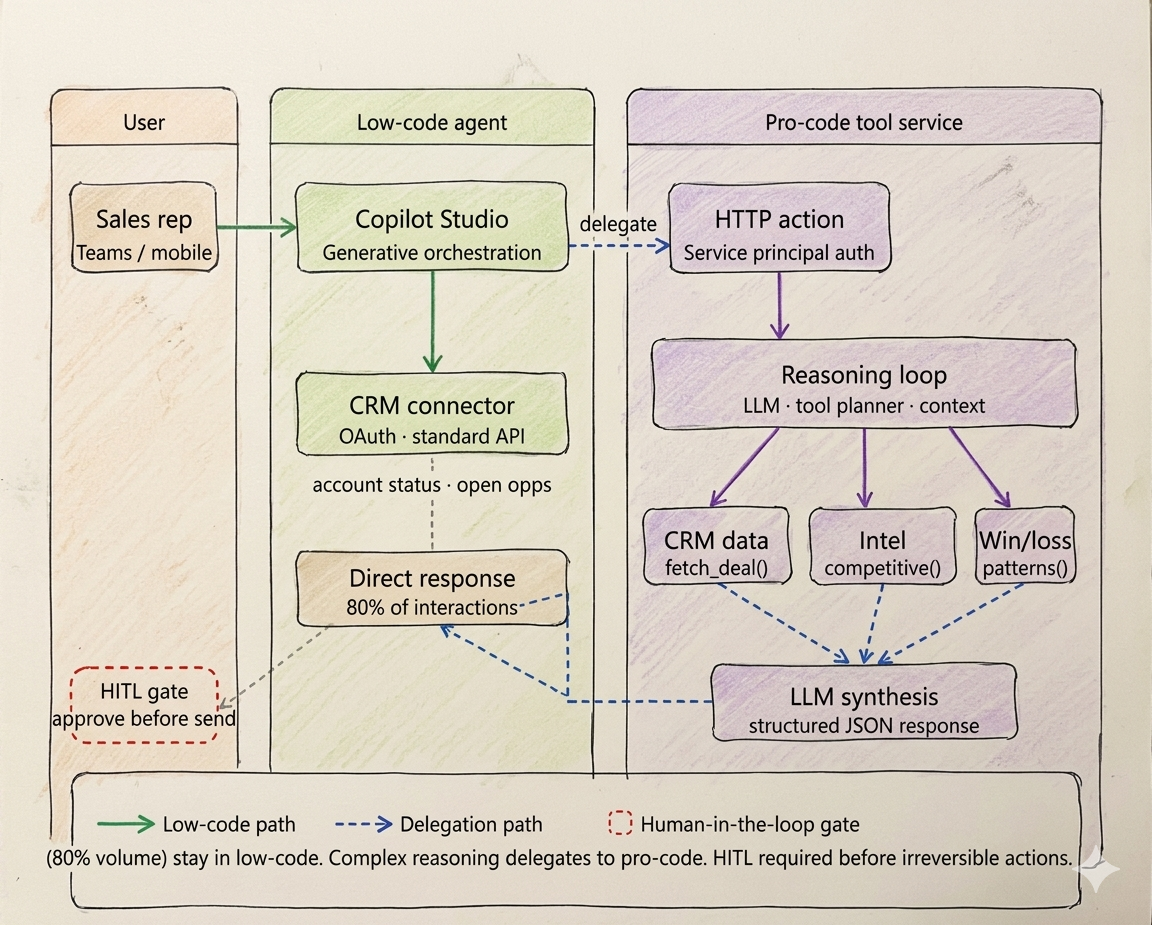
The most useful agent post Microsoft published this week begins by telling people not to build one. That should not feel radical, but in the current market it does.
In its new framework piece on the “three tiers of agentic AI,” Microsoft makes a point many vendors prefer to bury under demo videos: a large share of enterprise workflows do not need agents at all. Some need low-code orchestration. Some need pro-code systems. Some need a hybrid. And some need a deterministic workflow with good software around it, not an LLM wandering through your business process with a tool belt and an identity token. That is not anti-AI advice. It is the first serious sign of design maturity from a company that would very much like you to use more Azure AI.
The data Microsoft chose to foreground is telling. It cites an OutSystems survey of nearly 1,900 global IT leaders saying 96% of organizations are already using AI agents in some capacity, but only one in nine has them running at production scale. It also points to widespread concern that AI sprawl is increasing complexity, technical debt, and security risk, while only 12% of organizations have centralized management. Databricks data showing 327% growth in multi-agent workflows over four months sounds impressive, but it should also set off an architectural alarm: growth in agent systems is not the same thing as growth in good decisions.
That is the real story here. The bottleneck in enterprise AI is no longer mostly model quality. It is judgment.
The biggest agent mistake still happens before the first prompt
Most bad agent projects fail at problem selection. Teams start with a fashionable architecture and then go hunting for a justification. If a task is fully deterministic, well bounded, and already describable as tested business logic, adding an agent does not make it smarter. It makes it slower, harder to reason about, and more expensive to audit. Microsoft is basically saying this, albeit in cleaner corporate prose: agentic AI is not a badge of sophistication. It is a tradeoff. You only accept that tradeoff when probabilistic reasoning, messy context, and adaptive tool use create more value than variance creates pain.
That sounds obvious until you look at how organizations are actually shipping. Many teams still use “agent” as a euphemism for “workflow we have not designed properly yet.” The result is a system that can talk beautifully about a problem while remaining structurally worse than a queue, a rules engine, or a normal application service.
Microsoft’s tiering is helpful because it forces ownership questions that many projects dodge. Low-code makes sense when a workflow is narrow, latency-tolerant, and connector-driven. Pro-code is where you go when typed contracts, observability, auditability, and deterministic control planes matter. Hybrid is what serious enterprises usually land on anyway: a conversational surface up front, stricter orchestration beneath it, and humans inserted where approval or compliance actually lives.
MCP and A2A make agents easier to compose, not safer to choose
The post also uses the right supporting cast. MCP gives agents a standardized way to reach tools and data. Google’s A2A effort pushes toward more standardized inter-agent coordination, with more than 50 partners at launch. Those standards matter. They reduce the integration tax and make it easier to build systems that are less bespoke and more portable.
But standards do not solve misuse. They solve wiring.
This distinction is getting lost in a lot of current coverage. Protocol maturity is being mistaken for architectural maturity. An agent that can discover tools through MCP and hand off work through A2A is still a bad system if the underlying task should have been a deterministic service call with an approval workflow. Standardizing the connector layer does not change the economic and governance cost of letting a probabilistic model make decisions in the wrong place.
That is why the governance numbers in Microsoft’s post matter more than the protocol references. Companies using AI governance tools get over 12 times more projects into production, according to the cited Databricks data. That does not mean governance is red tape. It means governance is the mechanism that stops prototypes from collapsing under the first real security review.
There is a simple test teams should start using
If you are deciding whether to build an agent, stop asking “Can we?” and ask four uglier questions instead:
- If every valid output can be enumerated, why is this not a deterministic system?
- Where exactly does uncertainty add value instead of risk?
- What tool calls or approvals would a security team insist on seeing six months from now?
- Who owns the audit trail when the system does something clever and wrong?
If those questions feel annoying, good. They are supposed to. They force teams to design around operational reality instead of benchmark theater.
For practitioners, Microsoft’s framework is useful precisely because it is less interested in model mystique than in system boundaries. If you are building internal assistants, customer-support routing, compliance review, or data-enrichment workflows, the practical move is to define your deterministic core first. Then add agent behavior only where ambiguity, natural language messiness, or tool coordination genuinely benefits from it. Keep typed interfaces between stages. Keep observability from day one. Put human review where business risk actually lives, not where the architecture diagram looks nicest.
My stronger take is this: the next year of enterprise AI will reward teams that build fewer agents and better ones. The winners will not be the companies that managed to sprinkle “agentic” across the most workflows. They will be the teams that learned to say no early, reserve LLM flexibility for the right layers, and make governance part of the product instead of a late-stage apology.
Microsoft deserves credit here. In a market that keeps selling autonomy as default progress, one of the more credible things a platform vendor can say is: sometimes the right number of agents is zero.
Sources: Microsoft Tech Community, Model Context Protocol, Google Developers Blog, Microsoft Learn