Agent 365’s AMA Says the Quiet Part Out Loud: Enterprises Need an Agent Control Plane Before the Agents Finish Sprawling.

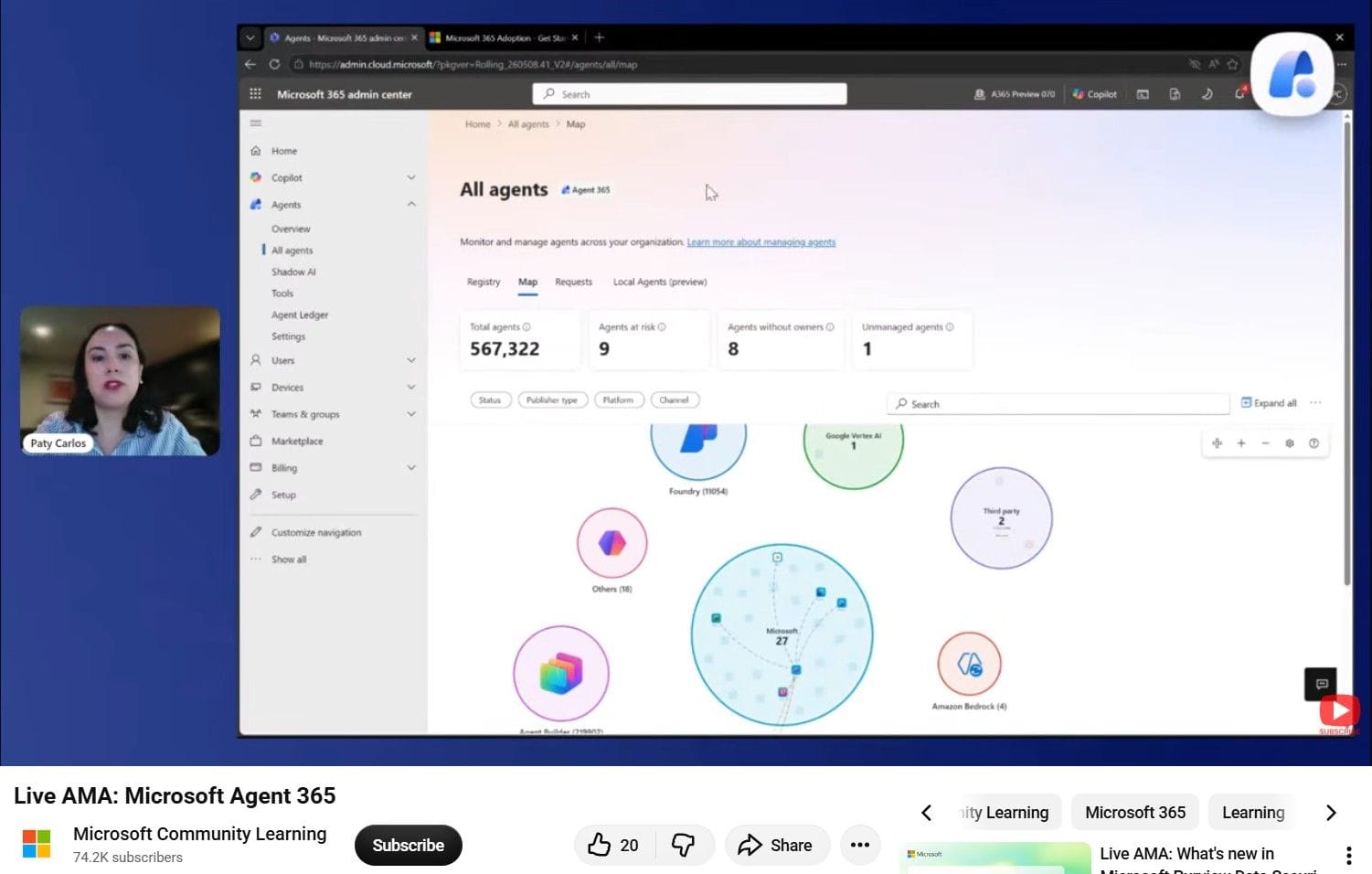
The most revealing thing about Microsoft’s Agent 365 AMA is not the product demo. It is the question list. Customers asked about licensing, identity models, monitoring third-party agents, managing shadow AI, defining risk, and what practical governance actually looks like. That is the enterprise-agent backlog in plain English: who owns these things, what are they allowed to do, how do we see them, and how do we stop the ones nobody approved?
Microsoft’s recap is short, but the signal is useful because Agent 365 has moved past launch messaging into operator friction. The company says the live demo and Q&A focused on visibility, security, and governance for AI agents across Microsoft and third-party ecosystems. That sounds tidy until you translate it into the operating environment most companies actually have: Microsoft 365 Copilot here, Copilot Studio there, a vendor agent connected to a SaaS tool, a browser extension someone installed, a local agent pointed at source code, and at least one team quietly using a personal account because the approved tool is too slow.
Agents need an org chart before they need more autonomy
Microsoft’s Agent 365 security docs identify five core challenges: agent sprawl, over-privileged agents, tool misuse, misconfigured or vulnerable agents, and prompt-injection or data-leakage risks across agent interactions. That list is useful because it avoids pretending agent security is one feature. It is inventory, identity, authorization, runtime behavior, data governance, and incident response glued together under a new noun.
The design center is sensible for Microsoft-heavy enterprises: extend existing systems instead of inventing a parallel agent-security universe. Agent 365 connects the agent problem to Microsoft Defender, Entra, and Purview, with centralized visibility in the Microsoft 365 admin center. Entra brings agent identity visibility, conditional access, identity protection, SASE monitoring and blocking for agents on user devices, and lifecycle governance with responsible sponsors. Purview brings data security posture management, sensitivity labels, DLP, insider risk management, communication compliance, auditing, retention and deletion policies, eDiscovery, and Compliance Manager assessments for agent instances. Defender brings posture management, attack-path visualization, suspicious activity detection, real-time blocking of malicious tool invocations, unified observability logs, and threat hunting.
That is the right architectural instinct. Agents should not be treated as magical chat bubbles. If they can act on business data, call tools, or modify records, they are non-human workers. Non-human workers need identities, owners, access packages, conditional access, audit logs, DLP boundaries, retention policies, and revocation. If your company would not let an intern with no manager, no badge, and unknown permissions update CRM or finance data, it should not let an agent do the same thing because the UI has rounded corners.
Microsoft’s May 1 security blog positioned Agent 365 as generally available and explicitly mentioned discovering agents and shadow AI using Defender and Intune capabilities across local and cloud agents. That is a smart wedge because discovery is where governance starts. You cannot enforce policy on an agent you cannot see. You cannot review access for an identity nobody knows exists. You cannot investigate tool misuse when tool calls are scattered across logs nobody retained.
The control plane is only as good as its telemetry
The hard limitation is also obvious: governance follows telemetry. If an agent runs through Microsoft-controlled identity, endpoint, app, and data surfaces, Agent 365 has something to see and enforce. If an employee uses a personal AI account in Chrome, pastes customer data into a prompt, installs an AI browser extension, or runs an unmanaged local agent on a contractor machine, the Microsoft control plane may see little or nothing. That does not make Agent 365 weak. It means executives should not confuse buying governance with achieving governance.
Security vendors are already circling that seam. LayerX argues Agent 365’s shadow-AI controls are strongest at the identity and endpoint layer and weaker at the browser-session layer, especially for personal AI accounts, unmanaged devices, non-Edge browsers, and AI browser extensions. The company cites figures that nearly 90% of AI logins in enterprise environments bypass oversight, 67% of employees access GenAI tools through personal accounts, 77% paste data into GenAI prompts, and 50% of that paste activity includes corporate data. Those are vendor-sponsored numbers, so do not frame them as physics. But they are directionally aligned with what most security teams already know: AI adoption starts with people trying to get work done, not with a platform architecture review.
Beam makes a related argument: access governance is necessary but insufficient without runtime behavior monitoring and accountability across agent-to-agent activity. Again, a vendor has a product to sell. Also again, the critique is real. An agent identity with approved access can still perform the wrong action, call the wrong tool, leak the wrong data, or delegate work in a way that makes the authority chain hard to reconstruct. Identity is necessary. It is not the whole story.
This is where the phrase “defining risk” from the AMA becomes more interesting than it sounds. Enterprises are used to classifying users, apps, data, and devices. Agents cut across those categories. An agent’s risk depends on what data it can read, what tools it can invoke, whether it can write or only suggest, whether it can delegate, whether outputs are reviewed, what logs are retained, and how easily a bad action can be rolled back. A read-only research assistant and a procurement agent that can modify supplier records do not belong in the same policy bucket.
What practitioners should do now
The practical starting point is an agent inventory with human owners. Every production or sanctioned agent should have a sponsor, a purpose, a data classification, an identity model, a permission set, an allowed tool list, an environment, and a retirement path. That sounds bureaucratic because it is bureaucracy. Some bureaucracy is just incident response written before the incident.
Next, separate read authority from write authority. Reading documents to summarize them is one risk class. Updating tickets, CRM fields, documents, code, HR records, invoices, or ERP objects is another. Require explicit approval gates for high-impact writes and irreversible actions. If the agent can call tools, treat the tool surface as the permission surface. If it can call another agent, treat transitive authority as an audit problem, not a philosophical question.
Third, log behavior in a way investigators can use. Prompts matter, but prompts alone are not enough. Keep tool calls, inputs, outputs, user approvals, policy decisions, identity context, data touched, and resulting mutations. Agent observability needs to answer both product questions and security questions: did it work, why did it do that, who allowed it, and what changed?
Finally, build a paved road people will actually use. The browser-session critique matters because shadow AI usually wins when the approved path is slow, useless, or overlocked. Agent 365 can help make the official path governable. It cannot, by itself, make the official path lovable. Platform teams need approved agents that solve real workflows, not just policies that say “do not use the thing that helps you finish your job.”
Agent 365’s AMA says the quiet part out loud: enterprises are not debating whether agents exist anymore. They are dealing with sprawl. Microsoft has a credible control-plane story because it builds on Entra, Purview, Defender, Intune, and the Microsoft 365 admin surface. The remaining work is messier and more local: define ownership, close telemetry gaps, cover browser and unmanaged paths, design write-authority boundaries, and make the approved tools good enough that employees do not route around them. Agent governance is not a launch announcement. It is an operating model.
Sources: Microsoft TechCommunity Agent 365 AMA, Microsoft Security Blog, Microsoft Agent 365 security docs, LayerX, Beam