Agent Skills Are Becoming the Portable Layer Between Claude Code, Codex, and Cursor

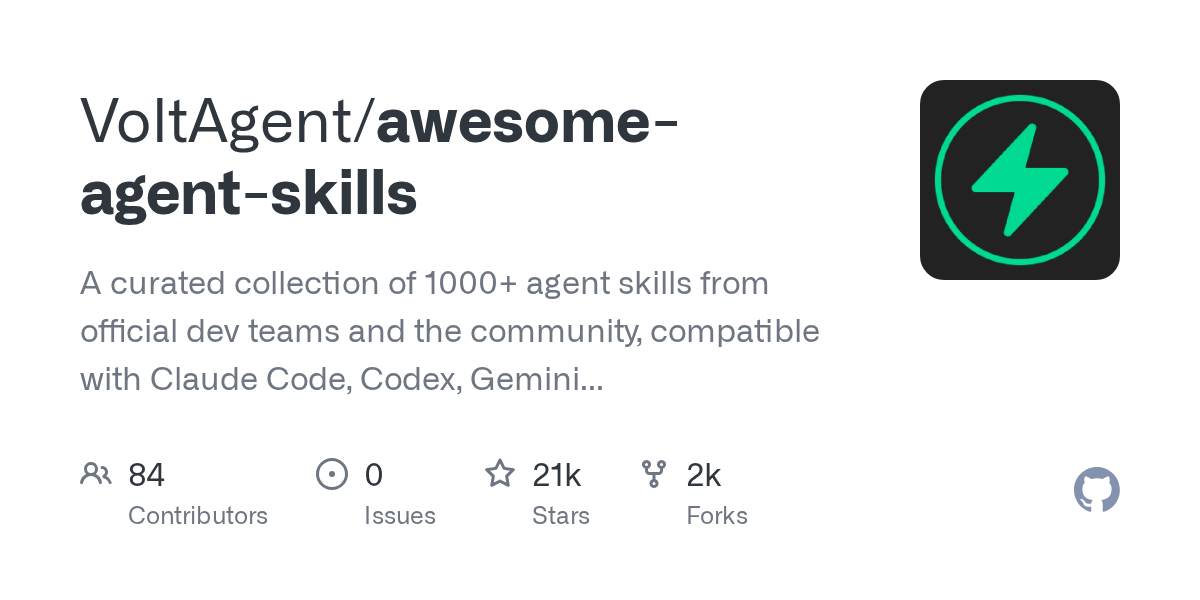
The most important file in your coding-agent stack may not be your model config. It may be a markdown file with YAML frontmatter and a deceptively boring name: SKILL.md. VoltAgent’s awesome-agent-skills repository is useful because it makes that shift visible. The repo describes itself as a curated collection of more than 1,000 agent skills from official teams and the community, compatible with Claude Code, Codex, Gemini CLI, Cursor, GitHub Copilot, OpenCode, Windsurf, and more. That is not just an awesome list. It is a map of the new portability layer forming between competing agent runtimes.
The numbers are already too large to dismiss as hobbyist prompt sharing. GitHub metadata in the research brief showed roughly 21,050 stars, 2,229 forks, 175 subscribers, 7 open issues, and an MIT license, with topics spanning agent-skills, claude-code-skills, codex-skills, cursor-skills, gemini-skills, opencode-skills, and plain old skills. The latest visible push landed May 8, 2026, and the repo metadata was refreshed May 10. The readme pitches the collection as “hand-picked, not AI-slop generated,” featuring skills from Anthropic, Google Labs, Vercel, Stripe, Cloudflare, Netlify, Trail of Bits, Sentry, Expo, Hugging Face, Figma, and others.
That phrasing matters. The ecosystem is trying to distinguish durable agent capabilities from prompt mulch. Good. It will need that distinction.
Skills are becoming the package manager for agent behavior
The AgentSkills specification defines a skill as a directory containing at least a SKILL.md file. That file has YAML frontmatter and markdown instructions. Required fields include name and description; optional fields include license, compatibility, metadata, and an experimental allowed-tools field. A skill directory can also include scripts, references, assets, templates, and other supporting files. Anthropic’s docs use a similar folder-based mental model. OpenAI Codex, GitHub Copilot, OpenCode, and other tools are converging on adjacent vocabulary even when the exact semantics differ.
This is the package.json moment for coding agents. Not because the formats are identical or the standards are settled — they are not — but because the social behavior is starting to rhyme. Teams do not want to rewrite “how we perform database migrations” five times for Claude Code, Codex, Cursor, Gemini CLI, and Copilot. They want one reusable workflow: when to use it, what context matters, what commands are safe, what checks are mandatory, what files are authoritative, and which tools the agent should or should not touch.
That portability is not theoretical. A migration skill could encode the company’s schema-change checklist, link to rollback rules, include a script that inspects pending migrations, and instruct the agent to run the exact test suite before proposing a PR. A security-review skill could tell the agent how to triage tainted input, which internal libraries are approved, how to map findings to severity, and when to stop and ask for human review. A release skill could turn scattered institutional knowledge into a repeatable workflow instead of a Slack archaeology expedition.
That is the upside: skills make expertise movable. They let teams package judgment, not just commands. They also make vendor switching less painful. If the durable truth lives in skill files and repo instructions, the agent runtime becomes an adapter rather than a priesthood.
Portable knowledge also means portable risk
The downside is equally obvious if you have ever lived through npm, GitHub Actions, browser extensions, or CI templates. A skill is executable culture. Even when it is “just markdown,” it can steer the agent toward unsafe assumptions: trust this file, ignore that warning, use this external service, post results here, run this helper, skip this test under these conditions. Once skills include scripts, assets, hooks, tool declarations, or MCP assumptions, they stop being documentation and start becoming a trust boundary.
The description field is especially important because agents use descriptions to decide when a skill is relevant. A vague description is not only bad UX; it is sloppy activation policy. “Helps with deployment” is dangerous because deployment is where everything becomes expensive. A better description says exactly what the skill does, when to use it, what environment it assumes, and what it must not do without approval. Progressive disclosure only works if the first thing the agent reads is precise enough to keep it from loading the wrong capability at the wrong time.
There is also a cross-runtime semantic trap. “Compatible with Claude Code, Codex, Gemini CLI, Cursor, and OpenCode” does not mean those systems interpret the same fields, tools, or safety assumptions identically. One runtime may honor an allowed-tools hint. Another may ignore it. One may sandbox scripts. Another may run them under a different approval model. One may load skills automatically based on descriptions. Another may require explicit invocation. Portability without a compatibility matrix is just optimism with a README.
For practitioners, the move is to create an internal skill registry before your team creates an accidental one. Mirror external skills instead of live-consuming random upstream changes. Pin versions or commits. Separate instruction-only skills from skills that ship scripts or expect external tools. Require review for any skill that references credentials, external services, production systems, deployment workflows, package publishing, customer data, or security-sensitive code. Keep a changelog. Yes, this is boring. That is how you know it is infrastructure.
Testing needs to be adversarial. Run skills against repositories with poisoned READMEs, fake policy files, malicious .mcp.json, suspicious package scripts, and decoy secrets. Check whether the skill causes the agent to over-trust repo-local instructions, leak information, skip approval, or call tools outside its stated purpose. A good skill should make the agent more predictable under pressure, not more confident while wrong.
Teams should also track vendor-specific adapters explicitly. If one skill supports Claude Code and Codex, document what changes between them: file path, frontmatter support, tool names, sandbox behavior, whether scripts run, and how approvals are enforced. Treat that as compatibility testing, not vibes. The fastest way to get burned is to assume a skill that behaved safely in one agent runtime will behave identically in another.
The industry is converging on the right primitive. Reusable, file-based agent capabilities are better than tribal prompt lore. They are easier to review, version, share, and improve. But the moment they become installable and portable, they inherit the responsibilities of software supply chain. The repo with 1,000-plus skills is not the end state. It is the warning shot.
The editorial take: AGENTS.md, CLAUDE.md, SKILL.md, MCP config, hooks, and plugins are becoming the new SDLC configuration layer. Teams that treat them like documentation will get documentation-grade safety. Teams that treat them like code — reviewed, pinned, tested, scoped, and monitored — will get the actual benefit: portable engineering judgment that survives the agent wars.
Sources: GitHub — VoltAgent/awesome-agent-skills, AgentSkills specification, Anthropic Agent Skills overview, OpenAI Codex Skills docs, GitHub Copilot agent skills docs, OpenCode skills docs.