AgenticOps Is DevOps After the Author of the Commit Stops Being Human by Default.

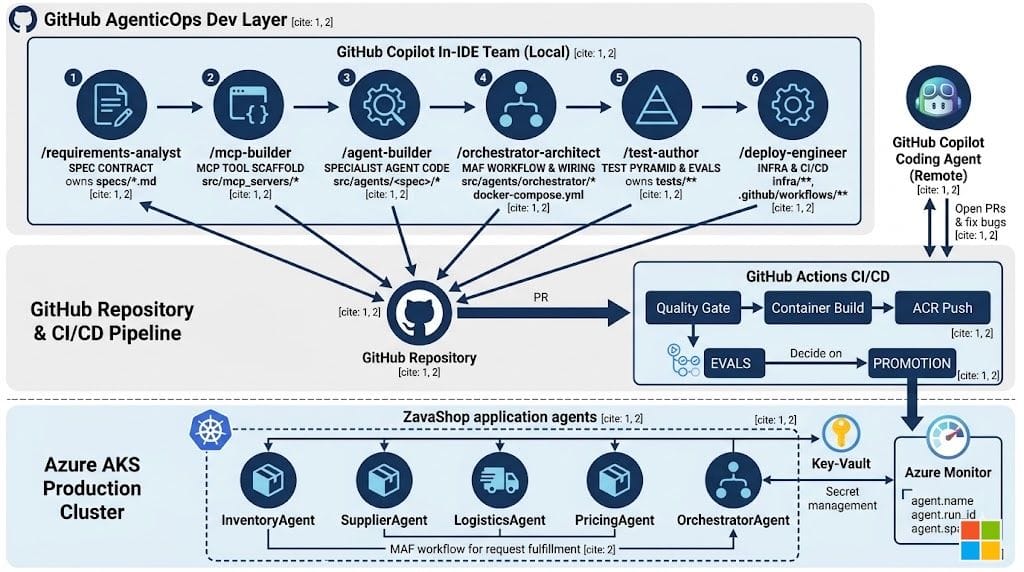
“AgenticOps” is the kind of label that makes engineers reach for the mute button. Fair. But Microsoft’s AKS lab is worth reading past the branding because it sketches a real operating model for a world where the author of a pull request is not always a human by default. The interesting part is not that Copilot can generate code. Everyone has seen that demo. The interesting part is how the software delivery system changes when specs, code, tests, infrastructure, and pull requests can all be produced by bounded agents under policy.
The post centers on microsoft/AKS-Lab-GitHubCopilot, a ZavaShop retail supply-chain lab running on AKS and Azure Container Apps with Microsoft Agent Framework and the GitHub Copilot SDK. The lab separates runtime application agents — InventoryAgent, SupplierAgent, LogisticsAgent, PricingAgent, and OrchestratorAgent — from dev-time coding agents: requirements-analyst, mcp-builder, agent-builder, orchestrator-architect, test-author, and deploy-engineer.
That separation is the first useful idea. Runtime agents operate the application. Coding agents change the application. Confusing those two categories is how teams end up with impressive demos and terrifying permission models.
The spec becomes the API between humans and agents
The lab’s workflow prompts tell the story: /feature-from-issue turns an issue into a spec, code, tests, PR, and deploy path; /spec-to-code moves from agreed design to implementation; /ship-it runs quality gates, build, push, ACR/ACA/AKS rollout, smoke tests, and evals. In that model, the commit is not the fundamental unit of intention anymore. The spec is.
That is a serious shift. Traditional delivery assumes a human reads requirements, carries context in their head, edits files, and uses CI as a backstop. Agent-native delivery has to make intent machine-readable enough that an agent can act without inventing the missing parts. Clear specs, acceptance criteria, file guidance, ownership boundaries, and refusal rules stop being nice process artifacts. They become the control surface.
GitHub’s own Copilot cloud-agent guidance is more conservative than the lab’s marketing language, which is exactly the cold shower this topic needs. GitHub recommends clear, scoped tasks with acceptance criteria and file guidance. It warns against broad, production-critical, security-sensitive, PII/auth-heavy, ambiguous, and learning-oriented tasks. Translation: the agent is not a senior engineer you can vaguely point at a swamp. It is a fast executor when the task contract is good and the review gates are real.
Refusal rules are the underrated primitive
The strongest design choice in the lab is scoped ownership. The requirements agent owns specs/*.md and refuses code. The MCP builder owns src/mcp_servers/*. The agent builder owns specialist agent code under src/agents/<specialist>/*. The orchestrator architect owns orchestrator and shared wiring, not business logic. The test author owns tests/** and never edits src/. The deploy engineer owns infra/** and .github/workflows/** and will not touch application code. The remote GitHub Copilot Coding Agent can open PRs against src/ and tests/ only, and never infra/ without human review.
This is the boring constraint layer most agent demos skip. Broad repo access plus a vague goal is not delegation. It is roulette with syntax highlighting. Narrow ownership gives reviewers a way to reason about intent and blast radius. Refusal rules matter because a safe agent is not just one that knows what to do; it is one that knows what not to do, and fails closed when asked to cross its boundary.
Path boundaries are not a complete security model, but they are a useful start. They make the review surface smaller. They let teams map agent behavior to code ownership. They help CI and policy engines enforce expectations. They also force humans to write down architecture boundaries that may have existed only as oral tradition. That alone has value.
Evals are where agent-written software earns trust
The lab uses a four-layer test pyramid plus five golden eval scenarios, labeled S1-S5, with uv run poe check locally and in GitHub Actions. The observability layer emits agent.name, agent.run_id, and agent.span_id through structlog. These details matter because agent-authored work cannot be trusted by enthusiasm. It has to pass gates indifferent to authorship.
Human-written, agent-written, copied from Stack Overflow, generated by a very determined raccoon — the pipeline should not care. Tests, linters, security scans, type checks, policy checks, and behavioral evals should decide what survives. For agentic systems, unit tests are necessary but not sufficient. You need regression scenarios for tool calls, orchestration paths, permission boundaries, business invariants, failure modes, and the cases developers usually keep in their heads.
The observability fields are equally important. If an agent opens a PR or a runtime agent takes an action, logs need to preserve identity. “Copilot did it” is not an audit record. Which agent? Which run? Which spec? Which tool calls? Which approval? Which code path? Without that metadata, incident response turns into archaeology.
The GitHub repository’s maturity should also temper expectations. At research time, microsoft/AKS-Lab-GitHubCopilot had 0 stars and 1 fork, with recent activity on May 15. This is a fresh Microsoft lab, not a proven reference architecture adopted across the ecosystem. That is fine as long as teams treat it as a pattern to test, not a template to cargo-cult into production.
For Azure teams, the cloud pieces are familiar: AKS, Azure Container Apps, Azure Container Registry, Key Vault, Workload Identity, OIDC-fed GitHub Actions, Helm, Bicep, OpenTelemetry. The agent layer does not make those fundamentals disappear. It makes least privilege and attribution more important. A generated workflow with too much permission is still too much permission. An agent that can deploy needs the same controls as a human deployer, plus clearer evidence because humans cannot inspect every intermediate thought that led to the diff.
The practical way to adopt this is small. Pick one repo. Define three agents, not six. Give each one path-level ownership and an explicit refusal rule. Require a spec before code. Add one behavioral eval that catches a business invariant ordinary unit tests miss. Emit agent identity into PR metadata and logs. Then measure: did review time improve, did defects move earlier, did engineers trust the output, and did the policy boundaries actually hold?
If the system only works when a senior engineer babysits every step, it is not AgenticOps. It is a complicated typing assistant. But if small, named agents can take scoped work from spec to PR under real gates, the delivery pipeline starts to look different. The future is not unbounded AI teammates wandering through the repo. It is constrained agents with ownership, refusal rules, evals, and logs. Less cinematic. Much more shippable.
Sources: Microsoft Tech Community, AKS-Lab-GitHubCopilot on GitHub, GitHub Copilot cloud agent guidance, Microsoft Agent Framework docs