agentmemory v0.9.17 Makes Persistent Agent Memory Less Tied to One Model Vendor

Persistent memory for coding agents sounds like a product feature until you try to adopt it across a real team. Then it becomes infrastructure. The question stops being “can Claude remember this?” and becomes “can the repo retain useful knowledge without binding our workflow to one model, one chat surface, or one vendor account?”
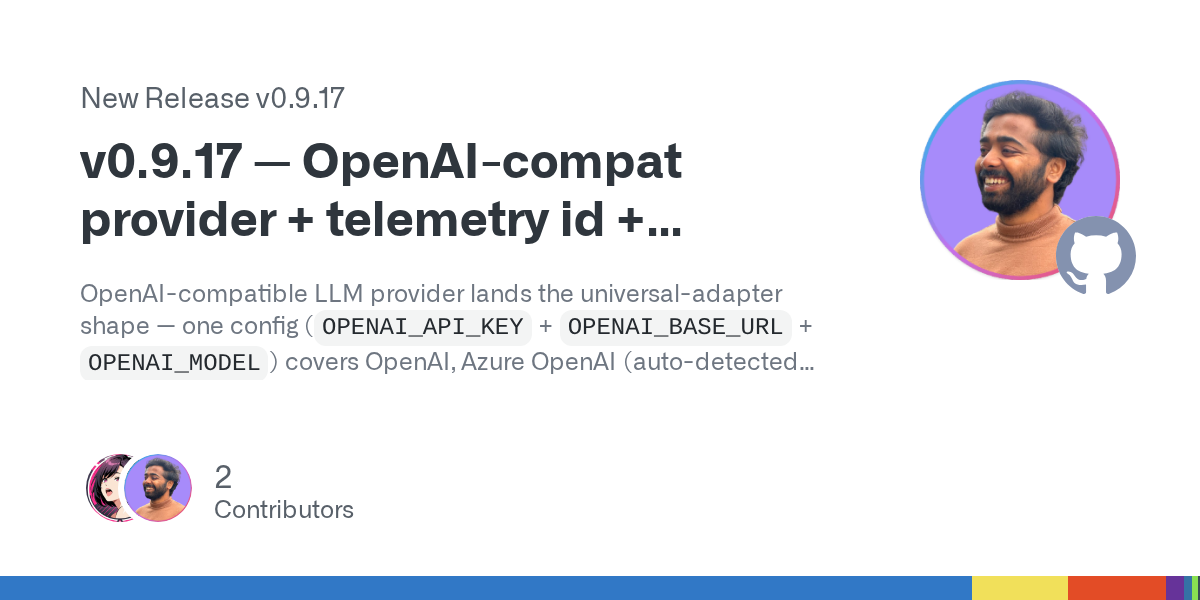
That is the useful lens for agentmemory v0.9.17. The release adds an OpenAI-compatible LLM provider, Azure OpenAI auto-detection, timeout controls, reasoning-effort passthrough, telemetry cleanup, and comparison-page polish. None of that is flashy. All of it matters if the goal is durable project memory that can serve Claude Code, Codex CLI, Cursor, Gemini CLI, OpenCode, local Ollama or vLLM endpoints, Azure deployments, and whatever agent UI your team swaps in next quarter.
The project already has attention: during research, the repo showed roughly 10,728 stars, 907 forks, 95 open issues, Apache-2.0 licensing, and fresh pushes on May 17. The README advertises support for Claude Code, Cursor, Gemini CLI, Codex CLI, Hermes, OpenClaw, pi, OpenCode, and any MCP client. It claims 95.2% retrieval R@5, 92% fewer tokens, 51 MCP tools, 12 auto hooks, zero external databases, and 950+ tests. Treat those as claims to validate, not gospel — but the product direction is clear. Memory is being pulled out of the chat transcript and turned into a service.
Model portability is the real feature
The v0.9.17 provider work uses familiar environment variables: OPENAI_API_KEY, OPENAI_BASE_URL, and OPENAI_MODEL. That opens the door to OpenAI, Azure OpenAI, DeepSeek, SiliconFlow, vLLM, LM Studio, Ollama through /v1, and future OpenAI-compatible endpoints. Azure OpenAI receives special handling: hostnames ending in .openai.azure.com are auto-detected, bearer auth swaps to api-key, the /v1 prefix is dropped, and an api-version parameter is appended with a default of 2024-08-01-preview.
This is plumbing, but it is strategic plumbing. Persistent memory should not belong to the current winning assistant. A team’s durable knowledge about a repo — architecture decisions, conventions, rejected migrations, flaky tests, local setup traps, deployment rituals — should outlive the tool currently editing files. Today the workflow may be Claude Code in the terminal. Tomorrow it may be Codex for GitHub-native tasks, Cursor for editor work, Gemini CLI in a Google-heavy environment, or a local vLLM endpoint for sensitive repositories. If memory is glued to one provider, it becomes another migration liability.
The release also adds OPENAI_TIMEOUT_MS, defaulting to 60 seconds, and OPENAI_REASONING_EFFORT passthrough for reasoning models and compatible providers. It includes OPENAI_API_KEY_FOR_LLM=false, which prevents an OpenAI key intended only for embeddings from automatically activating the LLM provider. That last switch is exactly the kind of small safety feature mature infrastructure needs. Surprising routing is bad. Surprising routing in a memory system that may store project facts is worse.
Memory is useful because it is dangerous
The phrase “your coding agent remembers everything” is emotionally appealing and architecturally suspect. You do not want an agent to remember everything. You want it to remember selected, reviewable, scoped facts with provenance and deletion paths. Persistent memory is valuable precisely because it survives compaction and session restarts. That also means stale decisions survive, accidental secrets survive, misleading debugging guesses survive, and “temporary” context can become permanent folklore.
Teams adopting agentmemory should start with a governance model before they start feeding it transcripts. Define categories. Repo conventions are good candidates: formatting rules, testing patterns, architecture boundaries, naming preferences, migration playbooks. Known operational facts are useful: flaky tests, required local services, slow integration suites, generated files not to edit manually. Decisions are useful when they include date, rationale, and owner: “we rejected GraphQL for this service because the mobile clients need cache semantics X and Y.” Secrets, customer data, incident details, private employee context, and giant debug dumps should be excluded by default.
The review loop matters as much as retrieval quality. A memory layer should let humans inspect what it stored, correct bad entries, delete obsolete facts, and distinguish durable project knowledge from one user’s preference. If two agents disagree because one retrieved an old convention and another retrieved a new one, the system needs more than a confidence score. It needs provenance and recency semantics that humans can understand.
The repo should remember, not the assistant brand
The best version of this architecture is project-scoped memory with many approved agents attached through hooks, MCP, REST, or native plugins. That way the memory belongs to the codebase, not to the last chat window. A fresh Codex session should be able to learn the same convention a Claude Code session discovered. A Cursor workflow should be able to query the rejected migration note from last month. A local model should be able to retrieve setup instructions without dumping half the repository into context.
That cross-agent shape is where agentmemory’s OpenAI-compatible provider work matters. Compatible endpoints are not actually identical; Azure auth differs, local endpoints stall differently, reasoning parameters vary, and hosted providers invent subtly incompatible behavior. A memory server that exposes the right knobs can absorb some of that complexity without forcing every agent workflow to be rewritten.
Practitioners should evaluate this with concrete follow-up tasks. Do not ask the system to “remember the repo.” Ask it to remember that migrations must be backward-compatible for two deploys, then start a fresh agent session and request a schema change. Ask it to remember that a flaky test fails under parallel execution, then see whether it avoids wasting time chasing a false regression. Ask it to store a rejected architecture decision, then test whether another agent can retrieve the rationale weeks later. Most important: intentionally store something wrong and verify that a human can correct or remove it.
Persistent memory also changes code review. Reviewers will increasingly need to ask not only “is this diff correct?” but “what context did the agent retrieve to produce it?” If a patch relies on stale memory, the bug may not be in the generated code alone. It may be in the organizational memory feeding the generator. That is a new failure mode, and teams should treat it as part of their engineering process rather than a mysterious model hallucination.
My take: agentmemory v0.9.17 is important because it moves the product away from model-branded remembering and toward portable repo memory. The valuable layer is not “Claude remembers.” It is “the project remembers, and any approved agent can ask — under rules humans can inspect.” That is less magical, which is exactly why it is more likely to work.
Sources: agentmemory v0.9.17 release, agentmemory repository, agentmemory README, agentmemory changelog