BioNeMo LoRA Makes Billion-Parameter Biology Models Feel Less Like a Cluster Reservation

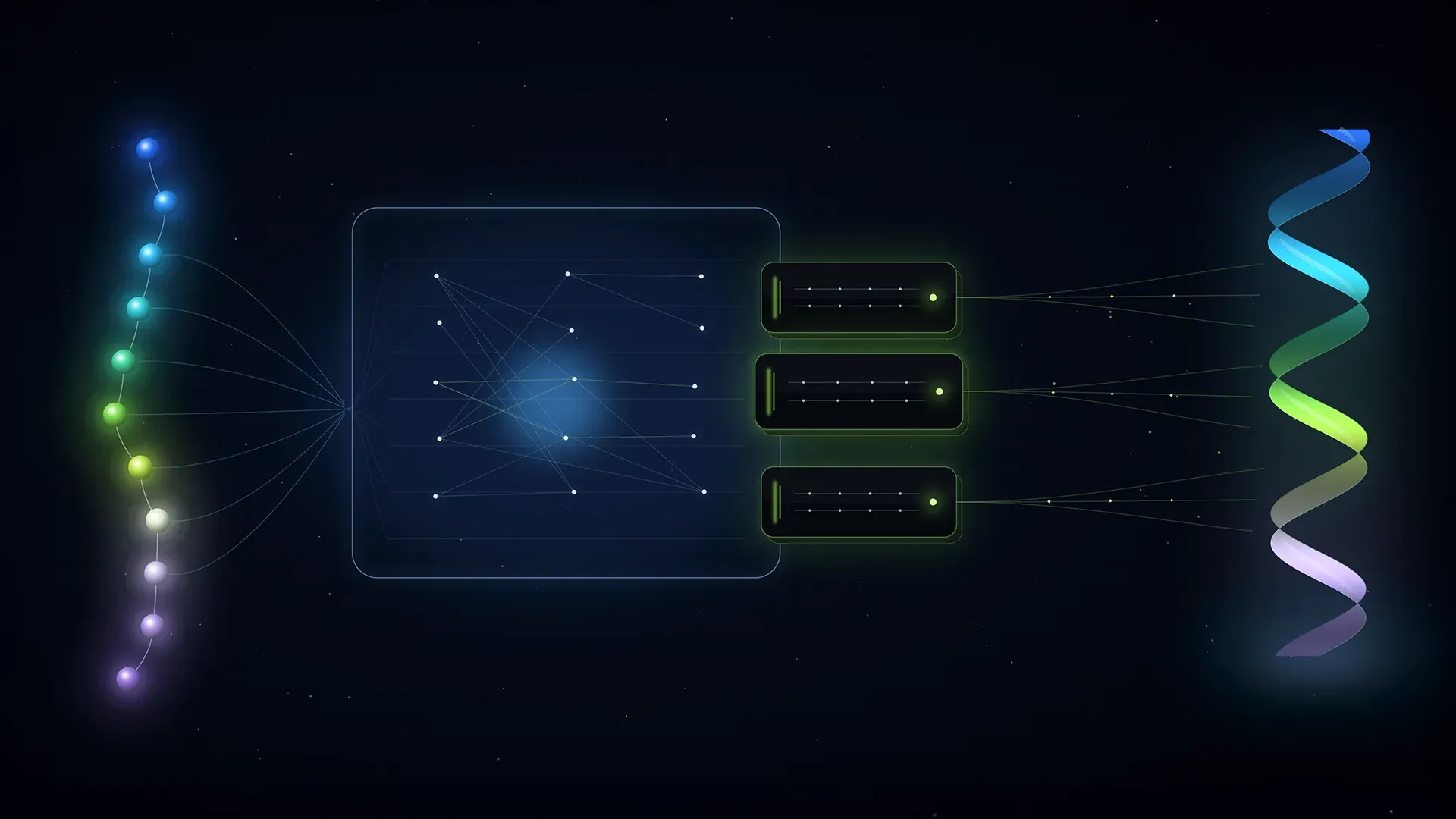
Biology foundation models have had the same problem as every other foundation model category, only with more lab coats involved: the demos are impressive, the checkpoints are huge, and the moment a team needs to adapt one to its own assay or organism, the workflow starts looking like a cluster reservation.
NVIDIA’s new BioNeMo Recipes post is useful because it aims at that boring, expensive middle. The company walks through LoRA fine-tuning for two biological models — ESM2-3B for protein secondary structure prediction and Evo2-1B for DNA splice-site classification — and does it on a single NVIDIA RTX 6000 Blackwell Workstation Edition GPU. That is not a magic wand for drug discovery. It is something better: a reproducible adaptation pattern that lets a team test whether a biological foundation model actually contains useful signal before turning the experiment into a distributed training project.
The core technique is familiar from language models. LoRA, or Low-Rank Adaptation, freezes the pretrained backbone and trains small adapter matrices plus a task-specific head. NVIDIA says that usually means training roughly 1% of the parameters instead of updating the full model and its optimizer state. The original LoRA paper reported a 10,000x reduction in trainable parameters and a 3x GPU-memory reduction when adapting GPT-3 175B, without adding inference latency. Those numbers are from a different domain, but the operational lesson carries over cleanly: if the base model already learned useful structure, don’t pay to relearn it for every downstream task.
That matters more in biology than in chatbots. A computational biology team may want separate adapters for a specific assay, tissue, organism, protein family, or label taxonomy. Full fine-tuning each variant is expensive, hard to audit, and annoying to reproduce. Adapter-based workflows make the base checkpoint stable and move the experiment-specific changes into small, swappable components. For regulated or high-stakes scientific work, “which exact model produced this result?” is not paperwork. It is part of the science.
The splice-site result is the cleanest signal
The sharper case study is Evo2-1B on DNA splice-site classification. NVIDIA uses the splice_sites_all task from the Nucleotide Transformer downstream benchmark: fixed 600 base-pair DNA windows, three labels — no splice, acceptor, donor — and roughly 30,000 training examples with 3,000 test examples. A head-only baseline trains 3,697,923 parameters, about 0.33% of the model, and reaches 52.3% test accuracy. Add LoRA adapters, bring the trainable parameter count to 15,985,923 — still only 1.42% of the model — and accuracy jumps to 96.6%.
That is the useful distinction. A frozen foundation model is not automatically a good scientific instrument. It may contain the biological signal, but the readout is not free. The head-only baseline says “the representation is there, but not linearly enough for this task.” LoRA gives the model a limited, controlled way to reshape internal representations for the label distribution. For practitioners, that is the difference between using a foundation model as a static feature extractor and using it as an adaptable model family.
Evo2 is also the right kind of model to test this pattern on. The public Arc Institute repo describes the family as DNA sequence models operating at single-nucleotide resolution with context lengths up to 1 million base pairs, trained on 8.8 trillion OpenGenome2 tokens. In other words: the pretraining bill has already been paid at a scale most labs will not reproduce. The engineering question becomes how cheaply a team can bend that prior toward its own biological question without corrupting the validation story.
The second case study, ESM2-3B for protein secondary structure prediction, is less dramatic but maybe more representative of day-to-day scientific ML. NVIDIA fine-tunes ESM2-3B with PEFT adapters on fused QKV projections and a per-residue classification head, using Porter 6 curated splits. The workflow reportedly runs in under an hour on one RTX 6000 Blackwell workstation GPU and reaches 84.80% Q3 and 74.30% Q8 accuracy. That slightly beats the Porter 6 table values for Porter 6 itself at 84.56% / 74.18%, NetSurfP-3.0 at 82.92% / 71.84%, and SPOT-1D-LM at 84.30% / 74.09%.
Do not overread the margin. The important part is not that LoRA-adapted ESM2 destroys specialized baselines. It does not. The important part is that a general protein language model can be adapted into a competitive secondary-structure predictor with a small adapter, a task head, and a workflow a researcher can inspect. That is how foundation models become useful lab infrastructure instead of conference furniture.
The unsexy throughput detail is doing real work
The most underrated number in the post is NVIDIA’s claim that THD sequence packing improves ESM2 fine-tuning throughput by roughly 5.5x compared with padded BSHD batching. That is the kind of detail that decides whether a “single GPU” workflow feels real or ceremonial. Biological sequences have uneven lengths. If the training loop spends most of its time computing over padding, the GPU is not doing biology; it is doing whitespace with better marketing.
This is where BioNeMo Recipes are more interesting than a generic LoRA tutorial. NVIDIA says the recipes sit on PyTorch, Hugging Face, Megatron-Bridge, Transformer Engine, and scale-out strategies where they help, but are meant to be readable rather than a monolithic framework. That positioning matters. Domain scientists need workflows they can audit and modify. ML engineers need enough performance plumbing — precision, packing, checkpointing, task heads, distributed options — that the experiment does not collapse under its own scaffolding.
The right way to use this is not to fine-tune every biological model on every dataset because adapters are cheap. Cheap experiments still produce bad science if the splits are leaky, the labels are noisy, or the validation set shares batch effects with training. Teams should build an adaptation harness: frozen-backbone baseline, head-only baseline, LoRA ranks and target-module ablations, held-out biological splits, calibration metrics, and wet-lab validation where the claim requires it. LoRA lowers the iteration cost. It does not lower the standard of evidence.
There is also a platform strategy hiding in plain sight. NVIDIA is not just selling GPUs into life sciences; it is attaching recipes to the GPUs. That is a smarter pitch than another “AI will transform drug discovery” deck. If BioNeMo Recipes remain hackable, they give labs a practical bridge between open biological checkpoints and workstation-scale experimentation. If they become too platform-shaped, researchers will route around them, because biology already has enough black boxes.
The senior-engineer takeaway: treat biological foundation models less like finished predictors and more like expensive priors that need disciplined adaptation. Start with small adapters, measure against honest baselines, profile the input pipeline before buying more hardware, and keep the base checkpoint stable enough that your results can be reproduced. LoRA does not solve biology. It makes the useful question cheaper to ask: does this model contain signal for my problem, or am I just projecting hope onto a giant sequence model?
Sources: NVIDIA Developer Blog, NVIDIA BioNeMo Recipes, LoRA paper, Arc Institute Evo2