Cheaper Copilot Cloud-Agent Models Mean Agentic Coding Needs a Scheduler, Not Just a Smart Model

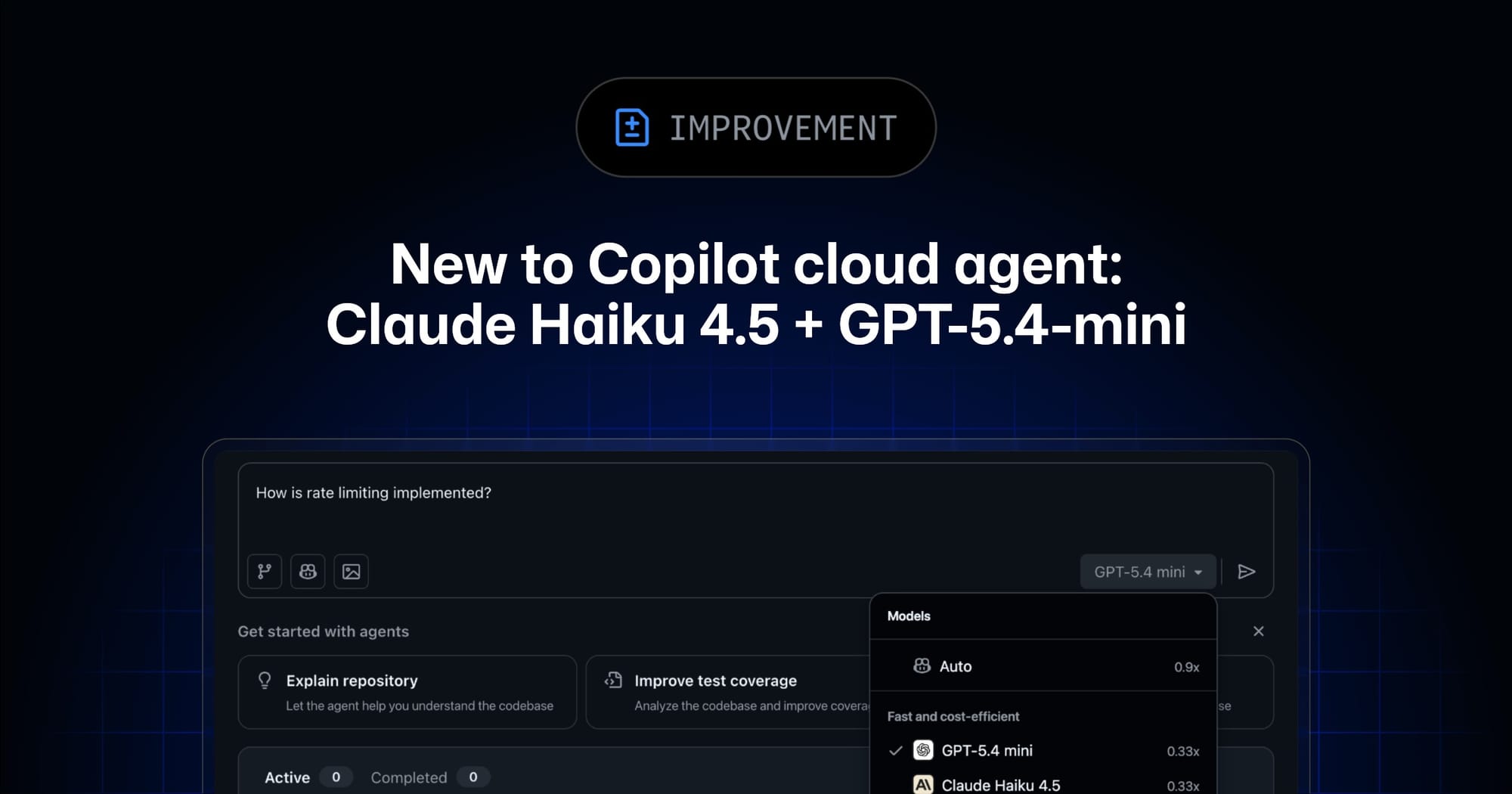
GitHub adding Claude Haiku 4.5 and GPT-5.4-mini to Copilot cloud agent is not really a model-news story. The model names will change. The useful signal is the price multiplier: both are listed at 0.33x. That is GitHub quietly admitting what every platform team is about to learn the expensive way: agentic coding needs routing economics, not just a smarter default model.
Copilot cloud agent is no longer just a chat box with repository access. It can run in a cloud development environment, inspect code, execute tasks, open branches, and work through issues or pull-request comments while consuming Copilot premium requests and GitHub Actions minutes. Once a tool can do background engineering work, model choice becomes part of the scheduler. Which tasks deserve the expensive model? Which should be handled by a cheaper, faster one? Which should not be delegated at all?
GitHub’s official framing is straightforward: use smaller, faster, more cost-efficient models for simple tasks and reserve more capable models for complex work. The current Copilot cloud agent model list includes Auto, Claude Sonnet 4.5, Claude Opus 4.7, Claude Haiku 4.5, GPT-5.2-Codex, and GPT-5.4 mini. Model selection is available from several entry points, including assigning an issue to Copilot on GitHub.com, mentioning @copilot in a pull request comment, the agents panel, GitHub Mobile, and Raycast. When a picker is not available, GitHub says Auto is used.
Auto is useful. Auto is not governance.
The 0.33x tier changes the operating model
There is a reason cloud teams built schedulers, queues, autoscalers, job classes, and priority lanes. Not every unit of work deserves the same resource profile. The same is now true for coding agents. A typo fix, dependency-manifest update, documentation cleanup, test name adjustment, or narrow linter repair should not burn the most expensive reasoning model in the catalog. A cross-service refactor, security-sensitive patch, workflow-permission change, or ambiguous production bug probably should not be handed to the cheapest model without stronger review.
The difference matters because coding-agent cost is not just tokens. It is premium requests, Actions minutes, elapsed time, review attention, CI churn, and occasionally incident risk. A cheaper model that produces a noisy pull request can be more expensive than a premium model that produces a smaller, correct patch. A premium model assigned to every trivial maintenance issue can be a budget leak with excellent grammar.
The right comparison is not “which model is smartest?” It is “which model produces accepted, non-reverted changes for this class of task at the lowest total cost?” That total cost includes reviewer time. If Haiku or GPT-5.4-mini handles 80% of simple chores at one-third the multiplier, excellent. If those models create plausible patches that senior engineers spend 25 minutes unwinding, the discount is fake.
This is where engineering organizations need to get more explicit than the product UI. Define task classes. Low-risk maintenance. Test-only changes. Documentation changes. Dependency updates. CI repairs. Bug fixes in non-critical packages. Security patches. Infrastructure changes. Then decide which model tiers are acceptable for each class, what review rules apply, and whether the agent may use additional tools or MCP servers.
The future is not one best coding model
Developer discourse still treats Claude Code, Codex, Copilot, Cursor, Gemini CLI, and the rest like a horse race. That is natural and mostly wrong for enterprises. The winning setup will look less like one model and more like a routing layer: cheap models for bounded chores, stronger models for ambiguous code work, specialized models for domain tasks, local or private deployments where policy requires it, and humans as the invariant review boundary.
GitHub’s model expansion points in that direction. The presence of Claude and OpenAI models inside Copilot cloud agent is already an admission that the product surface and the model layer are separable. Microsoft and GitHub want Copilot to be the governed agent runtime even when the underlying model varies. That is strategically important. Enterprises often care less about which model wins the benchmark this week and more about where policy, identity, audit logs, cost controls, and repository permissions live.
The risk is that Auto mode becomes a substitute for thinking. GitHub says Auto can select based on availability and help reduce rate limiting. Those are vendor-level concerns. Your organization may care about different constraints: repository sensitivity, code ownership, customer data exposure, regulated workflows, production blast radius, or reviewer capacity. A model router that only optimizes for availability can still route the wrong work to the wrong capability tier.
Practitioners should build measurement now, before the agent fleet sprawls. For each model and task class, track median runtime, Actions minutes, premium-request consumption, test pass rate, PR acceptance rate, review comments, rework, and revert rate. Capture whether the agent changed tests, production code, workflow files, dependencies, or documentation. Over time, this tells you whether the 0.33x model is genuinely economical or just cheaper at the invoice line.
There is also a workflow-design lesson here. Smaller models become more useful when tasks are better bounded. If you want cheap agents to succeed, give them narrow scopes, clean issue descriptions, good repository instructions, deterministic tests, and explicit constraints. Bad task hygiene pushes work toward more expensive models because the model has to infer everything humans failed to specify. That is not intelligence; that is organizational debt routed through a premium multiplier.
Platform teams should own the router
The immediate action item is not to tell developers “use the cheap model more.” That produces cargo-cult savings. The better move is to define default routing policy: maintenance chores to cheaper models, complex refactors to stronger models, sensitive repos behind stricter review, workflow and permission changes escalated regardless of model, and model selection logged as part of the pull request metadata.
GitHub’s 0.33x models are useful because they make the economics visible. Agentic coding will not scale on vibes and dropdowns. It needs the same discipline as any other compute workload: classify work, allocate resources, measure outcomes, and adjust. The model menu is becoming a scheduler. Teams that notice early will spend less and get better patches. Teams that do not will discover that “AI productivity” can generate a surprisingly traditional cloud bill.
Sources: GitHub Changelog, GitHub Docs: changing the AI model, GitHub Docs: Copilot cloud agent