Claude Code 2.1.146 Is a Patch Release About the Stuff That Breaks Real Agent Operations

Claude Code 2.1.146 is not the release you screenshot for the launch deck. Good. The more interesting signal is that Anthropic is now spending release-note budget on the failure modes that show up only after coding agents leave the demo repo: background sessions waking up with the wrong permissions, MCP servers hiding capabilities behind pagination, Windows terminals strobing under streaming output, managed-login policies leaking around alternate provider paths, and cleanup code getting too clever around NTFS junctions.
That is what maturity looks like for agent tooling. Not another “watch it build a todo app” trick. A runtime that keeps the same security and operational promises when it is detached, paginated, backgrounded, updated, nested, and run on a fleet that includes Windows machines with PowerShell installed from the Microsoft Store.
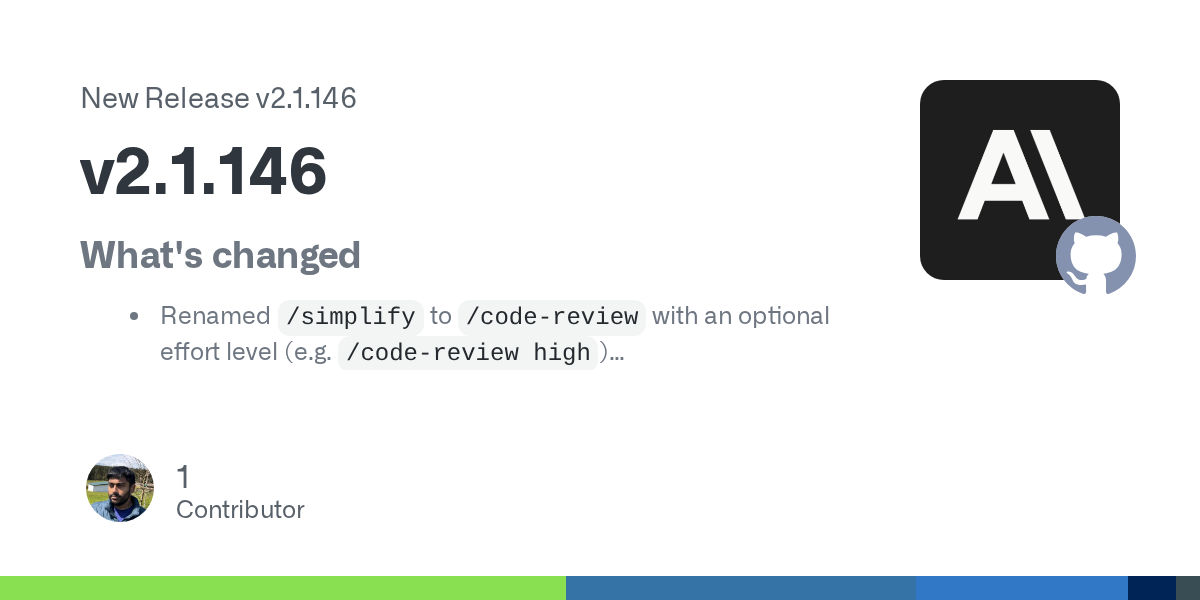
The headline change is cosmetic but revealing: /simplify is now /code-review, with optional effort levels such as /code-review high. Naming matters here because “simplify” sounded like an editing trick, while “code review” describes an actual engineering workflow. If Claude Code wants to be trusted as part of the PR path, the command surface should map to the way teams already reason about risk: review the diff, decide how hard to look, then ship or request changes.
Patch notes as an operations checklist
The rest of v2.1.146 reads like somebody dumped a week of real-world agent incidents into a changelog. Auto mode no longer suppresses AskUserQuestion when the user or a skill explicitly relies on it. Backgrounded sessions no longer re-prompt for tool permissions that were already granted with “don’t ask again.” /background no longer refuses sessions whose only typed input was a skill or custom slash command. CLAUDE_CODE_SUBAGENT_MODEL is now forwarded to child processes in multi-agent sessions.
Each item is small in isolation. Together they describe the trust boundary around unattended development work. If a user gives a permission grant and the background session forgets it, the runtime becomes noisy and operators start clicking through prompts. If a skill asks a question and Auto mode suppresses the question, the agent can proceed with a false assumption. If a child agent silently ignores the configured subagent model, a multi-agent workflow stops being reproducible. These are not paper cuts; they are places where the system’s stated policy and actual behavior drift apart.
The MCP pagination fix deserves special attention. Anthropic says resources/list, resources/templates/list, and prompts/list no longer drop items past page one on paginating servers. That sounds like ordinary connector plumbing until you remember what MCP is becoming: the inventory layer for tools, prompts, resources, databases, APIs, and internal systems that agents can use. If a server exposes 120 capabilities and the agent or administrator only sees the first page, governance becomes theater. You cannot review what you cannot enumerate.
There are two failure modes there. The agent may miss legitimate, safer, intended tools and instead improvise with worse ones. Or the operator may believe they have inspected the exposed surface when they have only seen a partial listing. Both are bad. Capability discovery in agent systems needs to be boringly correct because everything downstream — permissions, audit, documentation, and incident response — depends on it.
The enterprise line item is login policy
The most explicitly enterprise-shaped fix is that forceLoginOrgUUID and forceLoginMethod managed-settings policies are now enforced against third-party-provider and API-key sessions. This is the sort of bullet that will not trend on Hacker News and absolutely should matter to anyone rolling Claude Code into a company.
Managed login policy exists because organizations do not want developer tooling drifting into personal accounts, shadow providers, unmanaged API keys, or billing arrangements nobody can audit. A policy that applies only on the happy path is not a policy; it is a suggestion with nice stationery. Enforcing the same constraints against third-party-provider and API-key sessions closes a gap between “how the tool is supposed to be used” and “how a developer under deadline might actually get it working.”
That distinction is increasingly important because coding agents are no longer isolated assistants. They can call MCP servers, spawn child agents, run background jobs, edit worktrees, use plugins, hit internal APIs, and produce code that flows into production review. Identity is not a login screen detail. It is the root of attribution: who authorized this session, under which org, using which provider, with which settings, against which repository?
For security and platform teams, v2.1.146 belongs in the “upgrade before broader rollout” bucket if Claude Code is already used beyond one-off local experiments. After upgrading, do not merely check that the binary starts. Test the ugly paths: start a session with third-party-provider configuration and verify managed login policy still holds; try API-key flows; background a session after granting “don’t ask again”; dispatch a child agent and confirm the configured model propagates; connect an MCP server with enough resources or prompts to paginate; then inspect whether Claude sees the full inventory.
Windows is not an edge case anymore
The Windows fixes tell their own story. Claude Code fixed PowerShell execution when pwsh is installed via winget or the Microsoft Store, a regression introduced in v2.1.124. Attached background sessions no longer strobe full-screen in Windows Terminal while Claude streams output. Background-job worktree removal on Windows no longer follows NTFS junctions into the main repo.
This is the unglamorous part of making agent tooling real in enterprises: Windows fleets exist. NTFS junctions exist. Store-installed PowerShell exists. Terminals behave differently. Repos have filesystem weirdness. If an agent runtime is safe only on a pristine macOS laptop with a Unix shell and a clean Git worktree, it is not ready for the places where governance actually matters.
The NTFS junction fix is especially worth reading with a defensive mindset. Cleanup code is dangerous because it runs when the user thinks the work is done. Worktrees are supposed to isolate background jobs, but filesystem indirection can turn “remove the disposable workspace” into “touch the main repo” if the runtime follows the wrong path. The right agent platform should be conservative at filesystem boundaries. Clever cleanup is how you get a postmortem with a sentence everyone hates: “the tool deleted files outside the intended directory.”
Anthropic also improved native auto-updater reliability by retrying transient network failures, fixed the status line so it shows the current version when an update fails, and improved diff rendering performance for large file edits. Again, not glamorous. Also exactly the right work. An agent that edits large files needs diffs humans can review. An updater that fails under flaky networks needs to say what version is actually running. If teams cannot tell what binary produced a change, they cannot reason about behavior after the fact.
What engineers should do now
If you use Claude Code casually, v2.1.146 is a routine upgrade. If you use MCP, background sessions, Windows, managed settings, child agents, custom skills, or slash commands, it is more than that. It is a chance to turn the changelog into a regression test suite for your own agent operating model.
Start with inventory. List which MCP servers are connected, whether any paginate resources or prompts, and whether your review process sees the full surface. Then test identity. Confirm managed-login settings apply across provider paths, not just the default one. Next, test unattended work. Grant a permission with “don’t ask again,” background the session, detach or reattach if that is part of your workflow, and verify the permission behavior remains consistent. Finally, test multi-agent reproducibility by checking that child processes inherit the intended model and that logs make the lineage understandable.
The broader take is simple: Claude Code’s patch notes are becoming an operations manual. That is a compliment. Coding-agent maturity in 2026 is less about whether the model can write a plausible diff and more about whether the runtime preserves policy, inventory, filesystem safety, identity, and permission intent when humans are not staring at the terminal. v2.1.146 is a small release about big trust surfaces. Ship the patch, then test the boring paths. The boring paths are where production lives.
Sources: Claude Code GitHub release v2.1.146, Claude Code permission modes, Claude Code agent view docs, Claude Code MCP docs