Claude Code Prompt Diffs Are the Release Notes Your Agent Stack Actually Needs

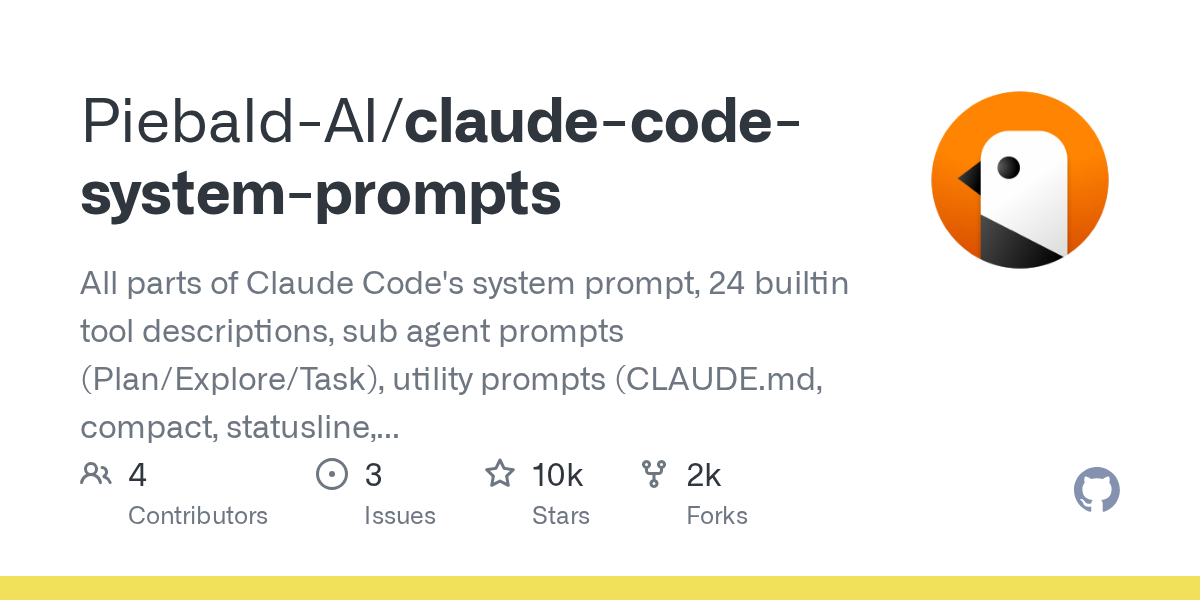
Claude Code has a new kind of unofficial release note, and it is not the one Anthropic publishes. It is the prompt diff: the quiet record of how the agent is being instructed to use Bash, review code, plan changes, summarize memory, classify background jobs, and negotiate the increasingly messy boundary between “assistant” and “automation surface.”
That is why Piebald-AI’s claude-code-system-prompts repository is worth more than a quick rubberneck. The repo updated again on May 9, within minutes of Claude Code v2.1.137, and now claims coverage for more than 110 strings across 174 Claude Code versions since v2.0.14. At research time it had 10,053 GitHub stars and 1,797 forks. That is not normal for a pile of extracted markdown unless developers have collectively realized something important: agent behavior is now a dependency.
The official Claude Code changelog tells you the product-level story. Piebald’s repo shows the instruction-level movement underneath it. The project says Claude Code does not have a single monolithic system prompt. It has conditional environment and configuration chunks, built-in tool descriptions, separate prompts for Explore and Plan agents, and utility prompts for compaction, CLAUDE.md creation, session title generation, WebFetch summarization, Bash command prefix detection, security review, memory synthesis, onboarding guides, managed-agent flows, and more. In other words, the agent is less one magic paragraph and more a small operating system of instructions.
Prompt drift is runtime drift
The May 9 update is small on paper. Manual GitHub API checks showed commit 648d3b3, “Update changelog for v2.1.137,” landing at 2026-05-09T00:19:01Z, after a5758c4, “v2.1.137 (+0 tokens),” at 00:15:08Z. The more interesting adjacent update is v2.1.136, which changed by +525 tokens on May 8. That is the sort of delta teams should learn to inspect when Claude Code suddenly feels better, worse, stricter, looser, or just different.
Software teams already understand this with libraries. If a dependency changes, you read the release notes, inspect the diff, check the API surface, and maybe pin the version if the risk is too high. Coding agents deserve the same treatment, because their prompts define part of the runtime contract. A change to a Bash command description prompt can alter what users think is about to run. A change to command-prefix detection can affect how injection is caught. A change to the security-review prompt can move the boundary between useful paranoia and checklist theater. A change to memory synthesis can decide which old project facts follow the agent into a new session.
This is not a theoretical concern. Claude Code now sits in workflows with MCP servers, plugins, hooks, managed agents, background jobs, scheduled tasks, worktrees, repo instructions, and enterprise policy settings. The user sees a conversational interface. Under the hood, the system is routing through a collection of instruction files and tool contracts that shape how much autonomy the agent believes it has. If those instructions change, the agent changed, even if the model name did not.
The useful part is not the “leak.” It is the inventory.
There is an obvious temptation to frame prompt repositories as voyeurism: someone extracted the hidden words and now everyone can gawk at the machinery. That misses the practical value. The real contribution is inventory. Piebald lists agent prompts for Explore, enhanced Plan mode, agent creation, CLAUDE.md generation, status-line setup, /batch, /review-pr, /schedule, /security-review, auto-mode rule review, background-agent classification, background-job instructions, Bash command description writing, Bash command prefix detection, memory synthesis, managed-agent onboarding, and more.
That inventory gives security reviewers and platform teams a map of what to care about. If a release changes the managed-agent onboarding prompt, check whether credential, file, or environment assumptions moved. If it changes the Bash injection detector, test your risky command patterns again. If it changes the security-review prompt, compare findings before and after on a known vulnerable sample. If it changes WebFetch summarization or memory selection, think about whether untrusted content can steer the agent’s next move.
The repository also points to tweakcc, a tool for modifying local Claude Code prompt pieces and patching npm-based or native installations with diff and conflict handling. That is powerful, and it is also where teams should slow down. Local prompt patching is great for research, experiments, and power users who own the blast radius. It is a supportability problem in shared environments. Once every developer has a slightly different agent instruction stack, debugging “Claude did the wrong thing” becomes a forensic exercise.
The safer enterprise pattern is boring: use prompt diffs for audit and diagnosis, then express sanctioned behavior through official surfaces — managed settings, permissions, hooks, skills, repo instructions, and policy. If you do patch prompts, version the patch, review it like code, document why it exists, and make rollback one command. Anything less is artisanal production infrastructure, which is a phrase that should make incident responders reach for coffee.
Agent observability needs to include instructions
The industry’s observability story for coding agents is still immature. We log tool calls, token usage, latency, and sometimes user feedback. That is necessary, but it is incomplete. If you cannot correlate a behavior change with the prompt layer, you are debugging shadows. “The model got worse” is often the least useful explanation. Maybe the system prompt changed. Maybe a tool description changed. Maybe a memory-selection utility got stricter. Maybe a background-agent classifier now marks more sessions as blocked. Maybe a security prompt started emphasizing a different class of risk.
For practitioners, the action item is straightforward. If Claude Code is operationally important to your team, subscribe to prompt diffs the way you subscribe to dependency advisories. After unexplained behavior changes, compare prompt deltas alongside version, model, settings, hooks, MCP server list, and repo instruction changes. Include tool prompt changes in security reviews when they touch Bash, WebFetch, permissions, memory, managed agents, or autonomous actions. And do not let local customization drift quietly across the team.
The broader point is uncomfortable but useful: prompts are no longer disposable strings. They are part of the control plane. They shape authorization, observability, safety, workflow quality, and developer trust. Official changelogs will keep telling the product story. Prompt diffs tell the runtime story. Teams that depend on coding agents should read both.
Sources: Piebald-AI/claude-code-system-prompts, GitHub commit feed, Claude Code changelog, Claude Code overview