Claude Code’s System Prompts Are Now a Changefeed for Agent Governance

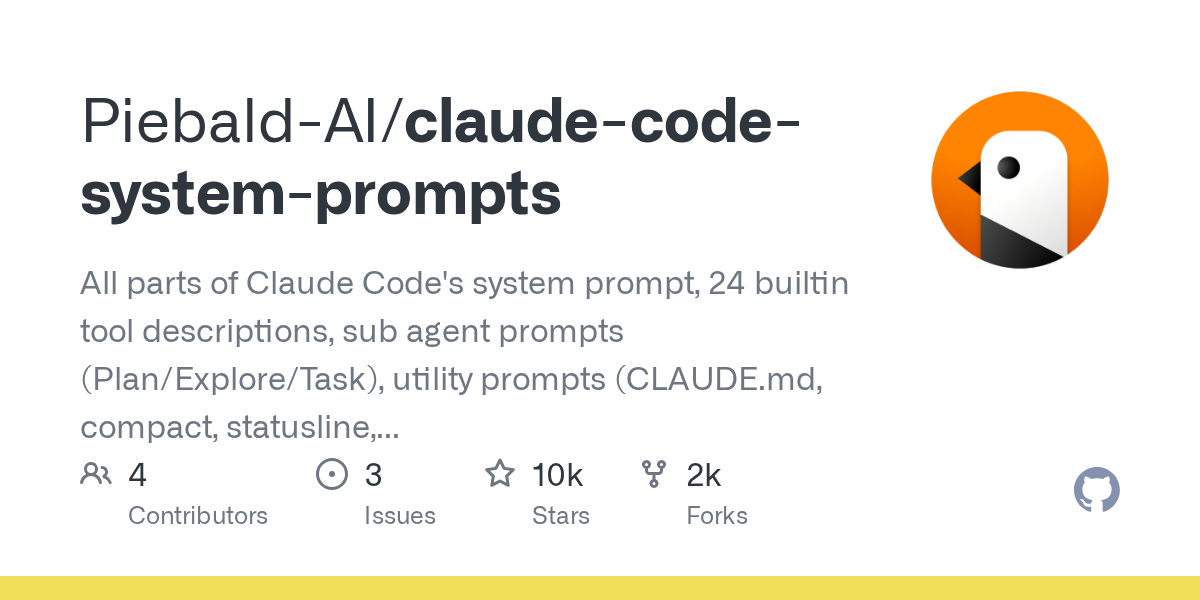
The most important Claude Code changelog this week did not come from Anthropic’s marketing team. It came from a third-party GitHub repository that diffs the text Claude Code carries inside itself: system prompts, tool descriptions, sub-agent instructions, compaction prompts, security-review language, slash-command behavior, and the quiet policy glue that determines how the agent acts when nobody is watching the raw prompt stream.
That sounds like trivia until you remember what modern coding agents actually are. They are not just binaries. They are product code plus model weights plus configuration plus policy text plus runtime tools. The policy text is where a surprising amount of behavior lives: when to ask for confirmation, what counts as risky, whether a background job may report success, how a security monitor thinks about exfiltration, and how a sub-agent should hand results back to its parent.
Piebald-AI’s claude-code-system-prompts repo makes that layer visible. As of Claude Code v2.1.138, the repo tracks more than 110 extracted prompt strings across 175 versions since v2.0.14. Its GitHub metadata is not niche curiosity either: the repo shows more than 10,000 stars, roughly 1,800 forks, and recent activity tied to Claude Code’s May 2026 release train. Developers are not starring a prompt-diff repo because it is decorative. They are doing it because agent behavior is becoming operational state.
Prompt diffs are dependency diffs now
The latest relevant commit, 6297f70, updates the changelog for Claude Code v2.1.138. That release reportedly has no prompt changes from v2.1.137, which is almost the least interesting part. The surrounding versions tell the story.
In v2.1.136, the extracted changelog says Claude Code added about 525 tokens, including a new “Action safety and truthful reporting” system prompt. That prompt requires confirmation for irreversible or outward-facing actions, inspection before deletes and overwrites, and honest reporting of skipped steps, failed tests, and verified outcomes. Good. Also: exactly the kind of behavior a team would want to know changed before letting an agent operate inside production-adjacent repositories.
The same version added settings.autoMode.hard_deny as a fourth custom-rule category for unconditional security-boundary blocks. It also moved data exfiltration into hard-block rules and treated agent-guessed external services or download sources as untrusted. Read that again with an engineering manager’s hat on: your agent’s interpretation of “safe enough to run automatically” just changed through a combination of settings surface and prompt language. If you only audit the YAML and never audit the prompt surface, your control plane has a blind spot wearing a friendly CLI mascot costume.
In v2.1.132, the diff reportedly added 6,720 tokens for Managed Agents: multiagent sessions, outcomes, webhooks, proactive schedule-offer gates, session-thread APIs, MCP OAuth credential validation, and a skill-limit change from 64 to 20 skills per agent. That is not “Claude can autocomplete a function better.” That is the vocabulary of a distributed agent platform. Threads, rosters, outcomes, webhooks, credentials, schedules — these are systems concerns, not chat concerns.
And v2.1.128 added another 1,406 tokens around background-job agent instructions, remote-trigger tool prompts for scheduled remote routines, and changes to how agent threads report results directly rather than writing markdown files for parent agents. Again: operational semantics. The agent is learning how to do work when the human is not sitting there babysitting every turn.
The hidden policy layer is still policy
Engineering teams already know how to review dependency updates. They diff lockfiles, pin GitHub Actions, scan Docker images, and panic appropriately when a CI workflow suddenly gains a deploy token. But coding-agent behavior often changes through a softer path: a vendor ships new prompt text, tool descriptions, or runtime instructions that shape the model’s decisions. That text may never appear in your repository, but it can still affect your repository.
This is why prompt diffing is becoming a real practice. Not because every team should fork Claude Code’s internal prompts and role-play as Anthropic. That would be a maintenance trap with better typography. The useful move is simpler: monitor what changed, decide whether it touches your risk model, and map it back to controls you own.
If a prompt update changes irreversible-action handling, review your approval modes. If a security-monitor prompt tightens data-exfiltration rules, check whether your own CLAUDE.md, hooks, and MCP config align with that boundary or accidentally punch holes through it. If Managed Agents gain new scheduling or webhook behavior, ask who can create schedules, where outputs are delivered, and whether those outputs can trigger follow-on automation. If skill-selection limits change, check whether your team’s “approved skills” story still works or whether the agent is now choosing from a different menu than you thought.
The practical implication is uncomfortable but useful: prompt text belongs in the same mental bucket as CI configuration and editor extensions. It may not be executable in the classic sense, but it can alter execution. A prompt that teaches an agent to trust a newly discovered external service, write durable repo instructions, or classify a command as safe is not just documentation. It is behavior.
What teams should do before this gets messy
Start by treating agent upgrades as reviewable changes, not background noise. If your company lets Claude Code touch serious code, maintain a lightweight upgrade note: CLI version, major prompt-surface changes, approval-mode changes, MCP/tooling changes, and any new managed-agent or scheduling capabilities. You do not need a 40-page governance PDF. You need enough discipline that, when something weird happens, someone can answer “what changed?” without spelunking Slack.
Second, keep repo-level instructions boring. This is the opposite of the power-user instinct. When vendor prompts are already evolving quickly, your CLAUDE.md, skills, hooks, and MCP config should be short, explicit, and testable. Prefer “run pnpm test before claiming success” over a philosophical essay about craftsmanship. Prefer hard denies for credential files, deployment commands, destructive database operations, and package publishing over trusting the model to infer your appetite for chaos.
Third, separate instruction-only assets from assets that can execute or expand reach. A markdown skill that explains your migration workflow is one risk class. A skill with scripts, hooks, MCP assumptions, OAuth scopes, or external service access is another. Treat the latter like a dependency with permissions. Review it, version it, and log when it is used.
Finally, test agent behavior adversarially. Give it a repo with a malicious README, a suspicious .mcp.json, fake credential files, a poisoned “policy” document, and a task that tempts it to reach outside the workspace. Then see whether your combination of vendor defaults, local instructions, and hard-deny rules actually holds. If it only works when everyone is honest, it is not a security boundary. It is onboarding material.
The Piebald repo is unofficial, extracted, and therefore not a contractual source of truth. That caveat matters. But unofficial observability is still observability. Security teams have long learned from reverse engineering, reproducible builds, and community-maintained diffs when vendors did not expose enough detail. Coding agents are entering the same phase.
The editorial take is simple: prompt diffs are now part of agent operations hygiene. If your coding agent’s safety rules, background-work behavior, scheduling semantics, and managed-agent coordination live partly in versioned text, serious teams need to watch that text. The model is the flashy part. The behavior change that bites you will probably arrive as a quiet prompt update.
Sources: GitHub — Piebald-AI/claude-code-system-prompts, Piebald changelog commit for Claude Code v2.1.138, Anthropic Claude Code npm package v2.1.138, Claude Code Week 19 docs