Coherent’s Texas Expansion Is the Unsexy Part of AI Scaling That Actually Decides the Rack

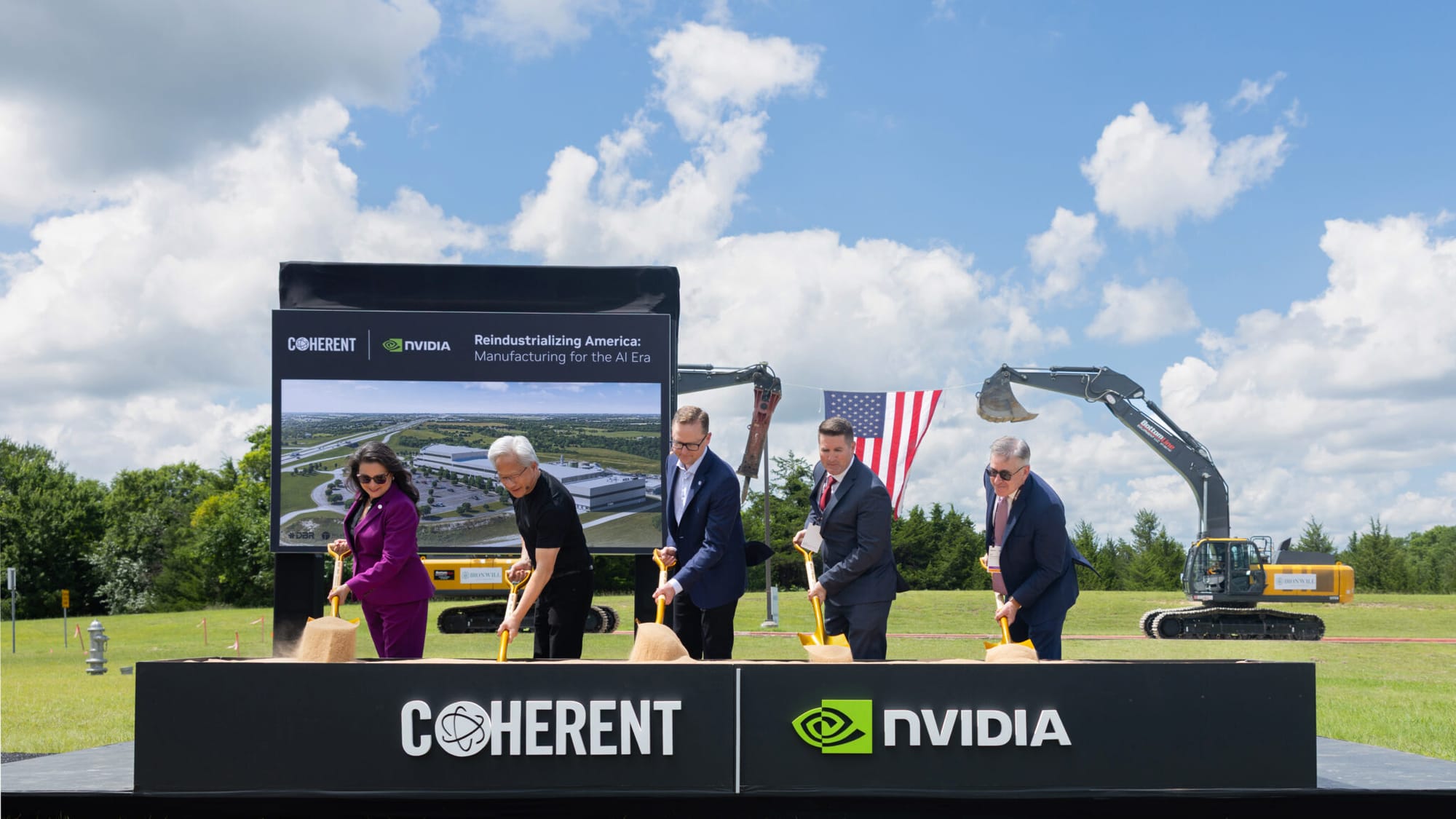
AI infrastructure usually gets sold as a GPU story because GPUs are the expensive thing everyone can point at. Coherent’s Sherman, Texas expansion is a useful correction: at rack scale, the expensive thing is increasingly the stuff that lets the GPUs behave like one machine instead of thousands of very hot islands yelling across copper.
NVIDIA’s post on Coherent breaking ground at its expanded indium phosphide photonics facility is not glamorous in the model-launch sense. There is no chatbot demo, no benchmark leaderboard, no “frontier” claim doing interpretive dance. But it may be one of the more important NVIDIA infrastructure stories of the week because it explains what has to be true for the Blackwell-to-Rubin roadmap to work outside a slide deck.
Coherent says the Sherman site already hosts the world’s first and largest volume-production 6-inch indium phosphide manufacturing platform. The expansion comes with a new U.S. Department of Commerce CHIPS Act letter of intent for up to $50 million in direct funding, plus earlier support from Texas and local economic-development programs. Coherent says the project will more than double manufacturing production space, quadruple wafer production capacity and eventually create more than 1,000 jobs, including more than 550 direct advanced manufacturing, engineering and technical roles.
Those numbers matter because NVIDIA is no longer treating optical components as commodity plumbing. In March, NVIDIA and Coherent announced a strategic partnership that included a $2 billion NVIDIA investment in Coherent, a multibillion-dollar purchase commitment and future access rights for advanced laser and optical networking products. That is not a casual supplier relationship. That is NVIDIA looking at its rack-scale roadmap and deciding the light source deserves board-level attention.
The rack is now a networking problem with GPUs attached
The concrete architecture example is Vera Rubin Ultra NVL576: eight NVLink racks, each with 72 Rubin Ultra GPUs, joined into a 576-GPU domain. Jensen Huang’s point at the groundbreaking was straightforward: copper cannot carry signals across those rack distances efficiently enough for where NVIDIA wants AI factories to go. The further signals travel and the faster they switch, the more copper asks for retimers, power, signal conditioning and patience. AI factories are not famous for having spare power or patience.
Optics changes the tradeoff. Converting an electrical signal to light has a cost, but once the signal is optical, distance becomes much cheaper than repeatedly nursing high-speed electrical signals across racks. That is why indium phosphide lasers, external laser modules, co-packaged optics and high-volume photonics manufacturing are suddenly strategic. They are not accessories to the GPU business. They are the physical layer that determines whether the next GPU domain can actually be built.
Coherent CEO Jim Anderson put it cleanly: “AI runs on compute, but it scales on connectivity — and Sherman is where that connective tissue gets built.” It is the sort of quote that sounds like conference copy until you map it to the failure mode. A cluster with great accelerators and weak connectivity is not a supercomputer. It is a utilization problem wearing a capex invoice.
The 6-inch wafer detail is also more than manufacturing trivia. Wafer area scales with diameter squared, so a 6-inch wafer offers roughly four times the usable area of a 3-inch wafer. In a market where every Rubin-era system wants more high-speed optics, that can translate into better component volume and a less punishing cost curve. It does not guarantee yield, qualification or delivery cadence, but it tells you why NVIDIA cares about the manufacturing base and not just the switch SKU.
Why builders should care about a photonics factory
Most engineering teams will never buy indium phosphide wafers. They will, however, live with the consequences of the systems those wafers enable. Training large mixture-of-experts models, serving high-throughput inference and running multi-rack AI factories all depend on communication patterns that can make or break utilization. Expert parallelism, tensor parallelism, distributed checkpointing and large-scale retrieval do not care how impressive the GPU spec sheet looks if the fabric becomes the bottleneck.
The practical lesson is to design AI infrastructure from topology backward. Start with the workload: dense model, MoE, retrieval-heavy inference, video generation, simulation, batch training, latency-sensitive serving. Then ask what the communication pattern demands, what the failure domains look like, how much power the network consumes, where optical reach becomes necessary and how the platform handles congestion. “Fast GPUs plus some networking” is no longer a plan. It is how expensive accelerators end up waiting on the fabric.
This also explains NVIDIA’s broader platform behavior. Spectrum-X Photonics and Quantum-X Photonics are not random networking products. They are part of the same control-plane logic that made CUDA sticky: own enough of the stack that performance tuning, procurement and operational assumptions all point back to NVIDIA. If the system roadmap depends on guaranteed optical supply, then investing in Coherent is not optional vertical integration cosplay. It is supply-chain risk management.
There is a caution here. Domestic manufacturing announcements are often better at promising capacity than delivering qualified components on schedule. A CHIPS Act letter of intent is not a production wafer, and quadrupling capacity still has to survive yield learning, customer qualification and the brutal timing pressure of AI hardware ramps. Coherent has a stronger claim than most because Sherman is an existing line with a long NVIDIA relationship, but the proof will be whether optical capacity arrives in time for Rubin-era deployments rather than becoming another constraint renamed as strategy.
The editorial read: AI scaling is becoming a light problem. Blackwell and Rubin get the headlines, but lasers, optics and data-center fabrics decide whether those chips behave like an AI factory or a pile of expensive thermal events. NVIDIA is buying the flashlight factory because the next rack-scale bottleneck is not only silicon. It is connectivity.
Sources: NVIDIA Blog, Coherent, NVIDIA Newsroom