Copilot Auto Model Selection Turns the Model Picker Into Policy

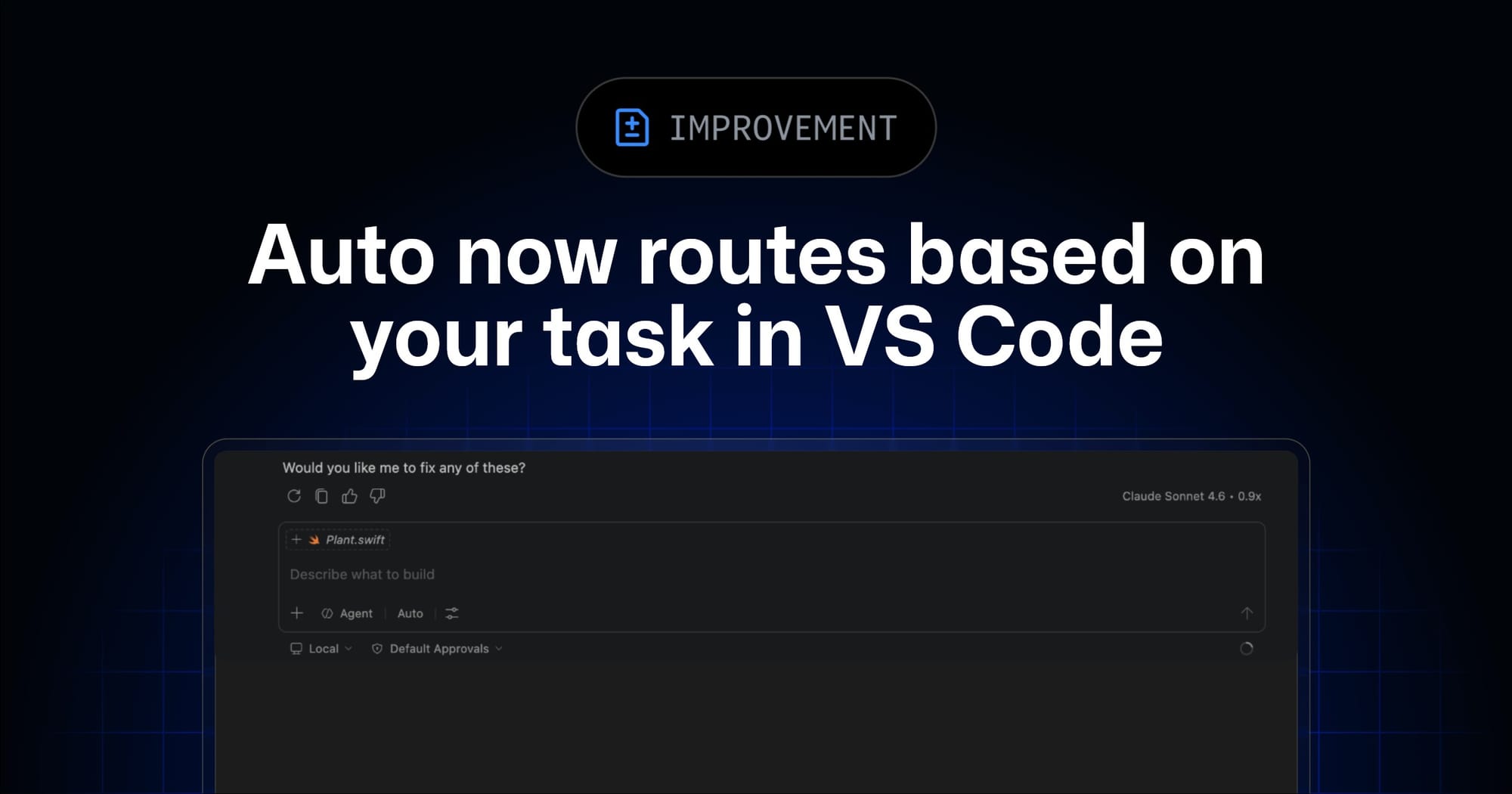
GitHub Copilot’s Auto button used to feel like a convenience setting. Now it is starting to look like the actual product.
GitHub says Copilot auto model selection in VS Code now routes based on the task itself, not just model availability. The router weighs real-time utilization and model-health signals, then evaluates the work across dimensions like reasoning need, code-generation complexity, bug-diagnosis difficulty, and tool-orchestration requirements. That sounds like a small improvement to a dropdown. It is not. It is GitHub moving model choice out of the hands of every individual developer and into a managed control plane where quality, cost, reliability, admin policy, and cache behavior all meet.
This is the right direction, mostly because the old direction was unsustainable. The modern Copilot model picker is not a simple “fast versus smart” choice. It is a shifting matrix of OpenAI, Anthropic, Google, Codex-tuned models, client-specific availability, request multipliers, enterprise policy gates, data residency constraints, FedRAMP restrictions, and deprecation schedules. GitHub’s own supported-model docs now list GPT-4.1, GPT-5.2, and GPT-5.2-Codex as closing down June 1, 2026, while GPT-5.3-Codex and GPT-5.4 are generally available. If developers need a weekly briefing just to pick a chat model, the platform has already failed the human-factors review.
The model picker was never going to scale
The core promise of Auto is simple: choose an allowed model that is good enough for the task, healthy enough right now, and economical enough not to burn the team’s budget on work that did not need a premium reasoning model. GitHub says Auto currently limits selection to models with 0x to 1x premium request multipliers. Paid Copilot users also get a 10% discount when Auto is used in Copilot Chat, Copilot CLI, or Copilot cloud agent; a 1x model selected by Auto draws down 0.9 premium requests instead of 1. That is not a marketing footnote. That is a product incentive telling teams: stop pinning expensive models by default unless you have evidence.
The policy layer matters just as much as the routing. Auto honors organization and enterprise model policies, including admin-disabled models, subscription availability, data-residency restrictions, and FedRAMP-compliant model restrictions. Users can hover over a model response to see which model Auto used, and they can still switch from Auto to a specific model. Those three properties — policy-aware routing, transparency, and manual override — are what keep this from becoming a black box with a Copilot logo.
Enterprise AI adoption keeps rediscovering the same lesson: autonomy is only acceptable when it is bounded. If Auto silently selected from every model GitHub can access, this would be a compliance problem with nice UX. If Auto refused to disclose what it used, debugging quality issues would become folklore. If Auto prevented override, senior engineers would immediately work around it. GitHub appears to be threading the practical path: make the default smarter, but keep the operating envelope visible.
Cache boundaries are the boring detail that matters
The most interesting sentence in GitHub’s changelog is the one about routing along natural cache boundaries. Agentic coding is not a sequence of unrelated prompts. It is a context-heavy session: files are read, tools are called, decisions accumulate, test output enters the conversation, and the next answer depends on the last five steps. Switching models mid-session can blow away cache locality, increase cost, and sometimes degrade continuity. The model router is therefore not just picking a brain. It is managing a session’s economics.
That is where model routing starts to resemble infrastructure. A team running Copilot at scale should care less about leaderboard drama and more about accepted-diff rate per dollar, latency under load, recovery from model incidents, and whether the router keeps long-running agent sessions on a stable path. The mature question is not “which model is best?” It is “which routing policy produces the best engineering throughput under our constraints?” That is a less fun question for social media and a much better one for people paying the invoice.
There is also an architectural parallel here with traffic routing in distributed systems. We already expect production platforms to route requests based on health, latency, cost, region, and policy. We do not ask every application developer to manually pick the least-bad backend instance before sending an HTTP request. Copilot is moving toward the same abstraction for coding models. The model is becoming a backend, not a personality.
How teams should actually use this
The mistake would be treating Auto as magic. It is a routing feature, not an accountability transfer. GitHub can estimate whether a task looks like bug diagnosis, code generation, or tool orchestration. It cannot know that your authentication middleware has a historical footgun unless the repository context, docs, tests, or prompt expose it. “Fix this flaky test” and “change tenant isolation semantics” may both look like coding tasks from far enough away. Only one should be delegated casually.
Platform teams should test Auto the way they would test a new CI runner, not the way they would test a theme preference. Build a small internal evaluation set from real work: small refactors, test generation, codebase Q&A, bug diagnosis, dependency upgrades, agent-mode tasks, and a few high-risk changes touching auth, concurrency, migrations, or public APIs. Compare Auto against pinned models. Track accepted suggestions, reviewer edits, test pass rate, time to useful answer, rate-limit behavior, and premium-request burn. If Auto wins on low- and medium-risk work, make it the recommended default. If it misses on a task class, document when engineers should pin a stronger model.
Managers should also separate “default” from “allowed.” Auto avoiding models above a 1x multiplier is sensible, but some tasks may justify expensive reasoning models. The policy should not be “never use premium models.” It should be “use them deliberately, with a task class and expected return.” Security-sensitive refactors, complex migrations, and design-heavy debugging may deserve a pinned high-capability model. Boilerplate test updates probably do not.
There is one more governance wrinkle: reproducibility. If Copilot chooses a model dynamically based on health and policy, two engineers may receive different results for similar prompts on different days. That is fine if teams treat Copilot output as reviewed work. It is less fine if they paste answers into runbooks, incident reviews, or architecture decisions without noting the model used. The hover disclosure helps, but teams should normalize capturing the model when output becomes durable guidance.
The broader story is that Copilot is becoming less about any single model and more about the managed layer around models. GitHub owns the IDE surface, the chat surface, the cloud-agent workflow, the billing abstraction, the admin policy, the model documentation, and increasingly the router. That is where enterprise leverage lives. Developers should not have to become model economists before writing a test. Admins should not have to trust every developer to pick the cheapest reliable option. Auto model selection is the obvious bridge.
The take: this is Copilot growing up. The best enterprise coding assistant will not be the one with the longest model menu. It will be the one that routes intelligently, exposes what happened, respects policy, and lets engineers override the default when judgment matters. The model picker is not dead, but it is being demoted. Good.
Sources: GitHub Changelog, GitHub Docs: auto model selection, GitHub Docs: supported models, GitHub Docs: Copilot request multipliers