Copilot Chat Finally Gets Agent Memory. Now Teams Need Session Hygiene.

Copilot cloud agent just became harder to ignore, which is both the point and the problem.
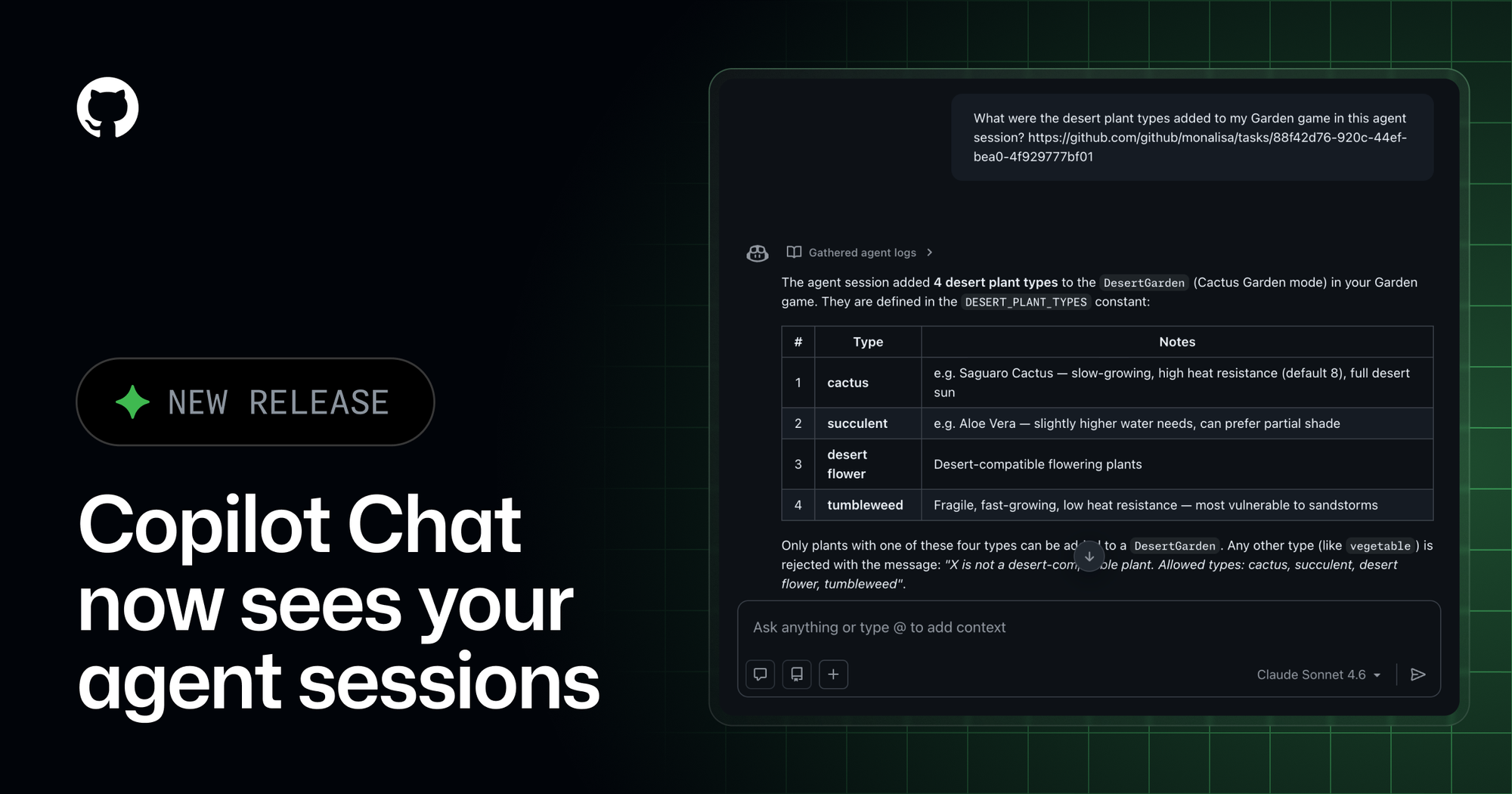
GitHub has updated Copilot Chat on the web so it can see the status of Copilot cloud agent sessions, answer questions about completed sessions, retrieve agent logs, and search past sessions by topic, title, or recency. On paper, that is a UX improvement. In practice, it moves Copilot’s asynchronous agent work from “some tab I opened earlier” into the main conversational surface where engineers already ask for help, start tasks, and negotiate context.
That matters because detached agents create detached accountability. A developer asks an agent to investigate a bug, the agent opens a pull request, CI runs, a reviewer notices a surprising change, and suddenly everyone is trying to reconstruct what the agent thought it was doing. Before this update, the answer often lived in a session log or activity view outside the flow of conversation. Now GitHub is making the session itself queryable from Chat.
Agent memory is useful only if teams treat it as evidence
The new behavior covers in-progress sessions started from Copilot Chat, including requests to create a session, create a pull request, or run deep research on a repository. Completed sessions can be queried after the fact. GitHub also names two concrete tools: Get agent logs and Session search. Session search can find and summarize prior sessions by topic, title, or recency.
That is exactly the kind of feature agent workflows need if they are going to survive contact with real teams. Modern engineering work is already fragmented across issues, pull requests, Actions logs, Slack threads, docs, and IDE state. Adding autonomous or semi-autonomous coding sessions without a retrieval layer makes the mess worse. A chat-native way to ask “what did the agent validate before opening this PR?” or “find the session where we tried the Redis migration” is not a gimmick. It is operational memory.
But operational memory is not the same thing as operational truth. Agent logs can explain intent. They can show which files the agent inspected, what commands it claims to have run, and why it chose one implementation path over another. They should not become the system of record for correctness. If Copilot says tests passed, CI should still be the source of truth. If it says a permission check is safe, a human reviewer still needs to read the diff with the actual threat model in mind. If it summarizes a previous session, that summary is a map, not the territory.
The right pattern is layered: use Chat to recover context, logs to reconstruct intent, CI and security tooling to validate facts, and pull request review to make the decision. Teams that collapse those layers into “the agent said it was fine” are not adopting AI. They are deleting review discipline and calling it productivity.
The feature quietly changes cost behavior
There is a billing story hiding inside the workflow story. GitHub’s own documentation frames Copilot cloud agent as running asynchronously in a GitHub Actions-powered development environment. It can inspect code, modify branches, run tests or linters, and produce commits and pull requests. That agent work consumes GitHub Actions minutes and AI credits. For Business and Enterprise, GitHub defines 1 AI credit as $0.01, with Copilot Business including 1,900 credits per user per month and Enterprise including 3,900 credits per user per month. Existing customers also get promotional June-through-September 2026 pools of 3,000 and 7,000 credits respectively.
Making sessions searchable and resumable from Chat will probably increase usage. That is not a bug; it is the growth loop. If the agent is easier to inspect, developers will be more willing to start it. If sessions can be resumed conversationally, developers will ask more follow-up questions. If logs are one prompt away, managers and reviewers will ask the chat box to explain work instead of opening the underlying artifacts.
That can be a good trade. A searchable session history is much better than orphaned agent work. But administrators need to classify agent activity before it becomes invisible spend. A cheap chat question, a deep repository research task, a pull-request-generating cloud session, and a long follow-up over agent logs are different budget events. They should not be treated as one vague category called “Copilot usage.”
Engineering leaders should define norms now: when should a developer start a cloud agent instead of doing the work locally? Which repositories are approved for agent sessions? Which tasks require human approval before a PR is opened? How are credits monitored per team, repo, or workflow? Who reviews failed or abandoned sessions? If those questions sound bureaucratic, wait until a high-context agent workflow burns through credits while producing five nearly-correct pull requests nobody asked for.
Session hygiene is the new prompt hygiene
The practical advice is boring and useful. Name sessions clearly. Tie them to issues when possible. Ask agents to state assumptions before they edit. Require them to run explicit validation commands and include the results in the pull request. Use session search for continuity, not as a substitute for documentation. Treat agent logs as review material, especially for security-sensitive or architecture-affecting changes.
Teams should also decide how long agent-session history should be retained and who can query it. Searchable logs can contain code snippets, environment details, failed attempts, internal naming, and sometimes embarrassing but important context. That is useful for debugging and audit. It is also a records-management problem. If agent sessions become part of the engineering record, they need the same seriousness teams apply to CI logs, PR discussions, and incident notes.
The larger product direction is clear. GitHub is turning Copilot Chat into the front door for agent orchestration: start work, inspect status, ask what happened, retrieve logs, and search prior attempts. That is the right direction if cloud agents are going to become team infrastructure rather than novelty tasks. The risk is that the chat surface makes agent work feel casual when the side effects are not casual at all.
My take: this is one of those small changelog entries that matters more than a flashy model announcement. Searchable sessions and log retrieval are the connective tissue agent workflows were missing. Just do not confuse connective tissue with a spine. The spine is still verification, review, cost controls, and clear ownership.
Sources: GitHub Changelog, GitHub Community discussion #198551, GitHub Docs: About Copilot cloud agent, GitHub Docs: usage-based billing