Copilot CLI’s Latest Releases Are Small Changelog Lines With a Big Enterprise-Agent Pattern.

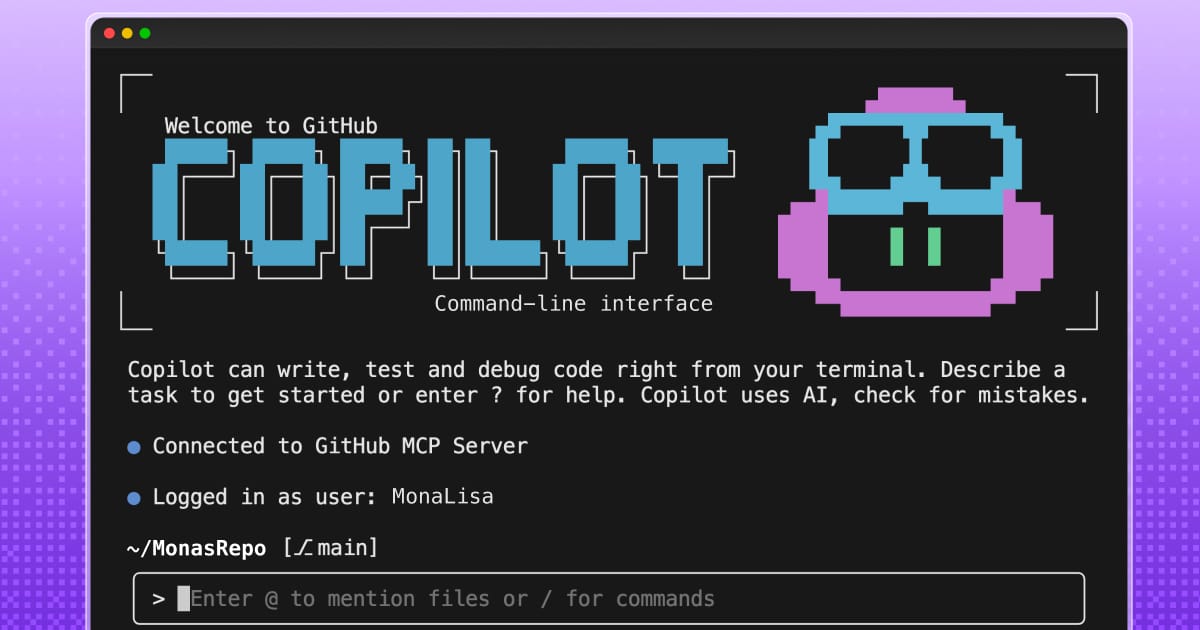
GitHub’s latest Copilot CLI releases look like routine changelog lint: a slash command here, a Windows fix there, a token-price display, a globbing correction. That is the wrong read. The May 11-14 release cluster is a map of where terminal coding agents are headed: less prompt toy, more enterprise runtime.
The visible changes are small. GitHub added or refined /autopilot, /fork, cloud-agent resume behavior, token-price display, model-picker behavior, instruction-file globbing, Azure DevOps-only workspace handling, terminal rendering, and OpenTelemetry output aligned with GenAI semantic conventions. None of that will trend on Hacker News unless it breaks something. But for platform and security teams trying to decide whether agentic coding can be allowed near real repositories, these are exactly the pieces that matter.
A coding agent is not just a model call. It is a loop: read context, plan, call tools, edit files, run commands, observe output, ask for approval, resume later, maybe fork work, maybe open a PR, maybe call MCP servers, maybe burn a surprising amount of budget. The hard part is not making that loop impressive in a demo. The hard part is making it observable, governable, scoped, and recoverable when thousands of developers use it against messy codebases.
Autopilot is a policy boundary
The new /autopilot command toggles interactive and autopilot modes. That sounds like a convenience feature until you remember what autopilot means in practice: the agent gets more room to continue without asking. Every mature agent surface is going to need this kind of explicit mode switch because autonomy is not a vibe; it is a policy state.
Teams should treat these modes like they treat deployment environments. What can the agent do in interactive mode? What can it do in autopilot? Which commands are auto-approved? Which file paths are protected? Does network access require confirmation? Are package installs treated differently from test runs? Does the policy change in a production repo versus a toy repo? If the answer is “developers will know when to be careful,” congratulations, you have reinvented production SSH with a chatbot attached.
GitHub’s May 12 release also auto-approves read-only gh CLI commands such as list, view, status, and diff. That is the right kind of friction reduction. Not every command deserves a modal. Read-only inspection should be cheap; mutation should be explicit. The future of agent UX is not asking permission for everything. It is asking permission for the right things, with enough context that approval means something.
Observability is the difference between automation and archaeology
The OpenTelemetry changes are the real signal. GitHub says Copilot CLI output now aligns with GenAI semantic conventions, MCP tool calls use standard tool_call spans, a new gen_ai.client.operation.duration metric tracks tool execution time, and the agentStop hook now fires correctly when the agent stops via task_complete. GitHub’s docs also describe Copilot SDK support for configuring OpenTelemetry on the CLI process and propagating W3C Trace Context between SDK and CLI.
This matters because agent failures do not look like ordinary application failures. A bad run might include a misleading retrieval, a wrong model assumption, a tool call with stale credentials, an MCP server returning unexpected data, a shell command that passed locally and failed in CI, or an approval granted with incomplete context. Without traces, teams get a diff and a shrug. With traces, they can reconstruct the path: model call, tool call, duration, token usage, exception, approval, file change, and stop condition.
The OpenTelemetry GenAI semantic conventions are still marked as development, so nobody should pretend the standard is settled. But waiting for perfect standards is how engineering organizations end up with six incompatible audit logs and no incident timeline. If Copilot CLI can emit useful spans now, SRE and security teams can start wiring agent runs into the observability estate they already operate. That is far better than treating agent telemetry as a vendor-dashboard island.
The GitHub issue requesting OTel visibility into agent interactions, LLM calls, tool executions, and token usage was exactly right. Agent observability is not a nice-to-have once agents can change code. It is audit evidence.
Repo instructions are a supply-chain surface
Instruction-file globbing is another boring change with sharp edges. GitHub fixed cases where unquoted glob patterns in applyTo frontmatter, such as **/*.ts, did not apply correctly. It also stopped injecting YAML frontmatter metadata from skill content into the model context. These look like implementation details until you remember that repo-local instructions shape the agent’s behavior.
If an instruction applies too broadly, conventions leak into the wrong part of the repo. If it fails to apply, tests may be skipped, security rules may be ignored, or architecture boundaries may disappear from the agent’s context. If metadata gets injected where the model treats it as guidance, scaffolding can become behavior. AGENTS.md, skill files, and scoped instructions are no longer documentation in the old passive sense. They are operational inputs to code generation. They need owners, review, and change control.
This is also why the Azure DevOps-only workspace fix matters. GitHub’s built-in MCP server is now auto-disabled in Azure DevOps-only workspaces when running in prompt/headless mode, matching interactive behavior. Many enterprises do not live entirely inside GitHub. They have Azure DevOps, GitHub, internal build systems, legacy CLIs, private package feeds, and permission boundaries that product pages flatten into diagrams. Environment-aware tool control is what keeps a terminal agent from assuming the wrong company.
What to evaluate before standardizing
For teams comparing Copilot CLI, Codex, Claude Code, Gemini CLI, and local agents, the evaluation checklist should change. Do not stop at “which model writes the nicest function?” Ask whether the tool exposes approvals clearly, logs tool calls, respects repo scopes, supports your identity model, handles non-GitHub environments, resumes long-running work safely, prices usage visibly, exports traces, and lets security query what happened after the fact.
Token-price display in the model picker is not cosmetic. Agentic coding can run long, branch work, retry plans, and generate large diffs. Spend feedback belongs in the workflow, not in a finance surprise 30 days later. /fork and --resume are similarly practical: agents need to branch and continue work without losing the audit thread. Long-running autonomy without continuity is just a pile of half-finished chats.
Copilot CLI’s latest releases are incremental. That is fine. Infrastructure usually arrives incrementally, one “small” changelog line at a time. The pattern is what matters: autonomy controls, scoped instructions, MCP tool governance, Azure DevOps context awareness, spend visibility, and OpenTelemetry. GitHub is not just polishing a terminal assistant. It is building the runtime evidence enterprises will need before they trust autonomous code changes at scale.
The agent that wins the demo may not be the agent that survives production. The survivor will be the one that can explain itself when the diff is wrong, the command was risky, the bill is high, or the security team asks what happened. Copilot CLI is quietly moving in that direction. That is more important than another benchmark screenshot.
Sources: GitHub Copilot CLI releases, GitHub Copilot CLI, GitHub Docs on Copilot SDK OpenTelemetry, OpenTelemetry GenAI semantic conventions, GitHub issue #1911