Copilot Memory Is Becoming a Cross-Repo Preference Layer, Which Is Useful Right Up Until It Becomes Invisible Policy

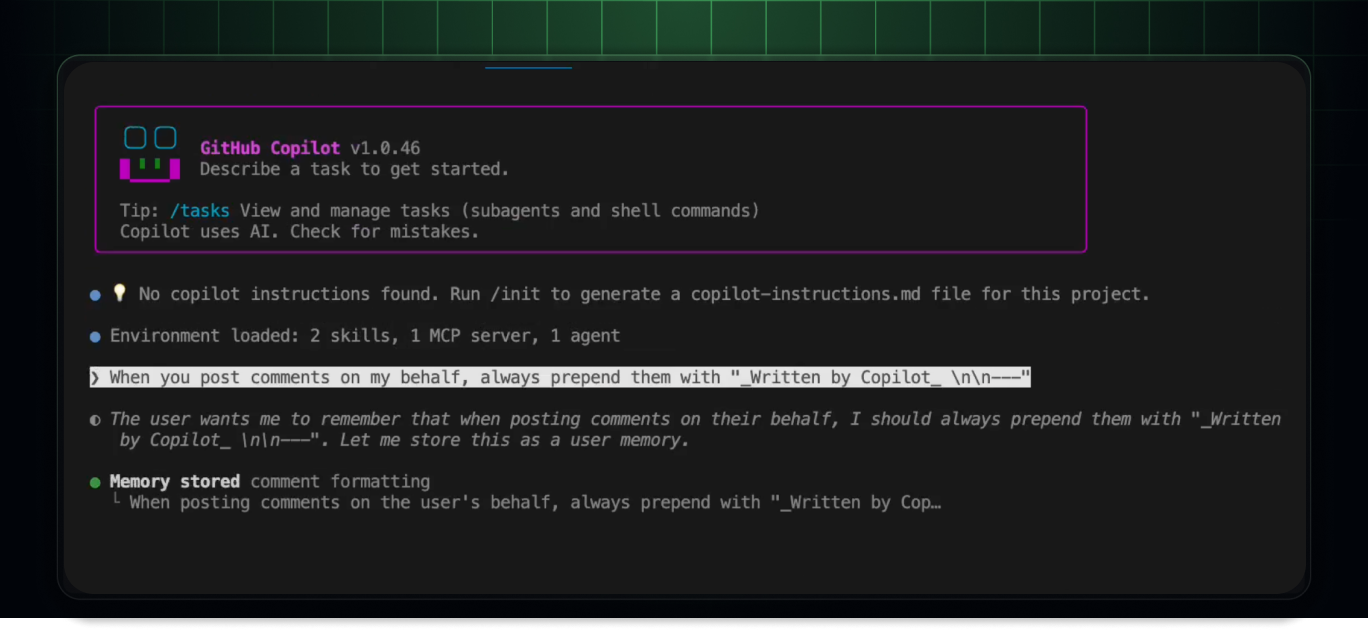
Memory is the feature every coding assistant needs and every engineering org should fear just a little.
GitHub’s latest Copilot Memory update gives Pro and Pro+ users a new user-level preference layer: Copilot can now remember things like commit style, pull-request structure, communication tone, and preferred ways of working across repositories and Copilot experiences. That sounds like convenience because it is convenience. It also quietly moves Copilot from “stateless assistant that needs better prompting” toward “persistent collaborator with a configurable personality and workflow memory.”
The distinction matters. A stateless assistant fails loudly: it forgets what you told it five minutes ago, asks you to repeat context, and burns time on prompt tax. A stateful assistant fails differently. It remembers something that used to be true, applies a preference where it does not belong, or turns one developer’s style into an invisible default that nobody else agreed to.
Personal style is not repository policy
GitHub is drawing a useful line between two kinds of memory. Repository-level facts can include coding conventions, architectural decisions, build commands, and project-specific rules. User-level preferences are personal: the way one developer likes PRs structured, commits written, explanations phrased, or assistant responses toned. GitHub says user preferences follow the user across repositories and agents without affecting other users in the same repository.
That is the right model. Repositories have shared conventions. People have personal habits. Enterprises have policy. Collapsing those three layers into one fuzzy memory bucket is how an assistant becomes a shadow configuration system.
There are some important guardrails in the design. Users can review and delete user-level preferences in Copilot Memory settings. Repository-level facts are stored with citations pointing back to supporting code and are validated against the current branch before use. Copilot code review uses repository-level facts only; user preferences are not applied during code review. Copilot CLI applies stored facts and preferences only for the user who initiated the operation. Unused facts or preferences are automatically deleted after 28 days, although the timer may reset when an entry is validated and used.
Those details are not footnotes. They are the product.
A memory that says “this repo uses Jest” is helpful until the repo migrates to Vitest. A memory that says “use conventional commits” is helpful until a repository has its own release-note convention. A memory that says “keep explanations terse” is harmless in most local CLI work and actively unhelpful if the same assistant is drafting onboarding documentation. Memory needs scope, citation, expiration, and deletion because stale context is worse than no context. No context fails predictably. Stale context fails with confidence.
The debugging problem nobody wants
The hard part is not storing preferences. The hard part is making assistant behavior debuggable after preferences start influencing output.
If Copilot writes a PR description in an odd format, chooses a commit style you did not expect, or keeps making suggestions in a tone that feels off, developers need to answer a basic question: is this coming from the current prompt, the repository, the model, the product default, or memory? Without a visible memory panel and deletion workflow, debugging an AI assistant becomes anthropology. You are not inspecting config; you are trying to infer culture from artifacts.
GitHub’s review-and-delete settings are therefore essential. But teams should go further in how they use the feature. Treat personal memory as a lightweight, inspectable preference file, not as a dumping ground for workflow rules. Keep things that reduce repeated prompting and do not conflict with team behavior: “prefer conventional commits,” “show commands before running them,” “use bullet lists in summaries,” “keep PR descriptions concise but include tests run.” Delete vague or policy-shaped memories: “prefer simple architecture,” “skip slow tests,” “avoid touching auth code,” “do not over-explain security changes.” Those belong somewhere enforceable and reviewable.
Shared rules should live in shared places: CONTRIBUTING.md, repository instructions, hooks, linters, review templates, CI, CODEOWNERS, or formal agent policy. Personal memory should adapt the assistant to the person. Repository memory should adapt it to the codebase. Enterprise policy should constrain both. That three-layer split is not bureaucracy. It is how teams avoid “Copilot remembered it” becoming the new “works on my machine.”
Persistent assistants need garbage collection
The 28-day deletion behavior is a good sign because persistent assistants need garbage collection as much as recall. The value of memory is not “remember everything forever.” That is a surveillance product with autocomplete. The value is remembering the small, high-friction preferences that make day-to-day work smoother while letting outdated context decay.
For solo developers, this is mostly upside. If you have told Copilot a dozen times how you like commits, reviews, or explanations, letting it remember saves time. For teams, the upside is still real, but the governance line matters. If every developer’s assistant is learning different implicit behaviors, the repo can start feeling inconsistent even when everyone is using the same tool.
The practical playbook is simple. If you are on Copilot Pro or Pro+, open the memory settings and audit what is there. Delete vague preferences. Promote shared rules into repo-level files. Keep personal style personal. If you manage a team, decide which agent behaviors should be policy and which should remain user preference before people accumulate months of invisible habits.
The broader signal is that the coding-agent race is moving from prompt engineering to state management. OpenAI is building hooks, mobile approvals, remote hosts, and access tokens around Codex. GitHub is layering memory into cloud agent, CLI, and review workflows. Other tools are doing the same under different names: rules, memories, profiles, skills, instructions, playbooks.
The winner will not be the assistant that remembers the most. It will be the one that makes memory observable, scoped, removable, cited, and easy to override when reality changes. Remembered preferences are useful. Invisible policy is a bug with better UX.
Sources: GitHub Changelog, GitHub Docs: Copilot Memory, GitHub’s March Copilot Memory public-preview note