DeepClaude Turns Claude Code Cost Pain Into a Backend-Switching Pattern

DeepClaude is the kind of project that shows up when a product has crossed from novelty into line item. Developers like the Claude Code workflow. They do not always like the bill, the caps, or the feeling that every routine edit needs to burn premium-model tokens. So a small wrapper appears with the oldest infrastructure pitch in the book: keep the interface, swap the backend.
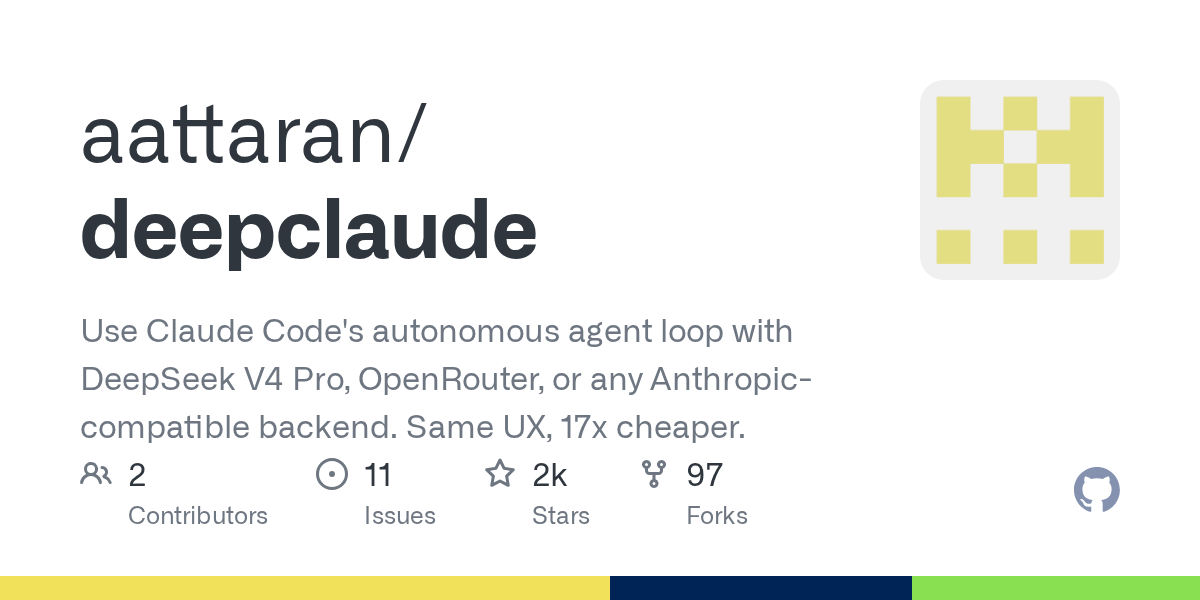
The project, published at aattaran/deepclaude, routes Claude Code-style model traffic through DeepSeek V4 Pro, OpenRouter, Fireworks AI, Anthropic, or any Anthropic-compatible backend. DigitalToday covered it on May 11, but the more useful primary source is the repository itself: created May 3, pushed May 9, updated May 11, with 1,743 stars, 97 forks, 23 open issues, and an MIT license at research time. The README’s pitch is blunt enough to be useful: “Same UX, 17x cheaper.”
That claim should not be treated as a universal law of physics. It should be treated as a signal. Claude Code has created enough workflow value that developers now want model arbitrage underneath it.
Cost pressure always finds the abstraction seam
The abstraction seam here is obvious. Claude Code trained developers to expect a terminal-native agent that can read files, edit code, run Bash or PowerShell, use glob and grep, handle Git operations, initialize projects, spawn subagents, and loop autonomously through a task. Once that pattern becomes habit, the model provider starts looking like an implementation detail — at least for routine work.
DeepClaude leans into that distinction. The README says it supports file read/write/edit flows, shell execution, Glob/Grep, autonomous multi-step loops, subagent spawning, Git operations, project initialization, and thinking mode. It also exposes a local proxy cost endpoint that reports backend token usage, estimated cost, Anthropic-equivalent cost, and savings. That is not a toy feature. It is the dashboard every cost-sensitive Claude Code user starts sketching after the third “why did that refactor cost this much?” session.
The pricing comparison is the marketing hook. DeepClaude cites Claude Code at $200/month with usage caps and compares Anthropic token prices against DeepSeek V4 Pro at $0.87 per million output tokens. DigitalToday uses a different Anthropic baseline — Claude Opus 4.7 at $5 per million input tokens and $25 per million output tokens — while the README’s table compares $3 input and $15 output. The exact ratio will vary by model, cache behavior, task, and provider. The direction is what matters: developers now see the model layer as something to route by task difficulty, not a sacred default.
That pattern is not new. Infrastructure teams have done it for years with storage tiers, compute classes, queues, and databases. You do not run every job on the most expensive instance type because some work does not deserve it. DeepClaude applies the same instinct to coding agents: use the cheaper backend for routine tasks, switch back to Anthropic for hard reasoning. The README even frames that split as roughly 80 percent routine work and 20 percent complex work.
The backend is still part of the product
The catch is that coding agents are not stateless text completion APIs with a nicer prompt. Tool-calling reliability, context handling, cache semantics, image support, MCP behavior, reasoning depth, and failure modes are all product behavior. Change the backend and you change the tool.
DeepClaude is responsible enough to admit several gaps. DeepSeek’s Anthropic endpoint does not support images. MCP server tools do not work through the compatibility layer. Anthropic cache_control is ignored in favor of DeepSeek’s automatic caching. Claude Opus remains stronger for some complex reasoning tasks. Those limitations are not footnotes; they define the safe operating envelope.
For engineers, the practical question is not “is DeepClaude cheaper?” It is “which of my workflows survive the swap?” A rename-heavy refactor with tests may do fine on a cheaper backend. A multi-repo architecture migration with ambiguous constraints may not. A task that depends on MCP tools is currently a poor fit. Anything involving images is out. The right benchmark is your own repo, your own test suite, and your own tolerance for reviewing the output.
There is also a trust boundary hiding inside the savings pitch. A localhost proxy that intercepts model calls can see prompts, code context, file excerpts, tool results, token counts, and sometimes secrets if the agent is allowed to read them. Routing through OpenRouter, Fireworks, DeepSeek, or another backend changes where source context goes. That may be acceptable for personal projects and unacceptable for regulated codebases. Saving money by silently changing data processors is not engineering discipline; it is incident prep with a coupon code.
Anthropic’s counter-move is compute, not vibes
DeepClaude’s emergence also makes Anthropic’s recent compute announcement easier to read. Anthropic doubled Claude Code five-hour rate limits for Pro, Max, Team, and seat-based Enterprise plans; removed peak-hour reductions for Pro and Max; raised Opus API limits; and announced access to SpaceX’s Colossus 1 capacity, described as more than 300 megawatts and over 220,000 NVIDIA GPUs within the month. That is the managed-product answer to backend arbitrage: make the official path less painful, more reliable, and harder to leave.
Both strategies can work. Anthropic wins when integration, reliability, model quality, support, MCP behavior, managed settings, and enterprise controls matter more than marginal token cost. Backend switchers win when routine work dominates, budgets are tight, data policy allows alternate providers, and teams are willing to own the routing layer.
What practitioners should do is boring and therefore correct: test DeepClaude only on low-risk repos first; inspect the proxy code; pin versions; document which providers receive which data; keep Anthropic fallback available for hard tasks; and verify MCP, image, caching, and subagent behavior before assuming compatibility. Measure cost per useful outcome, not just cost per token. A cheap failed session is still waste.
The larger story is that Claude Code’s moat may be less the model than the workflow. Developers who internalize that workflow will try to make the model layer swappable, because that is what engineers do when an abstraction gets expensive. DeepClaude is early, rough-edged, and constrained. It is also a preview of the next phase: coding agents routed like infrastructure, with cost, capability, and data policy deciding where each task runs.
Sources: DeepClaude repository, DigitalToday, Anthropic higher limits announcement