GB200 Scheduling Is Where AI Infrastructure Stops Pretending the Network Is Someone Else’s Problem

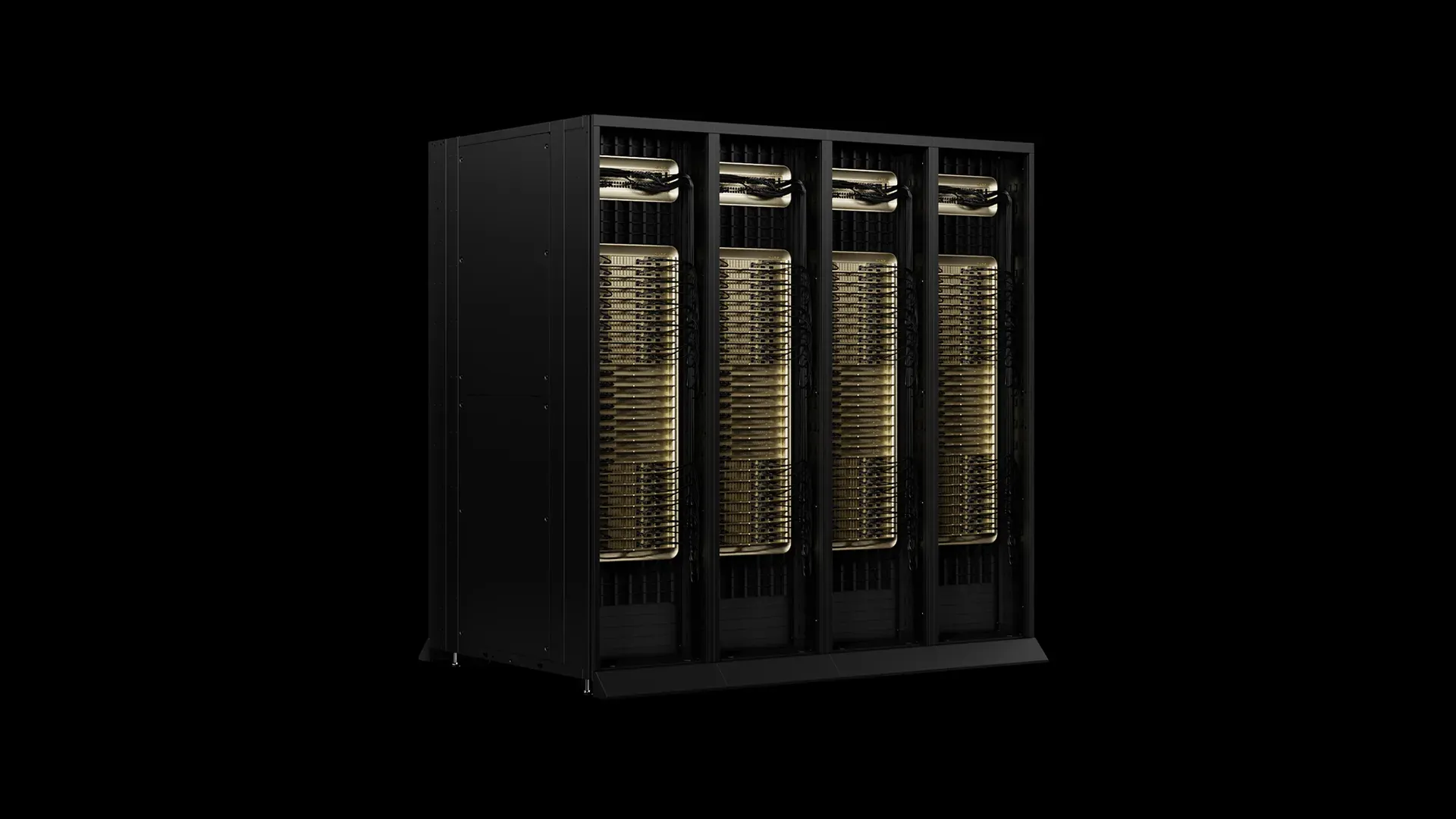
The least glamorous part of AI infrastructure is becoming the part that decides whether the expensive hardware was worth buying. NVIDIA’s latest GB200 NVL72 guidance is nominally about Slurm topology-aware scheduling, but the real message is sharper: at rack-scale Blackwell, you cannot treat GPUs as identical integers anymore. Placement policy is performance policy. In some cases, it is the difference between an AI factory and a very photogenic pile of underused capital equipment.
GB200 NVL72 is not just “72 GPUs in a rack.” NVIDIA’s system combines 36 Grace CPUs and 72 Blackwell GPUs into a rack-scale NVLink domain. The product page lists 130 TB/s of NVLink bandwidth, 13.4 TB of HBM3E, 576 TB/s of GPU memory bandwidth, 17 TB of LPDDR5X CPU memory, and 2,592 Arm Neoverse V2 CPU cores per rack. Those numbers are why model builders care. They are also why schedulers can no longer pretend topology is somebody else’s problem.
Flat scheduling made sense when the hardware was flatter
Traditional cluster scheduling often works from a simplified abstraction: a job asks for a number of nodes or GPUs, the scheduler finds enough available capacity, and the job runs. That abstraction is useful until the cost of poor locality overwhelms the convenience. With GB200 and GB300-class systems, NVIDIA is telling operators to think in segments: groups of nodes that preserve the right locality inside an NVLink domain for a given workload class.
The Developer post points to Slurm’s older topology/tree plugin as a best-effort fit that can fragment jobs to improve queue time. NVIDIA and SchedMD introduced topology/block in Slurm 23.11 for rack-scale systems like GB200 NVL72 and GB300 NVL72. A follow-on NVIDIA block-scheduling guide adds support details around Slurm 25.05 topology.yaml, --segment, --consolidate-segments, --spread-segments, and switch/nvidia_imex for IMEX channel allocation.
The reason this matters is that model-parallel workloads are not politely uniform. Mixture-of-experts training, dense model training, tensor parallelism, expert parallelism, long-context inference, and large distributed data pipelines all stress the fabric differently. A 128-node MoE job is not a pile of unrelated four-GPU tasks. It has a shape. If the scheduler ignores that shape, the job can become a networking benchmark that happens to consume GPUs.
The useful result: topology does not have to kill utilization
NVIDIA models a 5,000-node, 20,000-GPU GB200 NVL72 cluster running 15,000 jobs over seven days, with an average 2.5% of nodes down at any given time. That last number deserves credit. Large clusters are never perfectly green. Drained nodes, maintenance windows, fabric events, firmware issues, and random hardware failures are the normal operating environment. Scheduling policy that only works on a fully healthy cluster is not policy; it is a wish with YAML.
The recommended rule of thumb is to identify the critical large job size and choose segment size 16 when the percentage of GPU-hours used by those jobs is at or below 90%, leaving scheduling flexibility. NVIDIA’s table maps 128-node MoE jobs to segment size 16, 32-to-64-node dense model training to segment size 4, and jobs below 32 nodes to segment size 1. In the simulation, a Large_Perf_Custom policy ran jobs of 32 nodes or more at segment size 16 and smaller jobs at segment size 2.
The important finding is not that topology-aware scheduling improves placement. Of course it does. The important finding is that NVIDIA says the topology-aware policy reached occupancy within roughly 1% of a topology-naive theoretical policy while avoiding the runtime penalties of poor placement. That is the argument platform teams need when someone objects that stricter locality will waste capacity. The answer is not to ignore topology. The answer is to model the workload mix, choose sane segment defaults, and measure fragmentation continuously.
The simulation also notes that the topology plugin placed small jobs on the last two nodes of each NVLink domain, preserving cleaner capacity for larger jobs. That is exactly the kind of behavior a human cluster operator might learn through painful experience and tribal knowledge. Encoding it in scheduler policy is how the platform stops depending on the one person who remembers which launch template not to use on Fridays.
Scheduling is now a product surface
This changes what platform teams owe users. It is no longer enough to expose “request N GPUs” and hope the launcher does the right thing. Users need documented workload classes, default segment choices, queue-time expectations, placement-quality signals, and examples that map real training or inference patterns to scheduler options. If someone is running 128-node MoE training, segment size 16 should not be a rumor buried in Slack. It should be in the launcher, the template, the docs, the dashboard, and maybe the admission policy.
There is a governance angle too. Over-constrained jobs hurt everyone else. Under-constrained jobs hurt themselves and may waste shared hardware. A mature platform should show requested segment size versus actual placement, runtime variance by placement quality, queue delay by segment class, fragmentation by NVLink domain, and node-down impact on schedulable capacity. That telemetry gives users feedback and gives operators an evidence base for policy changes. Without it, every scheduling argument becomes vibes with invoices attached.
IMEX isolation is the other quiet detail practitioners should not skip. Multi-node NVLink memory sharing is powerful, but shared fabric and memory services need driver-level boundaries in a multi-tenant environment. NVIDIA’s guidance around Slurm’s switch/nvidia_imex plugin matters because Slurm can allocate IMEX channels per job instead of relying on fragile prolog and epilog scripts. If that sounds boring, good. Boring isolation is what keeps high-performance infrastructure from becoming high-performance incident response.
Even teams without GB200 racks should read this as a warning about accelerator abstraction. The same pattern shows up with GPUs behind different PCIe roots, NUMA domains, MIG partitions, NVSwitch islands, EFA placement groups, storage locality, and mixed accelerator fleets. Kubernetes, Slurm, Ray, and custom launchers all need enough vocabulary to express placement constraints. Treating accelerators as interchangeable tokens works until latency spikes, throughput collapses, or a procurement review asks why the new cluster performs like the old one with better branding.
The practical playbook is straightforward. First, classify workloads by communication pattern and size instead of only by GPU count. Second, define default placement policies for those classes. Third, instrument topology-aware utilization: occupancy, fragmentation, queue delay, node-health impact, runtime variance, and placement quality. Fourth, simulate policy changes before production. At Blackwell scale, “try it Friday afternoon” is not an experiment. It is a postmortem seed.
NVIDIA’s GB200 scheduling post is valuable because it connects hardware topology, workload parallelism, failure rates, scheduler policy, and occupancy into one operational model. The industry likes to talk about AI factories as if the factory is built when the GPUs arrive. It is not. The factory starts working when the scheduler understands what those GPUs are connected to.
Sources: NVIDIA Developer Blog, Slurm topology guide, NVIDIA Slurm block scheduling guide, NVIDIA GB200 NVL72, NVIDIA IMEX Service docs