Gemini 3.5 Flash in GitHub Copilot Is the Multi-Model Strategy Becoming the Product

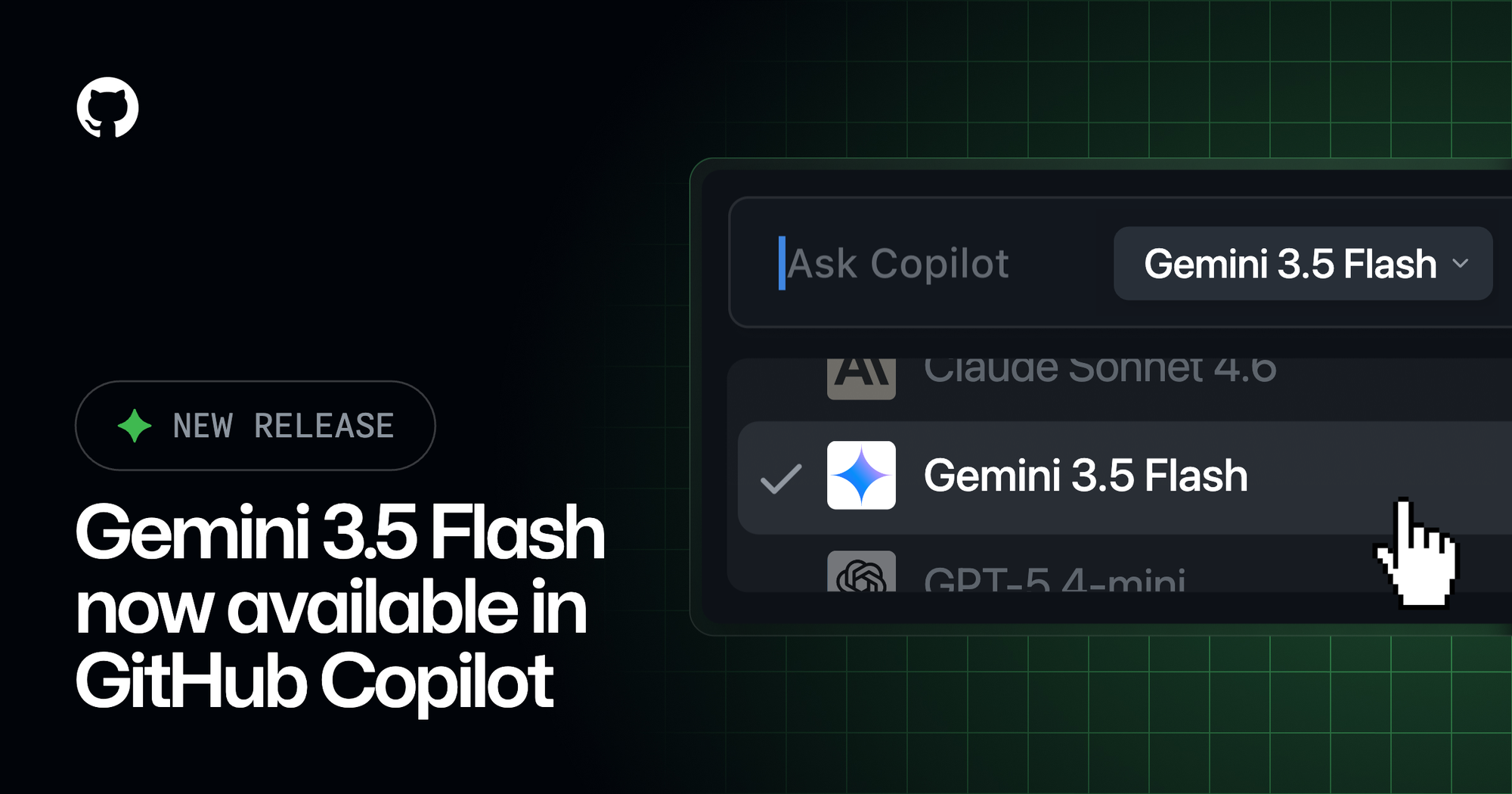
GitHub adding Gemini 3.5 Flash to Copilot is not the odd-couple story it looks like. Yes, a Google model is landing inside a Microsoft-owned developer product. That makes a tidy headline. But the better read is more structural: Copilot is becoming less of a model and more of a managed routing layer for software work.
That distinction matters because enterprise AI coding tools are drifting away from the simple question developers argued about in 2023 and 2024: which model is smartest? The answer now depends on the task, the budget, the risk, the IDE, the repository policy, the agent surface, and how much governance the organization needs wrapped around the model call. Gemini 3.5 Flash showing up in GitHub Copilot is another sign that the product value is moving upward, into the control plane.
GitHub says Gemini 3.5 Flash is generally available for Copilot Pro, Pro+, Business, and Enterprise users. The model is positioned for fast, iterative agentic coding workflows, with GitHub calling out strong tool use, fast response times, and high cache efficiency. In GitHub’s own phrasing, early testing showed “near-Pro coding quality at Flash-tier speed and cost.” That is the pitch engineers should interrogate, not merely repeat.
The model menu is becoming policy surface
The most important number in the announcement is not the version string. It is the 14x premium request multiplier. GitHub says the launch pricing is tentative and subject to change, but the signal is already clear: model selection is no longer just taste. It is accounting, governance, and workflow design.
That should sound familiar to anyone running cloud infrastructure. Teams once treated instance choice as an implementation detail until the bill made it a platform concern. Coding models are heading the same way. A model that feels fast and capable in an individual developer session may be the wrong default across thousands of seats if it quietly burns premium requests on routine completions, low-risk refactors, or chat prompts that a cheaper model could have handled.
This is where Copilot’s enterprise shape matters. Business and Enterprise administrators must explicitly enable the Gemini 3.5 Flash policy before users can access it. That may look like friction, but it is the mature part of the rollout. In a serious engineering organization, a new model is not just a dropdown option. It raises questions about data handling, contractual terms, output quality, cost attribution, content filtering, public-code matching, and support boundaries. A hobbyist can experiment first and explain later. A regulated company usually has to reverse that order.
GitHub’s supported-model documentation now reads less like a static capability matrix and more like a platform contract. Models differ by speed, cost efficiency, accuracy, reasoning, multimodal support, and release status. Default model prompts and completions run through Copilot content filters, including harmful, offensive, off-topic, and public-code matching filters where enabled. Those filters are not glamorous, but they are part of why enterprises buy Copilot rather than wiring every model API directly into every IDE and hoping procurement does not notice.
Copilot is winning by becoming boring infrastructure
The competitive subtext is hard to miss. Google used I/O to push the Gemini 3.5 developer story. GitHub quickly put Gemini 3.5 Flash where professional developers already live: Visual Studio Code, Visual Studio, JetBrains, Xcode, Eclipse, and the broader Copilot surface. Google gets distribution. GitHub gets to answer the predictable objection that Copilot is locked into Microsoft and OpenAI models. Microsoft gets to sell Copilot as the managed front door to a multi-model coding platform rather than a single-vendor bet.
That is a strong move because most teams do not want to become model integrators. They want agents and assistants that work inside existing workflows, respect existing permissions, produce reviewable diffs, fit budget constraints, and do not force every developer to maintain a private leaderboard in their head. The platform that can route work across models while preserving admin policy, auditability, IDE integration, and billing controls starts to look less like an assistant and more like developer infrastructure.
There is a trap here, though. Multi-model support can become a mess if it is presented as a buffet instead of a policy. Developers will overfit to anecdotes: Gemini was great on one refactor, Claude was better on one design review, Codex solved one gnarly test failure, and suddenly every standup contains folk wisdom about which model has the “vibe” today. That is not engineering. That is astrology with latency.
The more useful approach is to define task classes. Small mechanical edits, test generation, documentation updates, codebase Q&A, dependency bumps, agent-mode fixes, security-sensitive changes, and architecture refactors should not all share the same default model policy. Some tasks want speed and low cost. Some want deeper reasoning. Some want a model that behaves well with tools. Some should not be delegated at all without explicit human review. Gemini 3.5 Flash may be excellent for a subset of those jobs, but teams should prove it on their own repositories before making it ambient.
What teams should actually do
The right response is not “enable it everywhere” or “ban the new thing until the committee wakes up.” The right response is a small evaluation harness that resembles real work. Pick a representative set of internal tasks: bug fixes with failing tests, common refactors, framework upgrades, API usage corrections, test expansion, codebase explanation, and agentic tool-use flows. Compare Gemini 3.5 Flash against the currently approved Copilot defaults and any other approved OpenAI or Anthropic models.
Measure the boring outcomes. Accepted diff rate. Test pass rate. Reviewer edits. Follow-up rework. Latency. Premium request burn. Cases where the model made a locally correct change that hurt the design. Cases where it called tools well versus wandered through the repo like a tourist. If GitHub says the model offers near-Pro coding quality at Flash-tier speed and cost, make it earn that sentence against your actual codebase, not a public benchmark that conveniently contains none of your weird internal abstractions.
Admins should also document the enablement decision. Who approved the model? For which organizations? For which developer cohorts? With what cost expectations? Are there repos where the model is allowed for chat but not agentic code changes? Are security-sensitive repositories handled differently? Does the team guidance explain when the 14x multiplier is worth paying? If the answer is “we turned it on because developers asked,” that is not a rollout plan. It is a future billing investigation.
The larger trend is that model pluralism is becoming normal. Developers will not care which company trained the model when the workflow is mediated by a product that handles routing, permissions, cost, and review. They will care whether the agent fixes the issue, leaves a small diff, respects the repo conventions, and does not surprise finance. That is the layer GitHub wants to own.
Gemini 3.5 Flash inside Copilot is therefore less about Google versus Microsoft than it is about the managed multi-model layer winning over raw model fandom. The smartest model will keep changing. The more durable product is the one that makes model choice governable enough for real engineering organizations to use without turning every new release into a procurement incident. Looks good, with one required change: treat the model picker like infrastructure, not a toy.
Sources: GitHub Changelog, GitHub Copilot supported models documentation, GitHub Copilot cloud-agent model documentation