GitHub Copilot CLI’s April 16 Release Shows the Agent War Is Now About Control Surfaces

AI coding tools spent the last year competing on the fun part: benchmark screenshots, model names, and demos where an agent heroically writes a feature from scratch. The real market is now being decided by much duller questions. Can you resume a session without spelunking for a UUID? Can you steer work after you leave your desk? Can a long-running agent finish without spamming you, confusing you, or quietly losing the plot?
GitHub’s April 16 release for Copilot CLI is small on paper and revealing in practice. The changelog entry, published at 00:06 UTC, mostly reads like maintenance: better submodule-path handling, cleaner rewind navigation, clearer editor-launch errors, no redundant background-agent completion notices when read_agent is already waiting, and support for connecting to remote-control sessions directly from the --resume picker. None of that sounds like keynote material. All of it sounds like the work you do when a product has graduated from demo toy to daily tool.
That distinction matters. The category used to ask whether a coding agent could generate code. Now it is asking whether the agent can survive interruption. Copilot CLI’s recent release train makes GitHub’s answer pretty obvious: it is trying to turn the terminal into a durable control surface for longer-running software work, not just a chat box with shell access.
The boring fixes are the product
The April 16 build adds a handful of changes that make more sense as a bundle than as isolated bullets. GitHub says permission prompts now show the correct repository path when you are working inside git submodules, Azure resource IDs no longer trigger false path-security warnings in some az CLI workflows, the rewind picker now uses only arrow keys and Enter instead of the older 1-to-9 shortcut, and a new COPILOT_DISABLE_TERMINAL_TITLE environment variable lets users opt out of terminal title changes. Those are not glamorous upgrades. They are friction removers for people who are already using the product enough to be annoyed by the details.
The most telling line is the one about redundant completion notifications. GitHub specifically notes that background-agent completion notices are no longer sent when read_agent is already waiting for the result. Translation: the company is dealing with users who actually run background tasks, actually wait on them, and actually care that the notification model is sane. That is not experimental-user behavior. That is workflow behavior.
The adjacent release cadence reinforces the point. On April 15, GitHub added an /ask command for quick questions that do not contaminate conversation history and a plugin marketplace update command. On April 13, it shipped remote control for CLI sessions on web and mobile. On April 10, it added direct startup flags for plan, autopilot, and mode selection, plus mid-flight command support for things like /diff and /agent. Read together, the product direction is not subtle: GitHub wants Copilot CLI to feel resumable, steerable, and stateful over time.
The terminal-agent war has moved from output quality to control quality
This is where the AI coding market is getting more interesting, and more adult. In the first wave, vendors sold raw capability. In the second wave, they are selling control surfaces. A tool that can write a clever patch is nice. A tool that can keep working while you step away, then let you re-enter context without ritual pain, is infrastructure.
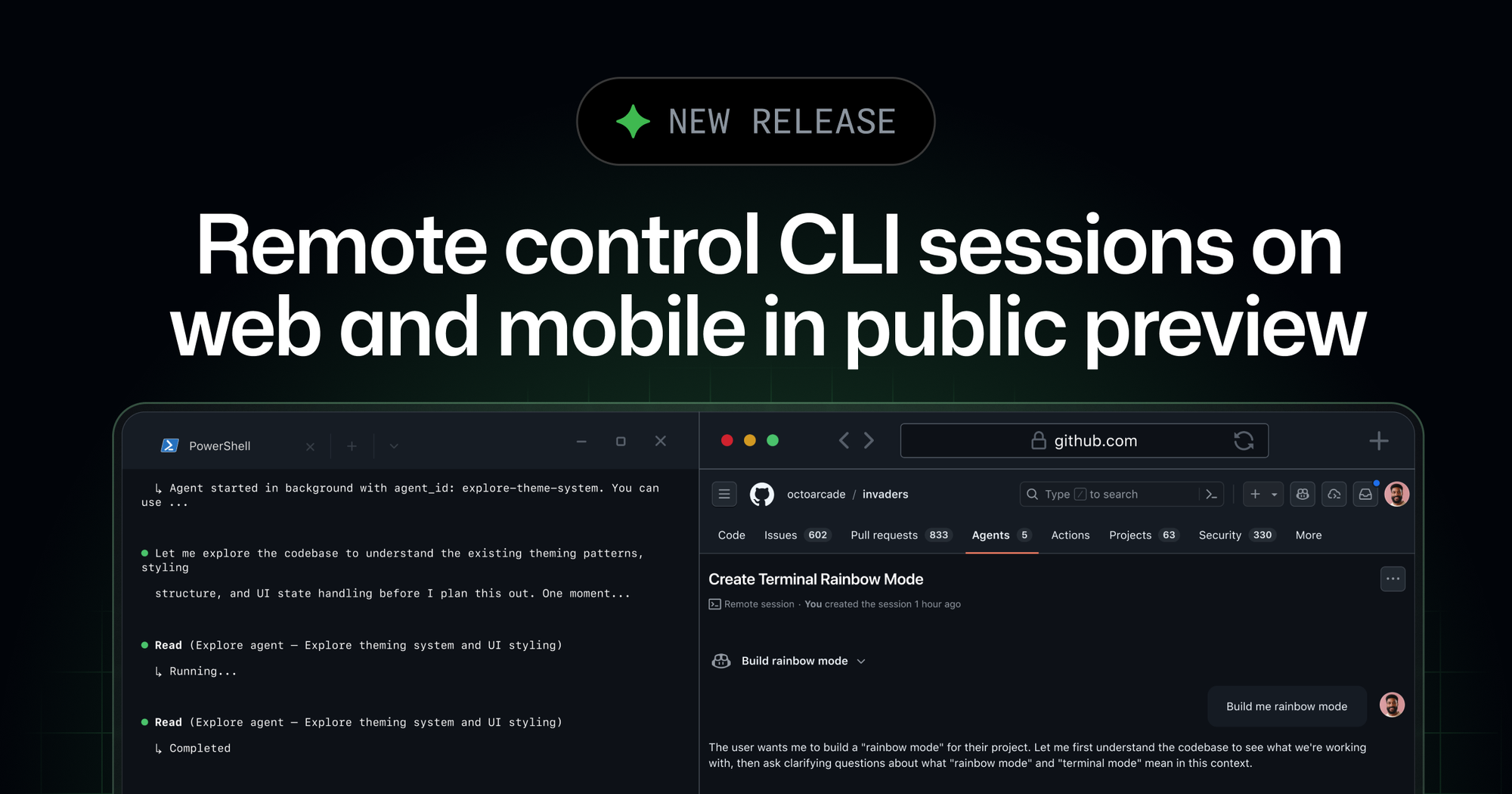
GitHub’s remote-control push makes that explicit. The April 13 public-preview launch for copilot --remote lets users monitor and steer a running CLI session from GitHub on the web or in GitHub Mobile, while execution still happens on the original machine. GitHub says users can send mid-session steering messages, review and modify plans, switch between plan, interactive, and autopilot modes, approve or deny permissions, and answer ask_user prompts from another device. That is no longer just terminal UX. It is a lightweight orchestration layer.
Now look back at the April 16 addition that lets users connect to remote-control sessions from the --resume picker. That is a tiny feature with a larger implication: session continuity is becoming a first-class concern. GitHub is not just helping users start agents. It is helping them recover, reattach, supervise, and continue them. That is exactly where developer trust gets built or lost.
There is a broader strategic pattern here. OpenAI has been spending recent Codex releases on background progress, approvals, packaging, and product-line clarity. GitHub is spending its energy on resume flows, remote supervision, session data, and CLI ergonomics. Different shapes, same destination. The winning agent is less likely to be the one with the prettiest benchmark chart than the one that handles the fifth interruption gracefully.
Session data is quietly becoming a moat
GitHub’s own docs on Copilot CLI session data make the story even clearer. The company documents that every session is recorded locally under ~/.copilot/session-state/, with a local SQLite session store powering resume behavior, historical questions, and the experimental /chronicle features for standups, tips, and workflow improvement. That is not just persistence for convenience. It is a memory model for agentic work.
Independent developer Jon Magic’s write-up on Copilot session search and resume fills in the practitioner angle. He describes using Copilot CLI across multiple repos and projects each day, then discovering that the tool maintains a session-store.db database with tables for sessions, turns, checkpoints, touched files, references, and a full-text search index. His response was not to marvel at the AI. It was to build a utility for finding and resuming the right session quickly. That is a useful tell. Once users start building tooling around session state instead of around prompt hacks, the category has moved into a more durable phase.
This is also why the April 16 release matters more than it looks. Resume flows, session search, remote control, less confusing navigation, and fewer redundant notifications all orbit the same problem: coding agents are no longer single-turn novelties. They are becoming long-lived work artifacts. Vendors that get that right will keep users. Vendors that keep optimizing only for first-turn wow will get demo applause and churn.
What practitioners should do now
If your team is evaluating Copilot CLI, Codex CLI, Claude Code, or any of the other terminal-native agents, stop scoring them only on code quality. Score them on operational behavior. Can you resume work without friction? Can you tell what state the agent is in? Can you steer it safely while it is running? Does it handle submodules, permissions, remote supervision, and interruptions without becoming mysterious?
That sounds less exciting than comparing benchmark percentages, but it is closer to the real buying decision. Engineering teams do not need another brilliant demo. They need an agent that behaves like a dependable coworker when the day gets messy.
GitHub’s April 16 release is a small changelog entry that says a large thing about the market. The terminal-agent war is no longer about whether the model can code. It is about whether the product can run your day without making you babysit it. That is a harder problem, a more valuable one, and finally the one these vendors seem ready to solve.
Sources: GitHub Copilot CLI releases, GitHub changelog, GitHub Docs, Jon Magic