GitHub Copilot Gets a Desktop App Because Agent Work Now Needs Its Own Workspace

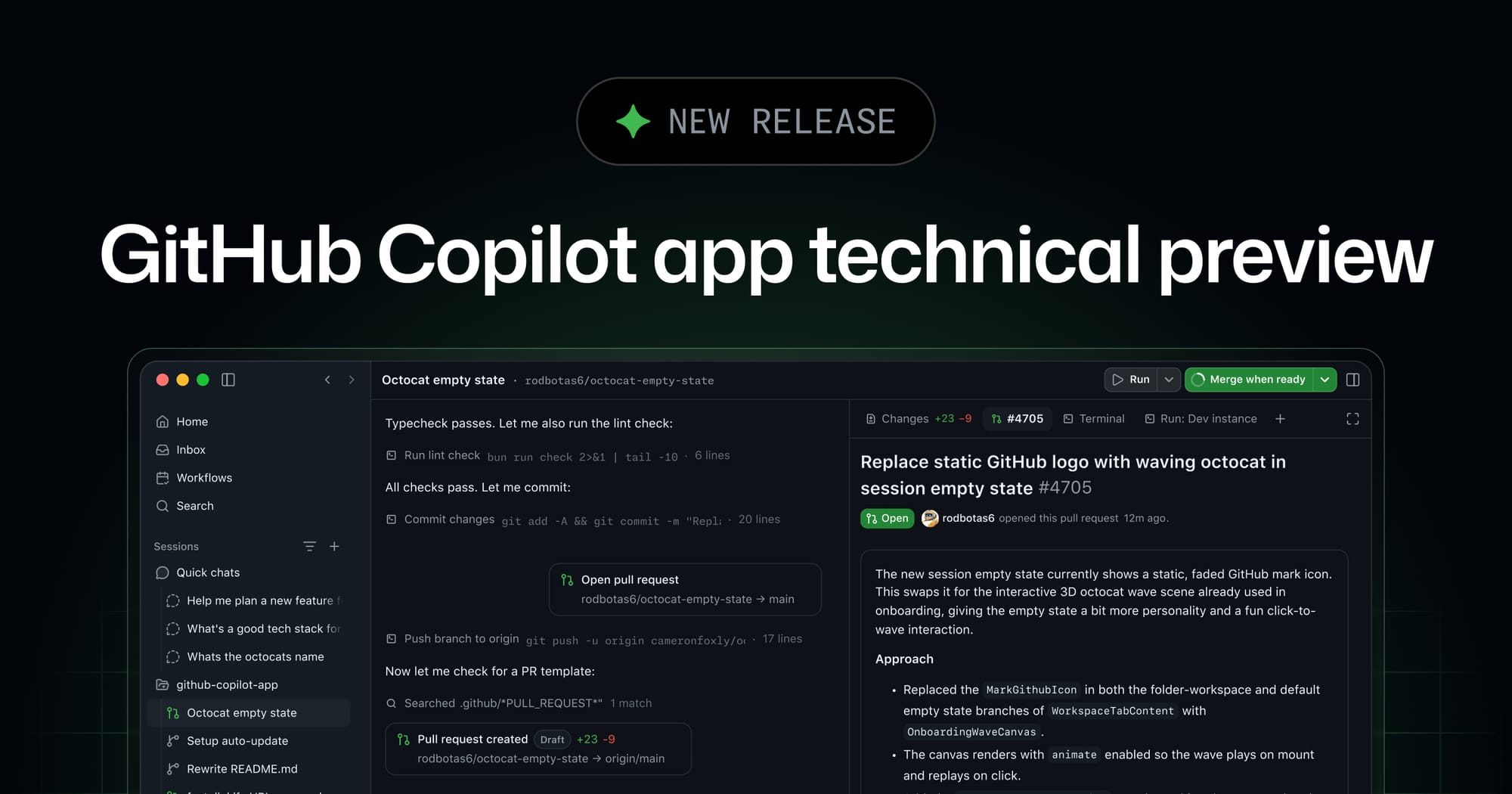
GitHub did not launch a Copilot desktop app because developers needed another window. It launched one because the IDE chat box is the wrong container for long-running agent work.
The new GitHub Copilot app, now in technical preview, is described by GitHub as a “GitHub-native desktop experience” for agentic development. The phrase is product-language, but the architecture underneath is the useful part: start from an issue, pull request, prompt, or previous session; keep the work isolated; steer it while it runs; validate the result with terminal and browser surfaces; then land it through pull request review. That is not a nicer chat pane. That is GitHub admitting that coding agents need a workbench.
The timing is not subtle. The same week, GitHub tightened Copilot individual-plan limits and wrote the sentence every agent vendor is eventually going to have to write: “Long-running, parallelized sessions now regularly consume far more resources than the original plan structure was built to support.” That is the economic shadow behind the product announcement. Agentic coding is becoming real enough that it needs state, governance, cost visibility, and lifecycle controls — not just a prompt box with a sparkle icon.
The session is the product now
The most important line in GitHub’s announcement is that each Copilot app session has its own branch, files, conversation, and task state. That maps directly to how engineering teams already manage concurrent work. A change is isolated on a branch. A diff can be inspected. Checks can run. A pull request becomes the place where the team reviews intent, implementation, and risk.
That sounds obvious because it is the workflow software teams spent decades refining. It is also exactly what many early coding-agent experiences got wrong. A chatbot inside an editor can produce useful snippets, but a real agent working from an issue needs durable context: the issue text, repository state, failing checks, review comments, terminal output, local previews, and a record of what it already tried. Without that state, the agent becomes a very fast intern making changes in whatever context happened to be open.
GitHub’s app tries to turn agent work into something closer to a managed task lane. Sessions can be paused and resumed. Multiple tasks can stay isolated across one repository or many. Repeatable workflows — triage, dependency updates, release notes, cleanup, routine pull requests — can become skills and prompts instead of one-off conversations. The desktop app is less interesting as a desktop app than as a place where those lanes become visible.
That visibility matters because agent work fails in the seams. The model may write decent code, but the workflow breaks when the branch is unclear, the checks are failing, the user cannot tell what changed, or the agent loses the thread after a restart. A dedicated session surface is GitHub’s answer to that problem: not “trust the agent,” but “give the agent a workspace that looks enough like engineering work for humans to review it.”
Agent Merge is useful only if the boring gates stay boring
The sharp edge is Agent Merge. GitHub says the app can let an agent address review comments, fix failing checks, and merge once user-defined conditions are met. That is potentially valuable. It is also the point where teams need to stop treating this like an assistant feature and start treating it like deployment automation.
A merge condition is not a vibe. It should mean branch protection, required checks, review requirements, CODEOWNERS where appropriate, clear audit logs, and explicit policy about which repositories or classes of changes are eligible. Letting an agent fix a documentation typo or dependency patch after checks pass is one thing. Letting it merge security-sensitive auth changes because it believes the review comments are resolved is another. The difference should be encoded in policy, not left to whoever is tired at the end of the day.
This is where the app’s boring integration with pull requests is actually the best part of the announcement. GitHub is not trying to replace PR review. It is trying to move agent-generated work into the existing review path. Good. The fastest way to make AI coding unmaintainable is to let it bypass the workflow humans use to maintain code quality.
Teams evaluating the preview should therefore ask fewer demo questions and more control-plane questions. Can admins restrict access by organization or repository? Are session actions logged clearly enough for incident review? Can teams distinguish read-only context gathering from write operations, external network calls, and merge authority? How are prompts, terminal output, browser previews, and review decisions retained? What happens when an agent gets stuck fixing a failing check and burns through a limit window?
Those are not procurement annoyances. They are the real product boundary.
Cost visibility is no longer optional
The Copilot plan-change post gives the desktop launch useful context. GitHub says usage limits are token-based guardrails separate from premium request entitlements, and that VS Code and Copilot CLI now display available usage when users approach limits. It also says Pro+ offers more than five times the limits of Pro, and that tools such as /fleet should be used sparingly when nearing limits because parallel workflows increase token consumption.
That is the part every engineering manager should read twice. Agent workflows change cost shape. A developer running one local chat turn is not the same as a developer launching several long-running sessions that read large context, generate diffs, run validation, respond to review comments, and retry failures. Once the app makes those sessions easier to start and resume, cost management becomes part of engineering operations.
The practical playbook is straightforward. Do not roll this out by telling everyone to install the preview and “see what happens.” Pick two or three workflows where session isolation and PR landing clearly help: dependency updates with testable acceptance criteria, failing-check repair, release-note cleanup, issue triage that produces small PRs, or narrow refactors with good validation commands. Avoid vague product work, large architecture rewrites, credential-handling code, and anything where the agent has to infer business intent from a stale issue title and hope.
Then measure the boring metrics: how many sessions produce mergeable PRs, how many require human rework, how often checks fail, how often the agent loops, how much usage each workflow consumes, and whether reviewers trust the diffs more or less over time. If a workflow saves ten minutes but creates a review queue nobody wants to touch, it is not automation. It is debt with a better avatar.
GitHub and OpenAI are converging from opposite ends
The comparison with OpenAI’s Codex mobile work is useful. OpenAI is making the phone an approval and steering layer for work happening on laptops, devboxes, or remote environments. GitHub is making the desktop a session workspace tied to issues, pull requests, checks, and merge flow. The surfaces are different, but the assumption is the same: agents now run long enough that they need state, interruption, review, and controlled authority.
That is the real competitive axis for coding agents in 2026. The winner is not simply the model that writes the prettiest patch on the first try. It is the runtime that makes the patch lifecycle boring enough for teams to trust: scoped work, isolated state, reproducible validation, understandable cost, reviewable diffs, auditable decisions, and merge rules that do not disappear because the demo looked impressive.
The Copilot app is promising precisely where it stays boring. Branches are boring. Checks are boring. Pull requests are boring. Merge conditions are boring. But boring is what lets teams scale engineering work without turning every change into an incident review. If GitHub can keep the app anchored in those primitives instead of letting “agentic” become a shortcut around them, this preview is more than another AI surface. It is a sign that coding agents are finally being designed around the work, not the chat transcript.
The desktop app is not the story. The session model is. And for once, that is the right abstraction to ship.
Sources: GitHub Changelog, GitHub Copilot plan changes, OpenAI Codex mobile announcement