GitHub Copilot’s New Default Model Is Really an Enterprise Change-Control Story

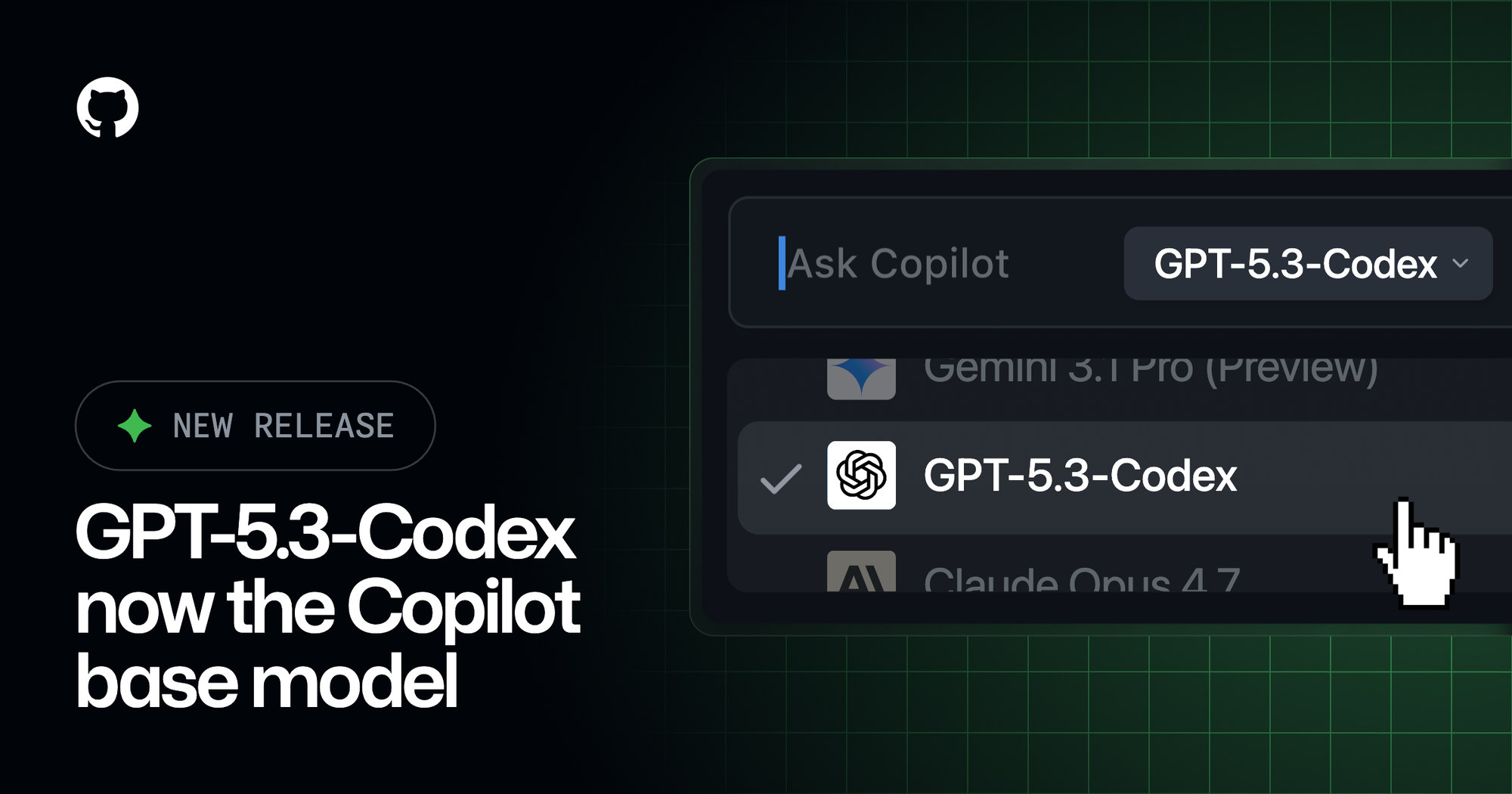
GitHub’s latest Copilot change looks like the usual model shuffle: GPT-5.3-Codex is now the base model for Copilot Business and Copilot Enterprise, replacing GPT-4.1 for organizations without approved alternatives. The more important story is less glamorous and more useful: GitHub is quietly turning model selection into enterprise change control.
That is the part senior engineering leaders should care about. Coding assistants have spent the last few years behaving like consumer software with admin panels attached: new model names, sudden deprecations, shifting limits, “try this better one” prompts, and enough pricing footnotes to make capacity planning feel like reading cloud egress docs in a bad mood. GitHub’s move says the obvious thing out loud: if a coding model is part of the software delivery lifecycle, enterprises need stability windows, policy boundaries, cost accounting, and reviewable defaults.
The announcement is narrow but loaded. As of May 17, GPT-5.3-Codex is the base model for Copilot Business and Copilot Enterprise. The base model is what an organization gets when it has not yet approved other models through its internal review process. It does not apply to Copilot Pro, Copilot Pro+, or Copilot Free. GPT-4.1 remains force-enabled at a 0x premium request unit multiplier, but GitHub says it will deprecate alongside usage-based billing on June 1, 2026. GPT-5.3-Codex carries a 1x multiplier.
That last sentence is not a billing detail to skim. It means a “default model” change can become a usage-accounting change for teams letting Copilot operate as background infrastructure. If your developer platform group does not know which orgs rely on defaults, which groups have model policies delegated, and which teams drive the most premium request volume, the dashboard will start asking questions the policy doc never answered.
The LTS label is doing more work than the model name
GPT-5.3-Codex is also GitHub Copilot’s first long-term-support model, in partnership with OpenAI. GitHub says designated LTS models will remain available for a full 12 months from launch. GPT-5.3-Codex launched on February 5, 2026 and is guaranteed through February 4, 2027 for Copilot Business and Enterprise users.
That is the adult part of the announcement. Model churn is fun if you are benchmarking toy tasks on a Friday afternoon. It is much less fun if you are a bank, insurer, healthcare company, defense contractor, or large SaaS vendor trying to validate an AI coding assistant against internal security, legal, and customer requirements. A model that changes every few weeks is not just an upgrade path; it is a moving dependency inside the SDLC.
For regulated and security-sensitive teams, a 12-month availability window is not luxurious. It is the minimum viable contract for treating an AI model as platform infrastructure. You need time to test it against internal repositories, run red-team prompts, compare output quality across languages, update acceptable-use guidance, brief security reviewers, document data-handling assumptions, and train developers on when to use it. Without an LTS window, “approved model” becomes a ceremonial phrase. By the time the committee finishes approving one model, the product surface has already moved on.
This is where GitHub’s framing gets interesting for the wider Microsoft AI stack. Copilot Business and Enterprise are not isolated developer toys; they sit inside the same enterprise conversation as Azure AI Foundry, Copilot Studio, Microsoft 365 Copilot, agent governance, model allowlists, and identity controls. The model question is increasingly inseparable from the runtime question: what can the assistant see, what can it change, who approved that capability, how is it logged, and what happens when the default changes under thousands of developers?
“Code survival rate” is the right metric, but not enough evidence
GitHub says Copilot telemetry shows GPT-5.3-Codex has a “significantly high code survival rate” among enterprise customers. That is exactly the kind of metric the industry should be using more often. The question is not whether a model can produce plausible code in a demo. The question is whether the code survives contact with review, tests, production constraints, and the developer who has to maintain it three weeks later.
But this is also where the announcement asks for more trust than it earns. GitHub did not publish the underlying methodology in the changelog. We do not get the numerator, denominator, language mix, repo types, task categories, review process, baseline comparison, or whether “survival” means accepted suggestion, merged diff, unchanged lines after a time window, or something else. The phrase points in the right direction; the evidence remains vendor telemetry behind glass.
Engineering leaders should treat that as a procurement question, not a gotcha. If “code survival rate” is being used to justify wider Copilot rollout, ask GitHub for the details. Ask how the metric behaves across generated tests versus business logic, greenfield code versus legacy refactors, typed languages versus dynamic ones, and agent-mode changes versus inline completions. Ask whether survival correlates with lower review burden or just higher initial acceptance. A line of code surviving is better than a line of code being suggested; it still does not prove the team shipped better software.
The better internal metric is probably a bundle: suggestion acceptance, reverted code, review comments, test failures, security findings, latency, developer satisfaction, and premium request consumption. If you can measure those before and after the default change, you have an engineering signal. If you only have “the new model is the default now,” you have vendor drift.
Defaults are policy decisions wearing comfortable shoes
GitHub’s Copilot docs make the control-plane shape clearer. Supported models differ by speed, cost efficiency, accuracy, reasoning, and multimodal support. Default models run through Copilot content filters, including harmful, offensive, off-topic, and public-code matching filters where enabled. Copilot policy controls are split into feature policies, privacy policies, and model policies. Enterprise owners can define policies centrally, delegate some decisions to organizations, or enable features such as the Copilot cloud agent only for selected organizations.
That policy stack matters because model selection is no longer a developer preference menu. In a small team, choosing a coding model can be as casual as picking a terminal theme with more consequences. In an enterprise, it is a governance surface. Legal cares about data handling. Security cares about prompt and output filtering, repo access, agent permissions, and public-code matching. Finance cares about premium request multipliers. Developer experience teams care about latency and quality. Platform teams care about who is allowed to approve a model and whether that approval applies globally or by organization.
The operational mistake is letting the base model become invisible. Defaults are where governance goes to become folklore. Someone approved Copilot six months ago, teams onboarded, developers got used to the behavior, and now the underlying model and billing multiplier have changed. Review it like any other platform dependency change, not as a changelog footnote.
The practical playbook is straightforward. First, inventory Copilot policies at the enterprise and organization levels. Know who controls model access, who can approve non-base models, and whether the Copilot cloud agent is enabled broadly or selectively. Second, identify high-volume Copilot cohorts: platform engineers, backend teams, frontend teams, data engineers, security teams, and anyone using agent mode heavily. Third, run a short internal comparison on real repositories. Track review outcomes, test behavior, reverted code, latency, and premium request units before and after the GPT-5.3-Codex default. Fourth, update developer guidance so “base model” does not become a synonym for “best model for every task.”
There is also a security checklist hiding here. If Copilot is moving toward agentic workflows, model policy alone is not enough. Teams need sandbox boundaries, repo trust rules, audit logs for prompts and tool calls where appropriate, least-privilege access for cloud agents, and clear rules about when generated code requires extra review. The model can be LTS and still operate inside a sloppy runtime. Stability is necessary. It is not a substitute for governance.
For Azure and Microsoft AI shops, this is the pattern to watch. Microsoft’s AI story is becoming less about isolated features and more about managed surfaces: Copilot in developer tools, agents in Foundry and Studio, model choices behind admin policy, and identity/security controls wrapped around the whole thing. That is useful when it gives enterprises a coherent control plane, and risky when teams confuse a vendor’s control plane with their own operating model.
So yes, GitHub upgraded the Copilot base model. Fine. The sharper reading is that enterprise AI is growing up one boring control at a time. LTS models, policy layers, cost multipliers, deprecation dates, and model approvals are not launch-demo material. They are what make AI coding tools survivable inside real engineering organizations.
The take: model churn is great for leaderboard screenshots and bad for production engineering. GPT-5.3-Codex becoming the Copilot Business and Enterprise base model is a governance story wearing a model-release jacket. Treat it like a platform migration, measure it, and do not let “default” become another word for “nobody owns this.”
Sources: GitHub Changelog, GitHub’s GPT-5.3-Codex LTS announcement, GitHub Copilot supported models docs, GitHub Copilot policy docs.