GitHub Just Gave Copilot Cloud Agent a Rollout Lever Enterprises Actually Needed

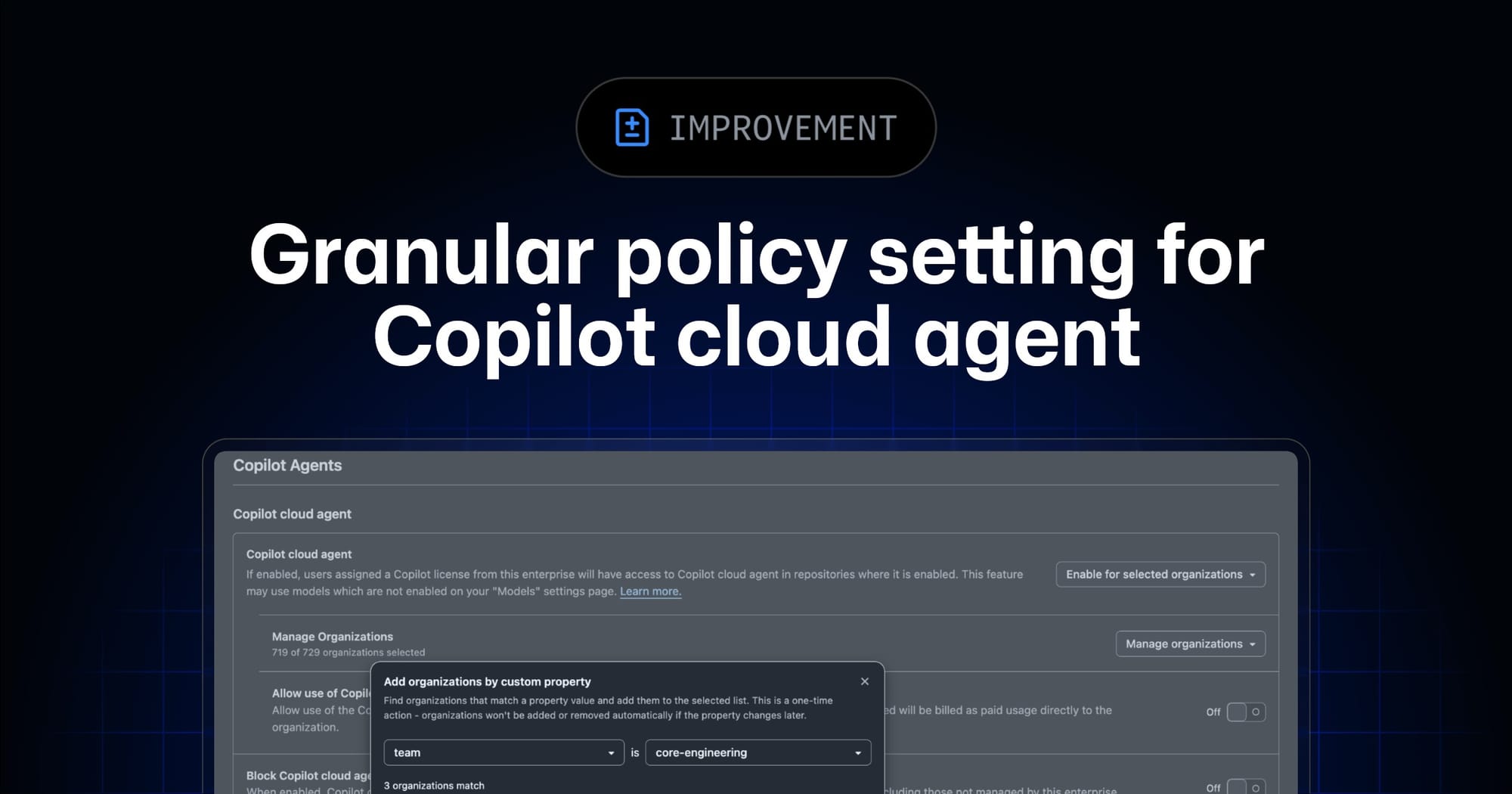
Enterprise software adoption usually dies in one of two places: procurement or policy. The model can be great, the demo can be slick, the benchmark chart can glow in neon, and none of it matters if the platform team cannot roll the thing out without flipping a giant switch for everyone at once. That is why GitHub’s new Copilot cloud agent control, which lets enterprises enable the feature for selected organizations via custom properties, matters more than its changelog entry suggests. It is not a model story. It is a "someone in platform engineering can finally say yes" story.
The feature itself is simple enough to fit in a paragraph. GitHub says enterprise admins and AI managers can now enable Copilot cloud agent for specific organizations instead of choosing between three blunt options: turn it on everywhere, turn it off everywhere, or let each organization decide for itself. The setting can be managed through the AI Controls page or through three new REST endpoints that handle policy state, adding organizations to the enabled list, and disabling access for organizations. GitHub also notes a caveat that deserves more attention than the headline: custom-property evaluation happens once at configuration time, so later property changes do not automatically update access.
That last detail is the difference between a real rollout lever and a full entitlement system. GitHub has shipped a practical pilot mechanism, not a complete dynamic-policy engine. That is still useful. In fact, it is useful precisely because most enterprises are not trying to solve abstract identity purity when they evaluate coding agents. They are trying to answer a very ordinary question: can we let a few teams use this without giving every repository in the company a background AI worker on day one?
The answer was previously awkward. Copilot cloud agent is not just autocomplete with better branding. It can research a repository, generate a plan, make changes in a GitHub-hosted environment, validate those changes, and hand back a branch or pull request for review. That means the trust boundary is different from inline suggestions in an IDE. Once you move into background execution and branch-level output, governance starts to matter a lot more than raw demo quality. The people signing off on deployment do not care that the agent shaved a few points off some benchmark if the only rollout mode is enterprise-wide exposure.
GitHub is tuning for the buyer, not the timeline
This is part of a bigger pattern in the agent market. Anthropic has been productizing the runtime layer through Managed Agents, trying to own the harness, session log, and sandbox model. OpenAI has been productizing pricing, safety classes, and security surfaces around Codex. GitHub, meanwhile, is doing the less glamorous work of productizing adoption mechanics. Usage metrics, faster validation, merge-conflict automation, and now staged enablement all point in the same direction. GitHub wants cloud agents to look like governable enterprise software, not like a toy that escaped from a hackathon.
That is strategically smart because GitHub has a structural advantage here. It already owns the repository host, the pull request workflow, the branch protections, the checks surface, and a lot of the admin plumbing. It does not need to convince enterprises to add a new destination for code review. It just needs to make delegation feel safe enough to turn on. A staged rollout control does exactly that. It lowers the political cost of saying yes.
There is also a subtle cultural point here. Most AI vendor messaging still assumes adoption is driven by enthusiastic individual developers. That matters, but it is incomplete. In larger organizations, tools become standard when platform teams can phase them in, observe behavior, and decide whether the operational reality matches the sales pitch. Selective organization enablement is the feature that admits this out loud. It says GitHub understands that autonomous coding is not just a personal productivity decision. It is an organizational change-management problem.
The real question is not access, but blast radius
For practitioners, the practical value is obvious. A central platform team can pilot Copilot cloud agent with a few receptive organizations, gather data on usage and review quality, and then widen access if the tool behaves. That is much cleaner than all-or-nothing rollout. It also creates the possibility of more honest evaluation. Teams can compare adoption patterns across orgs with different repo hygiene, compliance requirements, and engineering maturity, instead of pretending one universal policy will fit everyone.
But the caveat matters. Because GitHub evaluates custom properties once at configuration time, this is not the kind of policy you should mistake for continuously enforced segmentation. If your enterprise relies heavily on attribute-driven access controls that update automatically as org state changes, you still need operational guardrails around this. Somebody has to own the lifecycle. Otherwise, the staged rollout becomes another piece of admin state that drifts quietly until the wrong team still has access months later.
This is the broader lesson of agentic coding in 2026. The market spent the early phase obsessing over whether the models were smart enough. Now it is becoming clear that the harder problem is whether the software around the models is governable enough. Rollout mechanics, auditability, validation speed, entitlements, safety routing, cost visibility, and review ergonomics are where adoption will be won or lost. Benchmarks get people to try a product. Controls like this are what get procurement to renew it.
Engineers and engineering leaders should do three things with this update. First, treat staged rollout as a workflow experiment, not a permission toggle. Decide which teams are good pilots and what success looks like before you flip the policy. Second, pair adoption data with review outcomes, CI behavior, and security exceptions. A rising usage graph without quality context is just a nicer anecdote. Third, document the operational caveats. The one-time evaluation of custom properties is the sort of detail that becomes an incident retro if nobody writes it down.
My take is simple: GitHub did not ship a flashy new trick here, and that is why this matters. Agentic coding is maturing from demo theater into enterprise plumbing. The vendors that win this market will not just be the ones with the smartest models. They will be the ones that give cautious organizations a credible path from controlled pilot to boring standard tool. This feature is one of those path-building moves.
Sources: GitHub Changelog, GitHub REST API docs, GitHub enterprise docs, GitHub Community