GitHub Makes GPT-5.3-Codex the Enterprise Copilot Default — and Turns Model Choice Into Governance

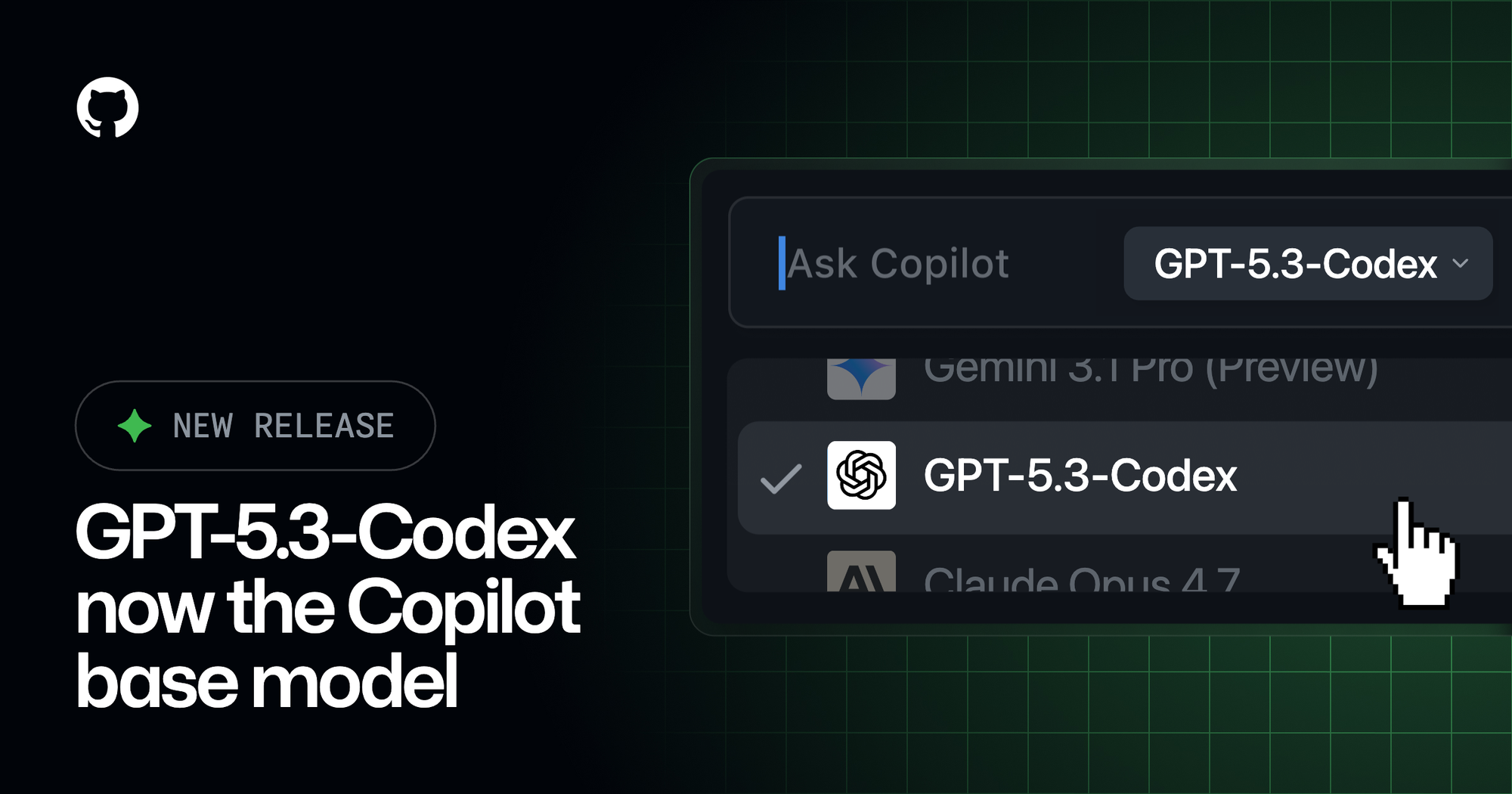
GitHub making GPT-5.3-Codex the base model for Copilot Business and Copilot Enterprise looks like a model swap. It is really a governance story. Enterprise coding assistants are moving from “which autocomplete engine do we like?” to a policy matrix: approved models, default models, premium multipliers, support windows, billing transitions, rollout paths, and who is allowed to override what. That is less fun than a benchmark, which is why it matters.
According to GitHub, GPT-5.3-Codex became the base model for Copilot Business and Enterprise organizations on May 17, 2026. It replaces GPT-4.1 as the default when an organization has not approved alternative models through its internal model-review process. GitHub says GPT-5.3-Codex is its first long-term support model in partnership with OpenAI, with availability from its February 5, 2026 launch through February 4, 2027 for Business and Enterprise customers. The model carries a 1x premium request unit multiplier. GPT-4.1 remains force-enabled at 0x for now, but GitHub has scheduled it for deprecation as usage-based billing arrives on June 1, 2026.
The phrase to watch is “base model”
Developers will naturally focus on whether GPT-5.3-Codex writes better code than GPT-4.1. That matters, but it is not the most important enterprise implication. The key phrase is “base model.” A base model is not just a technical default. It is the fallback that shapes behavior when nobody has made a more specific policy decision. In a small team, that may be fine. In a large organization, “default because nobody reviewed alternatives” is how accidental platform decisions become standard practice.
GitHub says internal Copilot data shows GPT-5.3-Codex has a significantly high code survival rate among enterprise customers. Code survival rate is a useful signal because it asks whether AI-generated code remains after review and subsequent edits, not merely whether a suggestion looked plausible. Still, enterprises should not outsource their evaluation to GitHub’s aggregate data. A model can perform well overall and still change behavior in ways that matter to a specific company: framework style, test strictness, security posture, review verbosity, migration patterns, or how it handles internal libraries.
The LTS label is the more strategic move. Enterprises hate model churn for good reasons. Security review, legal review, safety review, internal evals, developer training, documentation, and support all take time. If a model is approved in February and gone by summer, the platform team spends more energy chasing the vendor roadmap than improving developer productivity. A twelve-month availability window does not make the model perfect, and it does not guarantee identical behavior forever, but it gives organizations a planning surface. Coding models are starting to look less like novelty buttons and more like production dependencies.
Billing turns model choice into operations
The timing around usage-based billing is not incidental. GPT-5.3-Codex has a 1x premium request unit multiplier. GPT-4.1 is temporarily 0x, but scheduled for deprecation alongside the June 1 move toward usage-based billing. GitHub’s billing docs say premium requests can be consumed across Copilot Chat, Copilot CLI, code review, cloud agent, Spaces, Spark, the OpenAI Codex VS Code integration, and third-party agents. That means model selection is not confined to autocomplete. It can affect chat, agent mode, review, background work, and integrations that developers may experience as one product but finance experiences as usage.
That is the operational shift. For years, developer tools were usually budgeted as seats. Agentic tooling behaves more like cloud compute. A developer can trigger a plan, ask for edits, run code review, start a cloud-agent task, call tools, and iterate through failures. Depending on the product’s accounting model, the exact meter may differ, but the organizational lesson is the same: model defaults and agent surfaces now have cost consequences. If a company has not defined who can use which models where, the invoice will define the policy retroactively.
Platform teams should respond with a simple model-governance table. List the base model, approved alternatives, disallowed models, support window, multiplier, allowed surfaces, intended workloads, evaluation status, and rollback path. Then test the new base model against representative workflows: code review comments, generated tests, failing CI repairs, dependency upgrades, refactors in important services, CLI planning, and security-sensitive edits. Do not only count acceptances. Count reviewer corrections, reverts, follow-up bugs, style drift, and whether explanations are good enough for review.
There is also a communications job here. Developers need to know that a default changed, what behavior might change, and when to escalate to a different model. Managers need to know how usage will be measured. Security teams need to know whether the model has passed internal review for the relevant code classes. Finance needs forecasts that reflect real workflows, not polite demos. None of that is solved by the changelog entry. The changelog entry is the trigger to do the work.
This change also sharpens the Copilot-versus-Codex-versus-Claude-versus-Cursor comparison. Copilot’s pitch is increasingly enterprise integration: model policy, LTS stability, billing controls, organization settings, GitHub-native review surfaces, and cloud-agent workflow hooks. Claude Code may appeal to teams that want terminal-native agency and more direct token economics. Codex may appeal to OpenAI-native workflows, CLI/runtime control, and async agent patterns. Cursor may keep winning the tight IDE loop. The best tool is no longer just the one that writes the best patch in isolation. It is the one whose controls match how the organization actually ships software.
My take: GPT-5.3-Codex as an LTS base model is useful precisely because it makes part of AI coding governance boring. Boring defaults, documented support windows, visible multipliers, and reviewable model policies are what production developer tooling needs. But “base model” should never mean “unexamined model.” If Copilot is becoming infrastructure, treat the model like infrastructure: evaluate it, document it, monitor it, and have a rollback plan before the default becomes muscle memory.
Sources: GitHub Changelog, GitHub Docs on Copilot model comparison, GitHub Docs on Copilot requests and billing, GitHub Changelog on GPT-4.1 deprecation