GitHub Turns Broken CI Into a Copilot Handoff Button

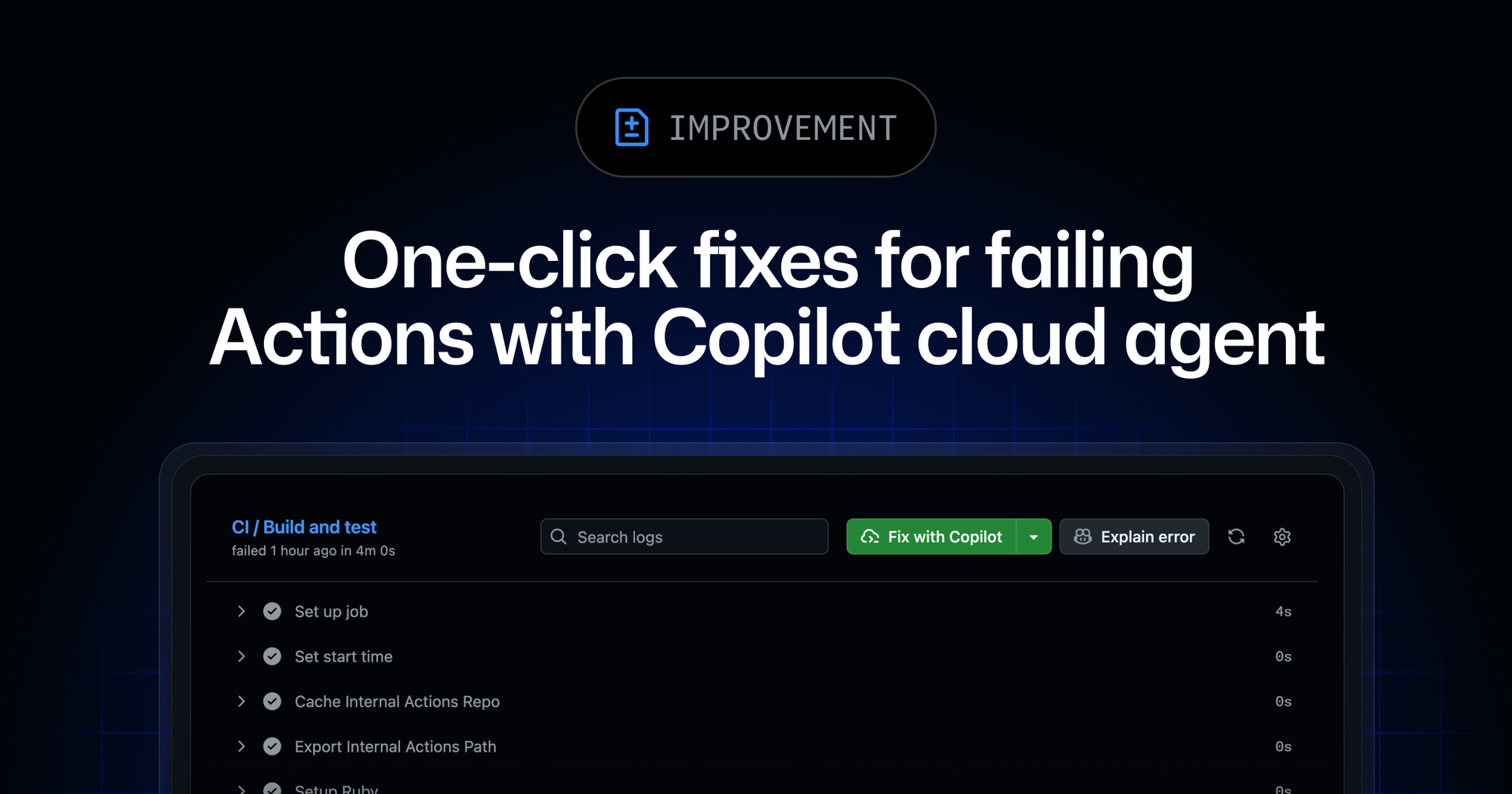
A red CI run is one of the few places where an agent should not need a motivational speech. The context is already there: logs, commit SHA, workflow file, branch, failing command, and a review loop. GitHub’s new Fix with Copilot button matters because it puts the agent at exactly that handoff point instead of asking a developer to copy a failure into chat and hope the assistant guesses the rest.
GitHub added a Fix with Copilot button to failed GitHub Actions workflow runs for Copilot Business and Copilot Enterprise subscribers. The cloud agent can inspect the failing logs, work in its own cloud development environment, push a fix to the branch, and tag the developer for review. This is small UI, large workflow: GitHub is turning CI failure from a notification into an agent entry point.
CI failure is the right-sized agent task
The specific details are what make this more than another model-dropdown or agent-button story:
- The feature is available to Copilot Business and Copilot Enterprise subscribers when Copilot cloud agent is enabled by an organization administrator.
- The entry point appears on the workflow run logs page as Fix with Copilot.
- GitHub says Copilot will investigate the failure, push a fix to the user’s branch, and tag the developer for review when complete.
- GitHub’s docs now list a failing GitHub Actions workflow run as one of many cloud-agent launch surfaces alongside issues, the agents tab, dashboard, Copilot Chat, GitHub CLI, GitHub Mobile, Jira, Slack, Teams, Azure Boards, Linear, Raycast, MCP-enabled tools, and the new-repository form.
- The source explicitly frames the target workload as “simple but time-consuming work,” such as fixing tests or correcting linter failures.
- The work happens from Copilot’s own cloud-based development environment, not the user’s local machine.
- This is source-traced to an official GitHub changelog item, not aggregator coverage.
This is GitHub making the most obvious agent handoff feel native. A failing Actions run is already structured context: logs, commit SHA, workflow file, branch, failing command, and usually a bounded class of fixes. Compared with “make this app better,” “fix this red build” is exactly the kind of task an agent should get first. It has a clear failure signal, a narrow artifact to inspect, and a natural review checkpoint.
The useful part is not that Copilot can edit code. Every coding agent claims that. The useful part is that GitHub put the agent at the point where developers already decide whether to context-switch. If the button saves a trip from browser logs to terminal archaeology, it will get used. If it generates drive-by fixes that hide flaky tests, loosen assertions, or patch symptoms instead of causes, teams will learn to distrust it quickly.
The workflow also pushes enterprises toward a new CI policy question: when can an agent push to a branch? A human still reviews, but branch protection, required checks, CODEOWNERS, audit logs, and model selection now matter more. Teams should require the agent to preserve or strengthen failing tests, not delete them; explain the causal chain from log to patch; and leave enough trace for reviewers to decide whether this was a real fix or a green-build paint job.
HN Algolia returned 0 matching stories for the exact launch title during the research window. That is not a surprise; CI repair buttons rarely hit the front page until one either saves a team hours or quietly commits nonsense. The practitioner reaction to watch will be inside pull requests: do teams rubber-stamp agent-authored CI fixes, or do they treat them as untrusted patches that still need review?
Green checks are not the same as a real fix
This aligns directly with the P1 governance topic. The button is convenient precisely because it hides machinery: cloud environment, model choice, repo permissions, workflow permissions, branch writes, and review tagging. Platform teams should make that machinery visible. Start by enabling the feature in low-risk repositories, measuring revert rate and reviewer edits, and writing a local policy for agent-authored CI fixes.
The safe rollout pattern is narrow. Enable this first in repositories where CI failures are usually bounded and review discipline is already strong. Require the agent to preserve or strengthen tests, not delete inconvenient assertions. Ask reviewers to look for the causal chain from log to patch, not just the final green check. Track revert rate, reviewer edits, time-to-fix, and the share of agent PRs that loosen validation. If those numbers look good, expand. If they do not, the button is not a productivity feature; it is a very convenient source of technical debt.
The broader pattern is consistent across Codex, Copilot, Claude Code, and the rest of the agent stack: the interesting battleground is shifting from raw generation to operability. Can the tool be resumed, audited, priced, sandboxed, steered, and reviewed without turning every engineering team into unpaid QA for a vendor demo? That is the bar. Anything less is autocomplete wearing a hard hat.
Sources: GitHub Changelog — One-click fixes for failing Actions with Copilot cloud agent, GitHub Docs, cloud agent docs