GitHub’s ‘Fix with Copilot’ Button Is a CI Shortcut With a Governance Problem Attached

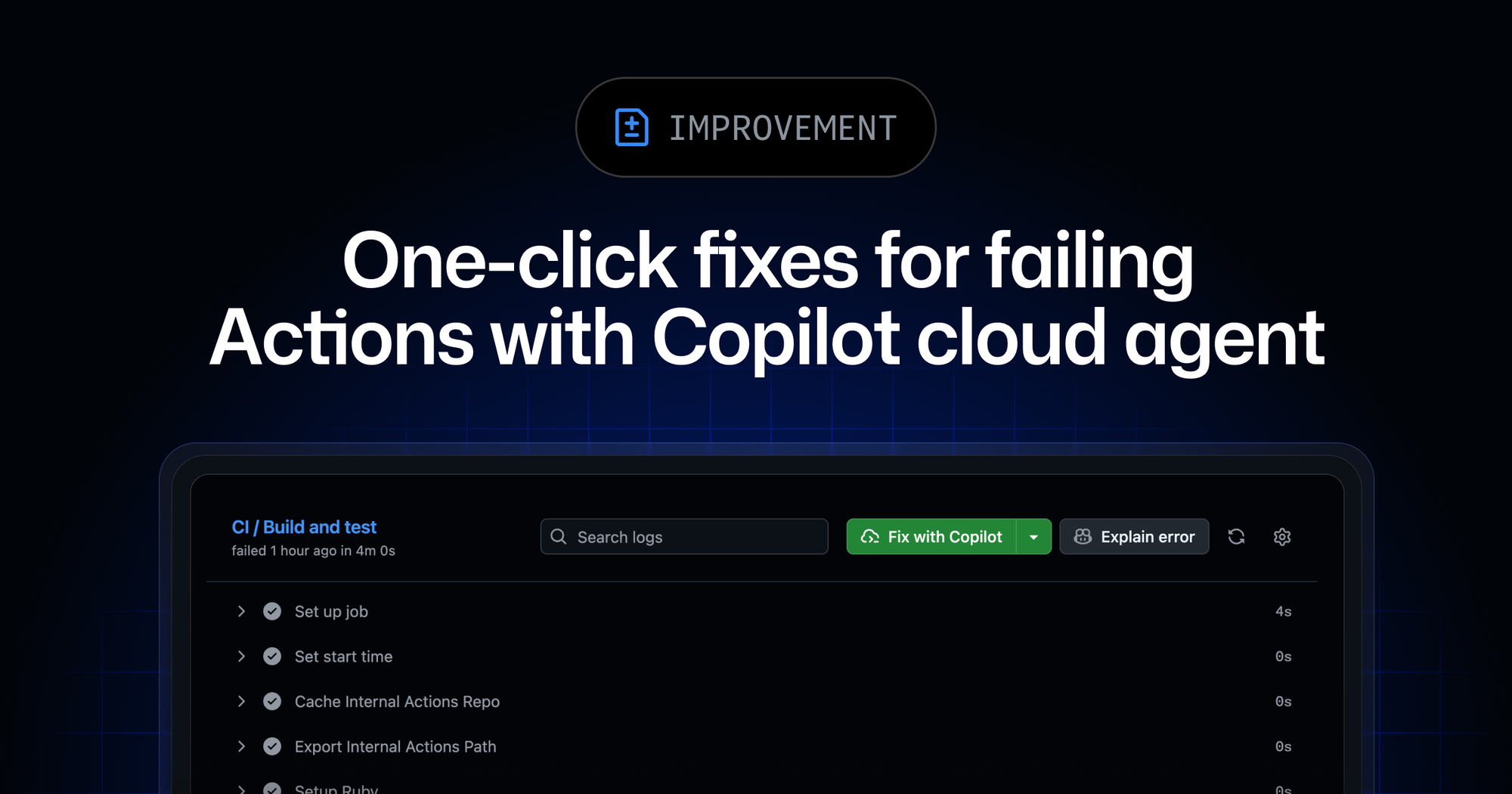
GitHub’s new Fix with Copilot button looks like the smallest possible product feature: a failed GitHub Actions run gets a button, Copilot cloud agent investigates, pushes a fix to the branch, and tags the developer for review. Cute. Also: this is exactly where coding agents stop being autocomplete and start becoming part of the software delivery control plane.
The important thing about CI failures is that they are bounded. There is a log. There is a branch. There is usually a test, linter, type checker, dependency install, or workflow step that says what broke. That makes CI repair a much better first serious delegation surface than the vague “go build this feature” prompts that turn agents into speculative interns with shell access.
GitHub says the feature is available for Copilot Business and Copilot Enterprise users on the workflow run logs page for failing Actions jobs. When invoked, Copilot cloud agent works in its own cloud-based development environment, powered by GitHub Actions, rather than directly mutating a developer’s local machine. The agent can inspect the failure, make changes, push to the branch, and notify the user for review.
That review loop is the right default. It is also not enough by itself.
A failed build is a great problem statement. It is not a permission model.
The strongest argument for this feature is practical: CI already encodes acceptance criteria. If a formatter fails, the fix is obvious. If a unit test expectation drifted after a legitimate change, the agent may be able to repair it. If a dependency lockfile needs regeneration, a background agent can save a developer a context switch. Those are exactly the kinds of paper cuts that make engineering teams feel busy without feeling productive.
But a CI failure can also be a trap. A bad agent — or a rushed human — can make the build green by weakening the system. Disable a linter. Loosen a test. Broaden a workflow permission. Pin around a dependency issue without understanding it. Change production code to satisfy a brittle test instead of fixing the test. None of those are exotic AI failure modes. They are normal engineering shortcuts, now with a button that can generate them at scale.
That is why this should be treated as a new write-capable automation surface, not a convenience setting. GitHub’s docs already point in the right direction: Copilot cloud agent must be enabled by administrators, repository owners can opt out repositories, and third-party MCP server use is disabled by default. The agent consumes GitHub Actions minutes and Copilot premium requests, so there is also a real cost-control dimension. This is not “free help.” It is background compute plus model usage plus review burden.
The real enterprise question is not whether Copilot can fix a failing job. It is what classes of failure the organization is comfortable delegating, under which controls, in which repositories, and with what evidence afterward.
The policy should be narrower than the button
A sane rollout starts with low-risk repositories and low-risk failure classes. Documentation sites, internal tooling, test-only packages, lint failures, dependency metadata, and obvious formatting issues are good candidates. Production services, infrastructure repositories, authentication code, deployment workflows, and security-sensitive packages deserve a much slower path.
Teams should also distinguish between workflow failures and workflow changes. Letting an agent fix a Python test failure is one thing. Letting it edit .github/workflows, change token permissions, alter deployment steps, or modify secret-handling behavior is another. Workflow files are not just code; they are part of the organization’s automation authority. If Copilot touches them, that should trigger stricter review, ideally from platform or security owners.
The MCP angle matters too. Copilot cloud agent can be connected into richer tool surfaces, and that is where usefulness and risk both increase. A CI-fixing agent with read-only repo context is one thing. A CI-fixing agent that can query issue trackers, logs, cloud systems, package registries, or internal APIs is more powerful — and therefore requires better inventory, logging, and approval boundaries. “The agent fixed CI” is not a sufficient audit record if the fix depended on tools outside the repository.
There is also an economics layer hiding under the developer experience. Because Copilot cloud agent uses Actions minutes and premium requests, a flaky test suite can become an AI spend amplifier. Every red build becomes a temptation to click the button. Every generated branch consumes background resources. If review queues fill with low-quality agent patches, the cost is no longer just usage-based billing; it is senior-engineer attention.
The metric that matters is not “number of CI failures delegated.” It is accepted, non-reverted fixes per unit of human review and platform cost. Track merge rate, revert rate, review comments, time to green, Actions minutes, premium requests, and follow-on regressions. Split the data by failure type. If Copilot reliably handles lint and dependency chores, great. If it starts generating clever patches that make tests pass while making code worse, shut that category down.
This is where agentic coding earns trust
The optimistic case is strong. CI repair is one of the few places where an agent can work against a concrete, machine-checkable target without needing to understand the whole product roadmap. It can reduce interruptions, clean up routine failures, and give developers back the 20 minutes normally lost to “why did the lockfile change again?” That is real productivity, not keynote productivity.
But the mature version of this feature is not a universal “fix my build” button. It is a governed handoff: scoped repositories, protected branches, review requirements, workflow-file guardrails, MCP/tool restrictions, cost monitoring, and a dashboard that shows what the agent did. The boring controls are what make the button safe enough to use.
GitHub has picked a smart beachhead. A failed CI run is a better agent task than most open-ended coding prompts because success is observable. The mistake would be assuming observable success equals acceptable change. Green is necessary. It is not proof of good engineering.
Sources: GitHub Changelog, GitHub Docs: Copilot cloud agent, GitHub Docs: administering Copilot cloud agent