GPT-5.5 Instant Hits Microsoft Foundry With 52% Fewer Hallucinations — and the Real Story Is That 'Chat-Latest' Is Now an Enterprise Product

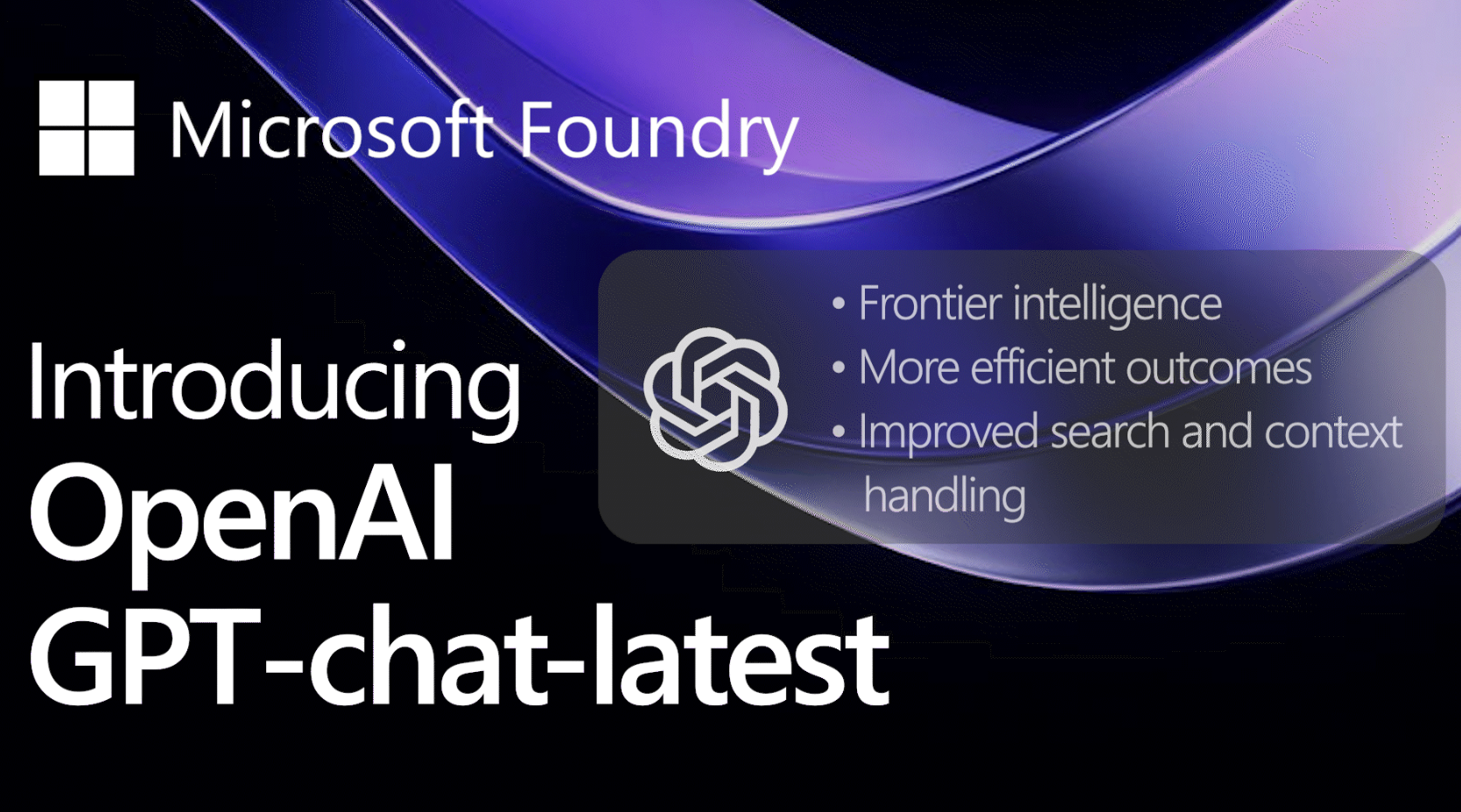
Microsoft confirmed on May 5 that GPT-5.5 Instant — OpenAI's latest default chat model — began rolling out in Microsoft Foundry the same day, and the rollout was fast enough that the announcement post landed before most developers had even finished reading the GPT-5.4 release notes. But the more interesting thing about this release is not the speed of the distribution deal. It is what the numbers actually mean for teams running production AI systems, and specifically, what the combination of a 52% hallucination reduction and a 30% output verbosity reduction actually changes in practice.
The hallucination number is specific for a reason. OpenAI tested GPT-5.5 against conversations where GPT-5.3 had previously generated hallucinated claims — the same prompts, the same retrieval grounding, the same models. On that benchmark, GPT-5.5 produced 52.5% fewer hallucinations and 37.3% fewer hallucinated claims. That is not a synthetic benchmark score that rewards style over substance. That is a direct A/B test against a production problem. For teams running retrieval-augmented generation at scale, where a hallucinated claim in a grounded answer is the failure mode that requires human review before serving, this is a direct reduction in the evaluation surface you have to cover.
The output efficiency number is equally concrete. GPT-5.5 produces 25–30% fewer words than GPT-5.3-chat at equivalent or better quality. For a high-volume chat application serving millions of requests per day, that is not a rounding error — it is a token cost reduction that compounds across every API call. At GPT-5.5's Foundry pricing ($5.00/M input, $0.50/M cached input, $30.00/M output), a 30% output verbosity reduction on output token spend is meaningful. Input token costs do not change, but output token costs do, and output tokens are the expensive direction on every GPT model.
The benchmark lifts tell a consistent story across reasoning, science, and math. AIME 2025 jumped 15.8 percentage points (65.4% to 81.2%), which is the kind of delta that separates "occasionally gets competition math right" from "can be trusted on a math-heavy reasoning chain." MMMU-Pro and GPQA both gained roughly 7 percentage points, which matters for teams building science or professional-domain assistants where accuracy on PhD-level content is a product requirement, not a nice-to-have. CharXiv-reasoning, which tests graduate-level scientific reasoning, moved 6.6 points. None of these are dramatic headline numbers, but the consistency across independent benchmarks is the signal: this is not cherry-picked improvement on one favorable task distribution.
For RAG workloads specifically, the post describes better query formulation — the model does a better job of translating a vague user question into a well-formed retrieval query. It also describes better result ranking and filtering, and more grounded synthesis of retrieved content into final answers. In practical terms, this means fewer cases where the model ignores a relevant document in the retrieval results, fewer answers that contradict the retrieved context, and fewer responses that require fact-checking before they go to users. The retrieval improvements are not headline-grabbing, but they are the difference between a RAG system that requires constant human oversight and one that can be trusted to surface accurate grounded answers at scale.
Tool calling got similar attention. The post says GPT-5.5 produces more structured and context-aware tool invocation outputs, makes better judgments about when to invoke a tool versus answering directly, and reduces unnecessary tool calls. For agentic workflows running on Foundry, this is operationally significant. Unnecessary tool invocations are silent budget burners — they add latency and token cost without improving output quality. A model that has better judgment about when to call search, when to call a function, and when to answer from context is a model that produces cheaper, faster agentic sessions.
One detail that deserves attention from teams with complex prompt scaffolding: the post says GPT-5.5 "makes better use of context developers pass in, including system prompts, conversation history, retrieved documents, and structured data." The practical implication is that elaborate prompt engineering tricks used to compensate for GPT-5.3's context utilization weaknesses may actively hurt GPT-5.5's performance. Teams that have built complex system prompts with heavy instruction repetition, redundant grounding instructions, or elaborate few-shot example formatting should test stripping those back and measuring against their current baselines. The model may be doing more of that work now, which means your scaffolding is adding noise rather than signal.
The Foundry pricing is worth noting in context. At $5.00/M input and $30.00/M output, GPT-5.5 sits above GPT-4o-mini ($0.15/M input, $0.60/M output) but below Opus 4.7 ($5.00/M input, $5.00/M output is misleading — Opus 4.7 is actually $15.00/M output). For teams that have been running GPT-4o or GPT-4o-mini and watching quality-comfort tradeoffs, GPT-5.5's combination of higher intelligence and lower hallucination rate makes it a plausible upgrade target for any workload where the 4o family was producing answers that required human review. The verbosity reduction also means that for tasks where earlier models were verbose out of caution, GPT-5.5 may produce shorter, more confident answers that are still more accurate.
The competitive picture is worth keeping in view. OpenAI's own announcement notes that GPT-5.5 matches GPT-5.4 per-token latency while delivering higher intelligence — which is the per-token latency that matters for real applications. The coding index claim — "state-of-the-art intelligence at half the cost of competitive frontier coding models" — is a direct shot at Anthropic's Opus 4.7 on cost efficiency. If that claim holds in production evaluation, it is a significant data point for teams making model selection decisions in a budget-constrained environment.
The editorial framing worth sitting with is this: GPT-5.5 Instant is the first GPT-5.x variant explicitly positioned for production enterprise workloads rather than capability exploration. The earlier variants were impressive demos and research milestones. GPT-5.5 is optimized for teams that have already decided to build AI into their products and are now trying to make those systems reliable, cost-efficient, and trustworthy at scale. The hallucination reduction, verbosity reduction, and tool calling improvements are not primarily benchmark wins — they are the features that make AI-assisted products defensible to legal, compliance, and product review. That is a different use case than "look what the model can do." It is "look what the model can be trusted to do consistently."
Sources: Microsoft TechCommunity, OpenAI, TechCrunch