Graphify v0.8.14 Is a Reminder That Agent Context Fails at the File Boundary

Graphify v0.8.14 is a small release about stale node IDs, ignore files, worktrees, and NAT64. In other words: exactly the kind of release that decides whether a coding agent is reasoning from the repository you actually have or from a corrupted map that happens to look authoritative.
That distinction matters more than the agent discourse usually admits. Everyone likes to talk about context windows, retrieval, and “understanding the codebase.” Far fewer people want to talk about whether the context layer honored .gitignore, accidentally indexed three sibling worktrees, crashed when deduplication invalidated community IDs, or blocked a legitimate docs fetch because IPv6 networking looked suspicious. But those are the details that turn compressed context into either leverage or hallucination fuel.
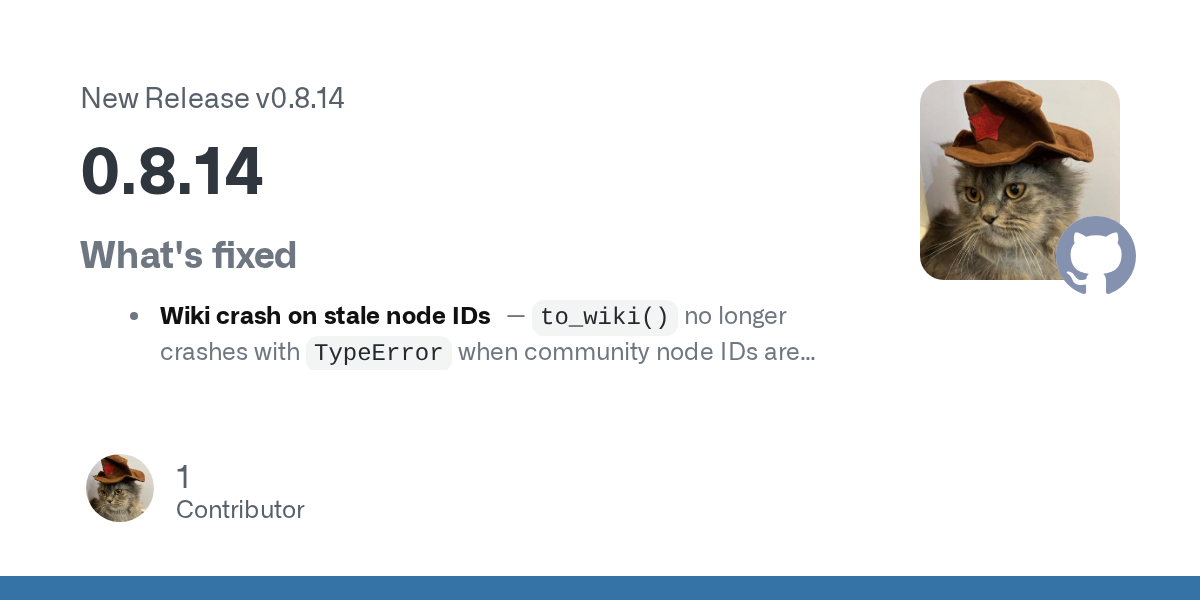
Graphify v0.8.14, published May 20, continues the context-integrity thread from v0.8.13. During the research window the repo had roughly 50,232 stars, 5,439 forks, and 261 open issues under the MIT license. The release fixes to_wiki() crashes on stale community node IDs, honors .gitignore when no .graphifyignore exists, adds a runtime --exclude flag, skips .worktrees/ sibling checkouts, and corrects a NAT64 SSRF false positive affecting hosts such as arxiv.org on IPv6-only networks.
The repository already told you what not to index
The .gitignore fallback is the most obviously useful change. Most real repositories already encode boundary knowledge in .gitignore: build artifacts, generated files, dependency directories, caches, temporary outputs, local environment files, and other noise that should not become part of an agent’s semantic view. If a context tool ignores that policy unless developers create a separate .graphifyignore, it forces teams to duplicate intent and guarantees drift.
That drift is not harmless. An agent context graph that indexes generated files can infer structure from build output instead of source. One that indexes vendored dependencies can waste retrieval budget on code the team does not own. One that indexes local artifacts can surface stale or sensitive data. The fix is conceptually simple: respect the repository’s existing contract by default. Graphify now does that when .graphifyignore is absent, while still letting the dedicated ignore file take precedence when present.
The new --exclude flag is the operational companion. Sometimes the right ignore pattern is contextual: skip a generated directory for this run, exclude a temporary corpus, or avoid a vendor subtree while testing a graph rebuild. Requiring a repo file edit for every one-off exclusion creates friction and pollutes config. Runtime gitignore-style patterns give practitioners a clean escape hatch without pretending every scan policy belongs in version control.
Worktrees make agent context weird fast
The .worktrees/ skip is the agent-specific bug hiding in plain sight. Worktrees are becoming common in AI-assisted development because they let agents run parallel branches, experiments, and background tasks without stomping on the main checkout. That is good workflow hygiene. It is also a trap for context tools.
If a graph builder indexes sibling worktrees as duplicate source, the agent receives a split-brain version of the repository. Two copies of the same file may appear to be current truth, possibly at different revisions. Relationships can be inferred twice. Search results can point at a branch the human is not actually editing. A refactor agent can make a decision based on stale code from a background experiment. The bug will not look like “Graphify indexed duplicate worktrees.” It will look like the model confidently misunderstood the codebase.
This is why agent infrastructure has to understand the workflows agents create. A code graph designed for a single static checkout is not enough when agents are opening branches, spawning background sessions, and generating intermediate artifacts. The context layer has to know which files are source of truth, which files are parallel experiments, and which paths are just the exhaust from previous runs.
Degrade honestly when the graph changes under you
The stale community node-ID fix is a nice example of honest degradation. After deduplication or re-extraction, some community IDs may no longer point to live nodes. Before v0.8.14, to_wiki() could crash with a TypeError. Now stale IDs are dropped with a stderr warning, and a clear error appears only if every ID is stale.
That is the right behavior for a context system. A hard crash makes the wiki unusable even when most of the graph is still valid. Silent recovery hides data loss and leaves the agent reasoning from a partial artifact with no warning. Dropping stale IDs while warning the operator preserves utility and exposes the fact that the graph shifted. Agent tools need more of this pattern: continue when safe, warn when fidelity changed, and fail loudly only when the artifact would be misleading.
v0.8.14 also fixes a NAT64 SSRF false positive. Blocking reserved IPs is a sensible guardrail for tools that fetch external resources; agent systems should not be allowed to wander into private networks because a URL looked innocent. But IPv6-only networks can resolve public hosts through RFC 6052 NAT64 addresses such as 64:ff9b::/96. Treating that as reserved and blocking hosts like arxiv.org punishes legitimate developer environments and creates hidden context gaps. The point of SSRF defense is to block private-network abuse, not make paper and docs retrieval mysteriously fail for people on modern networks.
The broader lesson is that token reduction is not automatically context quality. Graphify’s README positions the tool as a Claude Code skill that can turn code, PDFs, markdown, screenshots, diagrams, whiteboard photos, multilingual images, and videos into a persistent graph, claiming 71.5x fewer tokens per query versus reading raw files on a mixed corpus. That kind of compression is valuable only if the compressed view is faithful. A smaller map that includes ignored junk, duplicate worktrees, stale nodes, or missing external references is not efficient. It is efficiently wrong.
Practitioners should test context tools against the repo layouts their agents actually produce. Use worktrees. Re-run extraction after deduplication. Delete nodes and rebuild wikis. Add generated files, ignored directories, vendor folders, and runtime excludes. Try IPv6-only networks. Confirm that missing or stale context produces warnings humans can see. If your agent is going to review, refactor, debug, or explain a codebase from a graph, the graph needs to obey repository boundaries at least as well as git does.
Graphify v0.8.14 is not glamorous, and that is the point. Agent context fails at file-boundary details long before it fails at philosophy. The teams that win at “vibe debugging” will not be the ones with the prettiest graph visualization. They will be the ones whose maps are boringly, defensibly true.
Sources: GitHub — Graphify v0.8.14, Graphify README, Graphify v0.8.13 release, Graphify issues #936, #945, and #947