Halos OS Is NVIDIA’s Argument That Robotaxi Safety Needs a Stack, Not a Slogan

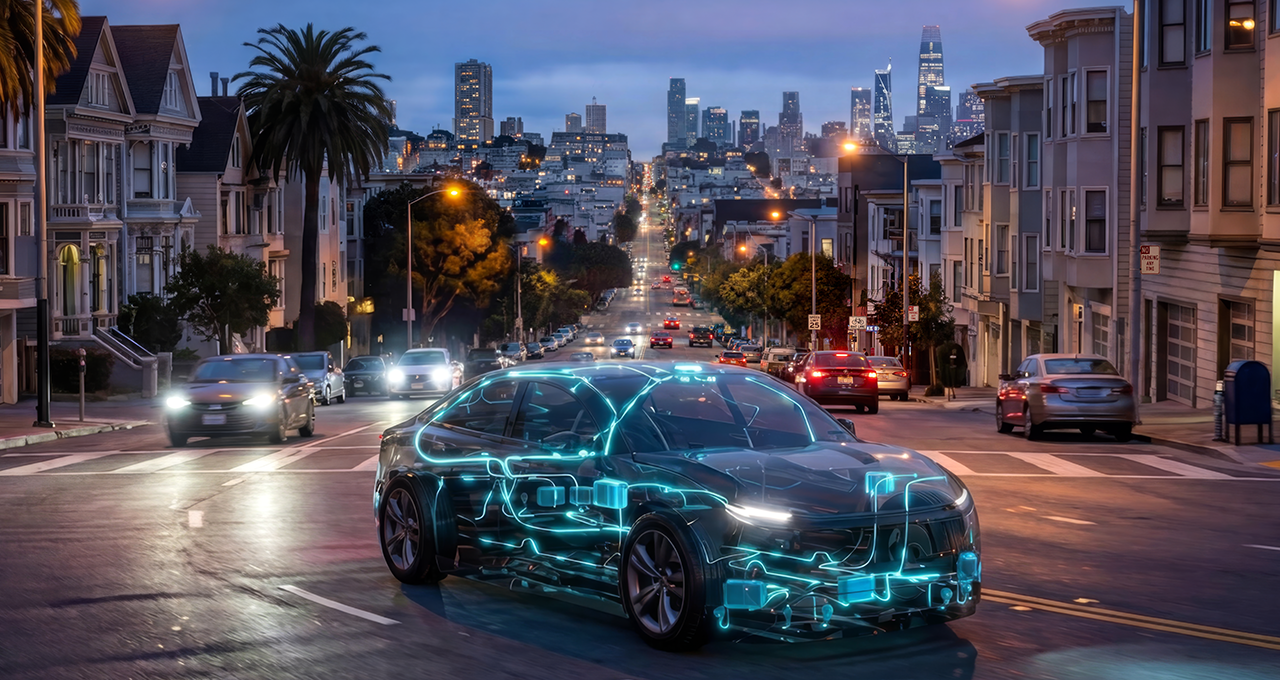
NVIDIA’s Halos OS announcement is not really about robotaxis. It is about what happens when autonomous-driving demos have to become boring enough for regulators, insurers, cities, fleet operators, and passengers to trust them.
That distinction matters. The robotaxi industry has spent years selling capability: better perception, smoother planning, more miles, cleaner demos, fewer disengagements, smarter end-to-end models. Capability is necessary. It is not sufficient. A commercial robotaxi fleet needs a safety case: evidence that the system behaves predictably, isolates faults, stays inside defined boundaries, records what happened, and can be validated before it carries strangers through public streets.
NVIDIA’s argument with Halos OS is blunt: perception and end-to-end driving models cannot carry the whole safety narrative. The company lists four problems that have to be solved together: a safety-certifiable operating system, safe standardized hardware/software interfaces, AI operating within verifiable guardrails, and validation at scale before public-road deployment. That is the right framing. A robotaxi is not a neural net with wheels. It is a distributed real-time safety system that happens to use neural nets.
The announcement lands alongside NVIDIA’s broader DRIVE Hyperion robotaxi push. Uber and Autobrains are working on a Munich robotaxi program on DRIVE Hyperion. Foxconn is expanding its collaboration with NVIDIA for fleets in Taiwan. VinFast and Autobrains are targeting Level 4 vehicles for Southeast Asia. HUMAIN is working on DRIVE Hyperion-powered robotaxis for Saudi Arabia. Those are the kind of deployments where a platform safety story stops being marketing and starts being procurement infrastructure.
The OS is the safety argument
At the base is Halos Core, described as the next generation of DriveOS. NVIDIA says it is compliant with ISO 26262 ASIL D, the automotive safety integrity level reserved for the highest-risk functions, and includes safety-certified support for CUDA and TensorRT. It also uses a hypervisor to isolate safety-critical functions so a failure in one area cannot casually wander into vehicle controls.
That may sound less exciting than a new driving model, which is exactly why it matters. The uncomfortable truth of autonomy is that the system can be impressive and still be unshippable if the runtime story is weak. Fault isolation, deterministic scheduling, safe interfaces, and certified compute paths are not optional decorations. They are how engineering teams make arguments that survive audits instead of only demo days.
Halos SDK is where NVIDIA’s platform pitch becomes more concrete. A robotaxi integrates cameras, radar, lidar, vehicle buses, timing constraints, calibration assumptions, and vendor-specific drivers. Every hardware change threatens to leak into application code and invalidate assumptions. NVIDIA says the SDK provides sensor abstraction, vehicle abstraction, deterministic application-level scheduling, zero-copy inter-process communication, system error handling, and scenario data recording.
Those details are easy to skim past. Don’t. Sensor abstraction is what lets a team swap or add hardware without rewriting the driving stack. Deterministic scheduling is what makes latency reviewable rather than vibes-based. Zero-copy IPC matters because safety-critical perception pipelines cannot afford arbitrary data movement overhead. Scenario recording is how teams preserve the evidence needed for debugging, simulation, replay, and regulatory review. This is the middleware that decides whether an autonomy stack behaves like a product or a research cluster duct-taped into a car.
End-to-end AI still needs guardrails
The most interesting editorial move is NVIDIA’s refusal to let “end-to-end AI” own the story. Halos Applications combines deterministic, rule-based safety functions with world-model perception, active safety systems, and optional end-to-end AI models such as the open Alpamayo family. The active-safety list is familiar — automatic emergency braking, lane departure warning, blind spot monitoring, collision warning — but the architecture point is sharper: use AI where it helps, then bound it with mechanisms that can be analyzed.
That is the correct posture for physical AI. In software, an agent that makes a bad edit can usually be rolled back from git. In a vehicle, a bad action has kinetic consequences. End-to-end models may improve driving behavior in messy, long-tail scenarios, but production safety cannot depend on a giant model being right for reasons nobody can explain under all conditions. Regulators do not need every internal activation explained. They do need credible boundaries, fallback behavior, test evidence, and fault handling.
The Halos Safety Evaluation Framework is NVIDIA’s attempt to package that evidence-making process. The company says SEF supports safety cases from L2 driver assistance to L4 robotaxis, drawing on more than 330 research papers and 1,000 patents developed within Halos OS. Halos Infra then connects the development loop across NVIDIA’s three-computer autonomous-driving solution: DGX systems for training, Omniverse on OVX for simulation and synthetic data, and AGX in the vehicle for real-time processing and safety.
There is obvious platform strategy here. NVIDIA wants robotaxi companies to inherit its safety substrate rather than assemble one themselves. That is powerful because most autonomy teams do not want to reinvent certified operating systems, simulation infrastructure, middleware, model serving, and vehicle compute all at once. It is also risky because adopting the stack means inheriting NVIDIA’s release cadence, abstraction boundaries, certification assumptions, hardware roadmap, and commercial leverage.
For practitioners, the takeaway is not “buy Halos.” It is to use Halos as a checklist for evaluating any autonomy or physical-AI stack. What is certifiable? Which components are deterministic? What fails closed? Where are AI decisions bounded by rules? How are sensor changes isolated from application logic? Can scenarios be recorded and replayed? How do simulation results connect to public-road deployment criteria? Where do CUDA and TensorRT optimizations intersect with safety certification? If the vendor’s answer is a demo reel, request changes.
This also applies beyond robotaxis. Warehouses, industrial robots, inspection systems, drones, and humanoids all face the same basic shift: AI systems are leaving screens and entering environments where latency, faults, and bad actions matter physically. The engineering culture has to move from “the model looked good in evaluation” to “the system has a defensible operating envelope.” Halos OS is NVIDIA making that culture shift explicit because its customers cannot scale fleets on model performance alone.
The skepticism is fair. Safety frameworks can become paperwork engines. Platform abstractions can hide hard problems until they fail expensively. Vendor certification claims deserve careful reading, not applause. But NVIDIA is aiming at the right layer. Robotaxi safety will not be solved by a better perception model bolted onto a fragile runtime. It needs certified compute, standardized interfaces, bounded AI behavior, validation infrastructure, and evidence that survives contact with regulators.
The take: Halos OS is NVIDIA’s bid to become the boring substrate underneath commercial autonomy. Boring is the point. If robotaxis are going to scale beyond pilots and press rides, the industry needs fewer slogans about intelligence and more reviewable systems that fail predictably. Ship the safety case, then ship the car.
Sources: NVIDIA Blog, NVIDIA Newsroom, NVIDIA DRIVE AV, NVIDIA Halos Safety Evaluation Framework