JUPITER Shows Exascale Science Becoming a Production Workflow

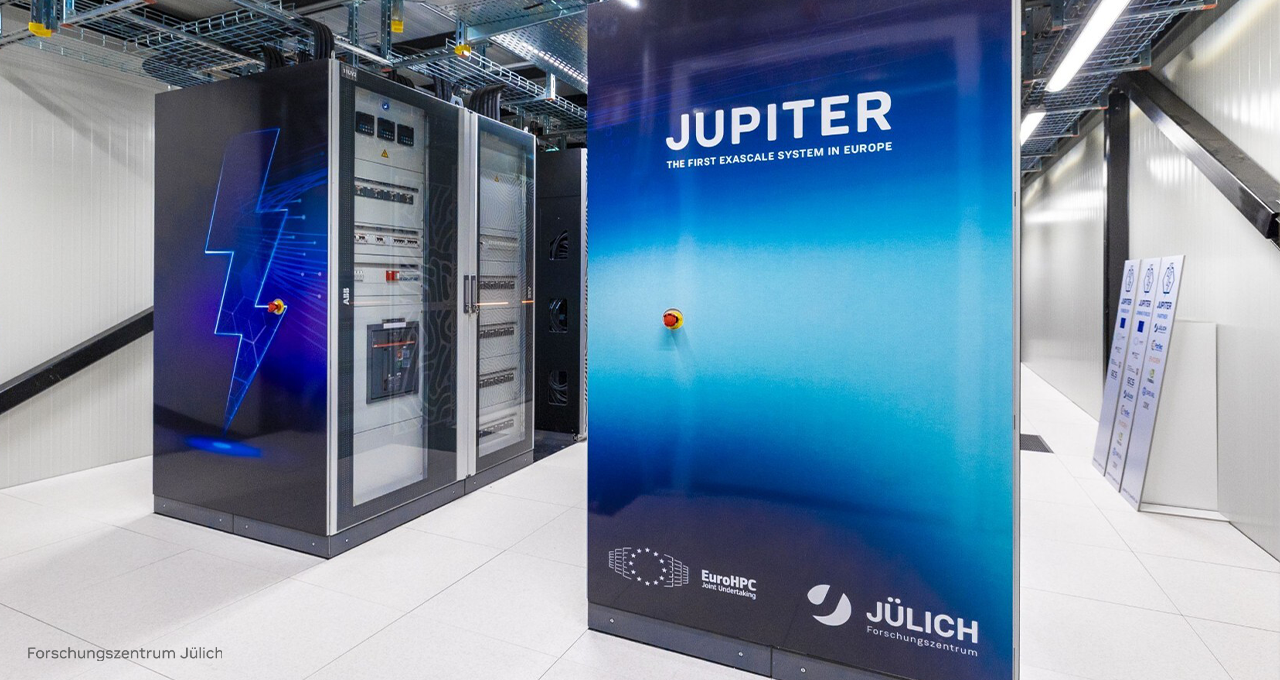
Exascale machines used to be covered like trophy cabinets: biggest, fastest, most national-pride-per-rack. JUPITER is more interesting if you ignore the trophy and look at the workloads. Europe’s first exascale supercomputer is being used to train cellular-scale brain models, run kilometer-scale climate simulation, explore 5G and 6G systems, and simulate a universal 50-qubit quantum computer. That is not one benchmark story. It is a stress test for whether a single infrastructure stack can support radically different scientific workflows without turning every research team into cluster plumbers.
JUPITER is hosted at Forschungszentrum Jülich in Germany. Jülich says it is the first computer in Europe to exceed one quintillion calculations per second. NVIDIA says the system runs on NVIDIA Grace Hopper Superchips and NVIDIA Quantum-X800 InfiniBand networking. At ISC, NVIDIA framed JUPITER as a working proof point for AI-era science infrastructure, not merely a leaderboard entry.
That framing is useful because exascale is no longer just about peak floating-point performance. The hard workloads now mix petabyte-scale data, AI training, traditional simulation, memory-hungry state spaces, visualization, scheduling and increasingly agentic interfaces. The machine has to be fast, yes. It also has to be balanced.
The brain model is a data pipeline before it is an AI story
The Jülich Brain Atlas project produced CytoNet, a foundation model for brain microarchitecture analysis, trained on 6.5 PB of data from 21 post-mortem brains. NVIDIA says the training ran in under five days on 4,096 NVIDIA Grace Hopper Superchips. The target domain is not small: the human brain contains roughly 86 billion neurons and 100 trillion connections.
The next planned step is the part software builders should watch: an AI agent for brain researchers that combines multimodal reasoning, language interfaces and Q&A using open models including NVIDIA Nemotron 3 120B. That is the right direction, but it raises the bar. A useful research agent cannot just recite neuroscience. It needs to reason across images, atlases, metadata, model outputs, uncertainty and the provenance of the underlying data. Otherwise it is a search box with a more expensive personality.
CytoNet is therefore a reminder that AI infrastructure starts before training. Petabytes must be stored, moved, decoded, normalized, labeled and fed to the system at a rate that keeps the expensive hardware doing work. If that path is weak, the model is not the bottleneck; the pipeline is. Practitioners building smaller enterprise systems should steal the lesson. Before adding another model, ask whether your data path can answer basic questions about freshness, lineage, quality and throughput.
Climate at one kilometer changes the question
JUPITER’s climate workload is ICON, a model NVIDIA describes as the first to simulate a coupled Earth system at 1-kilometer resolution with ocean, atmosphere, land, biogeochemistry and the full carbon cycle. NVIDIA says ICON ran on 20,480 Grace Hopper Superchips and simulated roughly 146 days of real climate in 24 hours of compute, which it calls a world record in global climate simulation.
Resolution matters because it changes what scientists can model directly. At coarser scales, important processes — fine-scale winds, ocean eddies, upper-ocean mixing, regional precipitation effects — are often parameterized away. At one kilometer, more of the physics can emerge inside the model instead of being approximated at the boundary. That does not make climate prediction “solved.” It makes the questions sharper and the uncertainty more specific.
The engineering takeaway is that simulation and AI are converging into the same infrastructure conversation. Climate teams need numerical kernels, data assimilation, storage, checkpointing, visualization and analysis. AI teams need many of the same things once their systems become data-heavy and long-running. Exascale science is not a separate planet from production AI; it is the extreme version of problems large enterprises will eventually recognize in miniature.
Quantum simulation exposes the memory boundary
The 50-qubit quantum-computer simulation is a different kind of proof point. Jülich researchers and the NVIDIA Application Lab simulated a universal 50-qubit quantum computer, surpassing the previous 48-qubit record. NVIDIA says the result depends on the coherent CPU-GPU memory architecture of GH200 Grace Hopper, which allows data beyond GPU limits to spill into CPU memory with minimal performance loss. The JUQCS-50 simulator is expected to be accessible through JUNIQ, JSC’s quantum computer user facility.
This is not just quantum theater. Classical simulation is still essential for designing, testing and sanity-checking quantum algorithms while hardware matures. The problem is brutally memory-hungry. Neat GPU memory boundaries become a practical constraint, not an implementation detail. Coherent CPU-GPU memory is valuable because it lets the workload exceed device memory without immediately collapsing into “out of memory, please enjoy a smaller demo.”
For builders, the analogy is broader than quantum. Many AI and data workloads fail at boundaries: GPU memory to CPU memory, local disk to object storage, training cluster to serving stack, offline data to online inference. Architectures that make those boundaries less punitive create room for more ambitious workflows. The boring plumbing is the product again. Funny how that keeps happening.
JUPITER also sits inside a wider European buildout. NVIDIA’s Newsroom says Europe has 35 NVIDIA AI HPC supercomputers in development across 23 countries, serving more than 3 million researchers, with 800 AI exaflops deployed or announced since last year. That sovereignty angle should not be reduced to flag-waving. Scientific AI needs access near sensitive data, local expertise and public-interest problems. If every serious research workflow has to pass through a small set of commercial endpoints, pricing and policy become part of the scientific method. That is not ideal.
The caveat is utilization. Big machines are easy to announce and hard to keep productively busy. The real test for JUPITER is not whether it can produce four excellent ISC demos. It is whether hundreds of research groups can port code, schedule jobs, debug failures, reproduce results and build useful agents on the system over time. Hardware can create capacity. Software, documentation, allocation policies and support decide whether capacity compounds.
For practitioners, the standup version is simple: optimize the workflow, not the logo on the rack. JUPITER matters because its workloads force the full stack to show up — petabytes of data, coherent memory, InfiniBand, domain kernels, AI models, simulation codes and research agents. If your own AI infrastructure plan only discusses GPUs, it is probably missing the expensive part.
Exascale is finally becoming less of a trophy and more of a production tool. That is the interesting milestone. The machine is big; the point is whether it can make the research loop smaller.
Sources: NVIDIA Blog, Forschungszentrum Jülich, NVIDIA Newsroom, NVIDIA Nemotron