LG Is NVIDIA’s Physical-AI Productization Test, Not Just Another AI Factory Buyer

NVIDIA’s deal with LG is easy to misread as another “AI factory” press release, which is now the industry’s default way to say “we bought a lot of GPUs and would like the market to clap.” The more useful read is sharper: LG is one of the few companies messy enough to test whether NVIDIA’s physical-AI stack can survive contact with real products.
That matters because LG is not a single-lane partner. It builds consumer devices, home robots, automotive systems, batteries, displays, data-center infrastructure, telecom services, and industrial software through LG CNS. If NVIDIA wants “AI factory” to mean more than accelerated training infrastructure, LG is a serious proving ground: robots in homes, factories with downtime costs, vehicles with validation requirements, sovereign-style enterprise models, and power systems that have to keep the whole machine running.
The announced collaboration puts that entire surface area on the table. NVIDIA says the AI factory will support LG Group’s AI-based applications across robotics, autonomous driving, data centers, GPU cloud, smart factories, and infrastructure. More specifically, the companies are talking about a workflow that links AI model development, physical-AI data generation, robot simulation and training, edge deployment, and factory-scale digital twins.
The interesting part is the workflow, not the logo wall
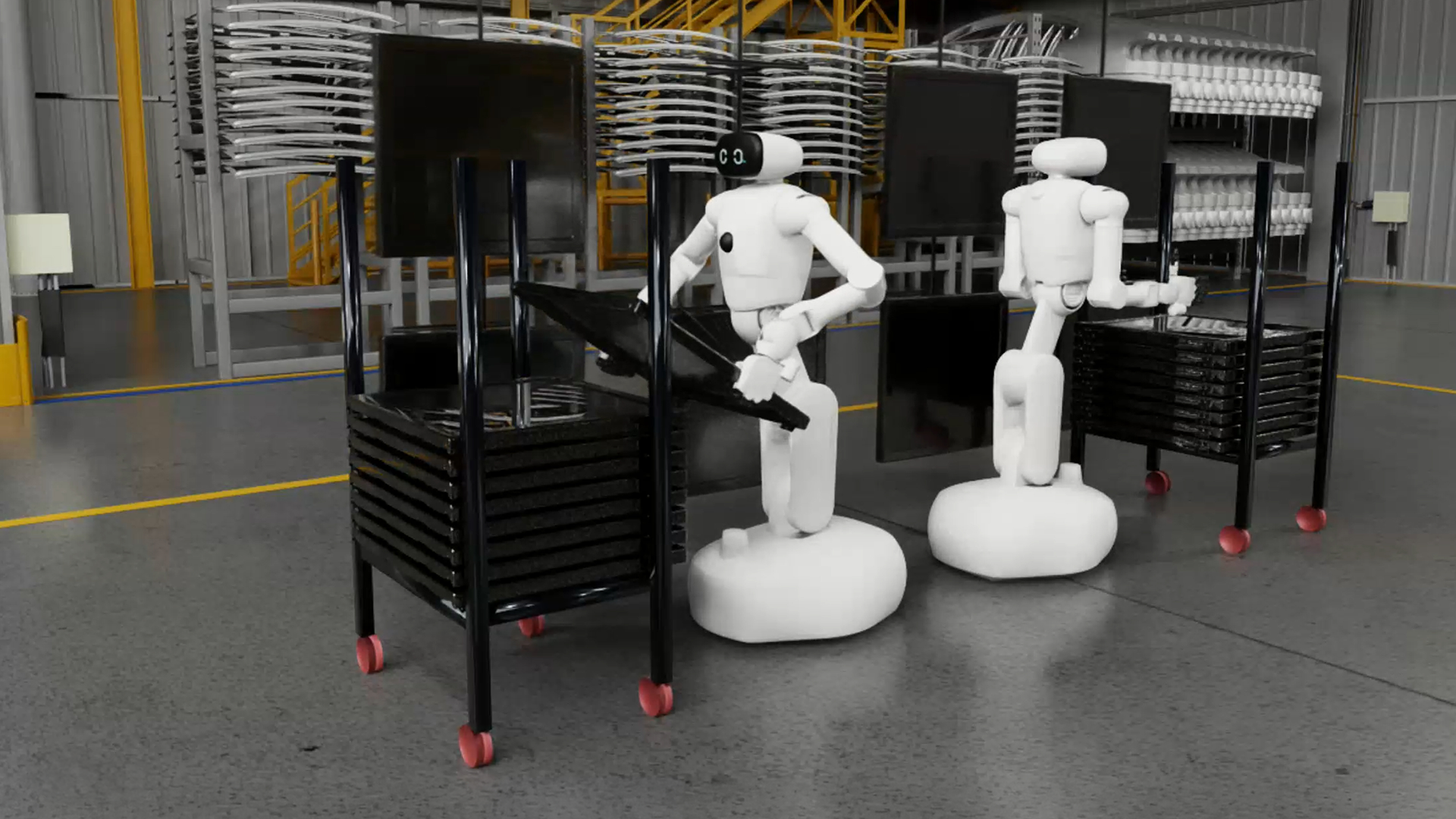
LG Electronics is developing home-based robots, including CLoiD, and NVIDIA says LG can use Isaac Sim and Isaac Lab to simulate, train, and validate those cobots in physically accurate environments before deployment. LG is also exploring Isaac GR00T for home robots and modular robotics platforms, with planned joint reference robots that put LG hardware inside the GR00T ecosystem.
That is the right abstraction level. A physical-AI product is not a chatbot with wheels. It needs perception, planning, simulation, evaluation, rollout controls, telemetry, and fallback behavior. If the model is wrong, the bug may not be a bad answer in a chat pane; it may be a robot that grabs the wrong object, blocks a hallway, or fails in a kitchen full of reflective surfaces, pets, and human impatience.
LG’s physical-AI data factory plan is also worth watching. NVIDIA says LG Electronics is using NVIDIA Cosmos world foundation models for synthetic data generation and augmentation. Synthetic data has become the industry’s favorite escape hatch for the fact that the real world is expensive to label and hard to reproduce. But it only helps if the synthetic world is calibrated against reality. Otherwise, simulation becomes a confidence generator rather than an engineering tool.
The same concern applies to LG CNS, which plans to integrate Isaac, Cosmos, and GR00T into its PhysicalWorks industrial robot platform for logistics and manufacturing floors. Factories are ideal candidates for physical AI because they are structured, instrumented, and economically sensitive. They are also unforgiving. If a digital twin is stale, if a robot policy changes without a validated rollback path, or if a planner optimizes for the wrong metric, the cost shows up in downtime, scrap, safety risk, or angry operations teams.
AI factories have thermal and power bills
The announcement gets more interesting when it leaves the robot demo zone. LG Electronics is extending AI-factory thermal work beyond CDUs and cold plates into prefabricated modular design aligned with NVIDIA DSX. LG Uplus plans scalable, power-efficient AI factories based on NVIDIA DSX, combining accelerated computing with LG infrastructure, energy, and telecommunications capabilities. LG Energy Solution is discussing emerging 800V direct-current data-center energy solutions aligned with NVIDIA BESS Self-Qualification guidelines.
That is not decorative infrastructure language. Sustained GPU utilization is a physical event. It becomes heat, power draw, rack density, maintenance planning, and eventually a procurement argument with the grid. Teams building inference-heavy systems often model cost as tokens times price. The mature version includes power availability, cooling efficiency, redundancy, deployment lead time, and whether the data center can run the workload at the duty cycle the product assumes.
This is where LG gives NVIDIA something more useful than a customer quote. LG touches batteries, telecom, thermal systems, industrial deployment, and consumer hardware. If the AI-factory pitch cannot be made operational across a company like this, it probably cannot be made operational at all without a lot of custom integration glue and professional-services invoices.
There is a software story here too. LG AI Research used NVIDIA Blackwell GPUs, NeMo, Nemotron open datasets, and TensorRT-LLM to support EXAONE model development and optimized inference deployment. That detail makes the announcement broader than robotics. The emerging enterprise pattern is hybrid: train or tune large models upstream, optimize or distill for domain deployment, serve latency-sensitive workloads closer to where the work happens, and feed results back through simulation, telemetry, and data-generation loops.
Mobility adds another hard boundary. LG Electronics is aligning ADAS and in-vehicle AI systems with NVIDIA DRIVE Hyperion and plans to use DRIVE AGX for AI cockpits and edge AI processing. In cars, “agentic” cannot mean “the model seemed confident.” It needs isolation between infotainment and safety-critical systems, deterministic control boundaries, audited model updates, and validation regimes that do not collapse under the weight of a weekly AI release cycle.
What engineers should actually do with this
If you are building robotics, manufacturing AI, edge inference, or mobility systems, the LG announcement is a useful checklist disguised as partner news. Before shopping for GPUs, ask whether your workflow has sim-to-real validation, reproducible training data, task-specific benchmarks, inference latency SLOs, rollback paths, and post-deployment telemetry. If those are missing, more compute will mostly help you produce bad decisions faster.
For infrastructure teams, treat DSX-style “AI factory” language as an architecture review prompt. What is the target utilization? What happens to cost per completed workflow under long-context inference? Can the cooling plan survive sustained load? Are you relying on synthetic benchmarks rather than production concurrency? Do you know which workloads belong upstream in centralized infrastructure and which must run at the edge for latency, privacy, or resilience?
The optimistic read is that NVIDIA and LG are assembling a credible full-stack physical-AI deployment path: Blackwell and TensorRT-LLM for model work, Isaac and Cosmos for simulation and data, GR00T for robotics, DRIVE and Jetson-class systems for edge deployment, DSX for infrastructure, and LG’s own hardware and operations footprint to make it less theoretical.
The skeptical read is equally important: every “unified workflow” hides ownership problems. Who signs off on synthetic data quality? Who approves robot policy updates? Who owns failures when the simulation said yes and the factory floor says no? How are models versioned across home robots, industrial robots, vehicles, and cloud services? The press release names the stack. The engineering work is in the governance.
LG is not just buying into NVIDIA’s physical-AI story. It is volunteering to expose the integration tax. That is the part worth paying attention to. If this works, “AI factory” starts becoming a deployment template. If it does not, it remains a slide with excellent lighting.
Sources: NVIDIA Blog, NVIDIA DSX, NVIDIA Isaac Sim, NVIDIA Isaac GR00T, NVIDIA Cosmos