Microsoft’s Best Azure AI Story Tonight Is Not a New Model. It Is a Latency Argument.

Microsoft’s most interesting Azure AI story this week did not come from a benchmark chart, a foundation-model drop, or another vague promise about autonomous agents. It came from a much duller place: network topology. That is exactly why it matters.
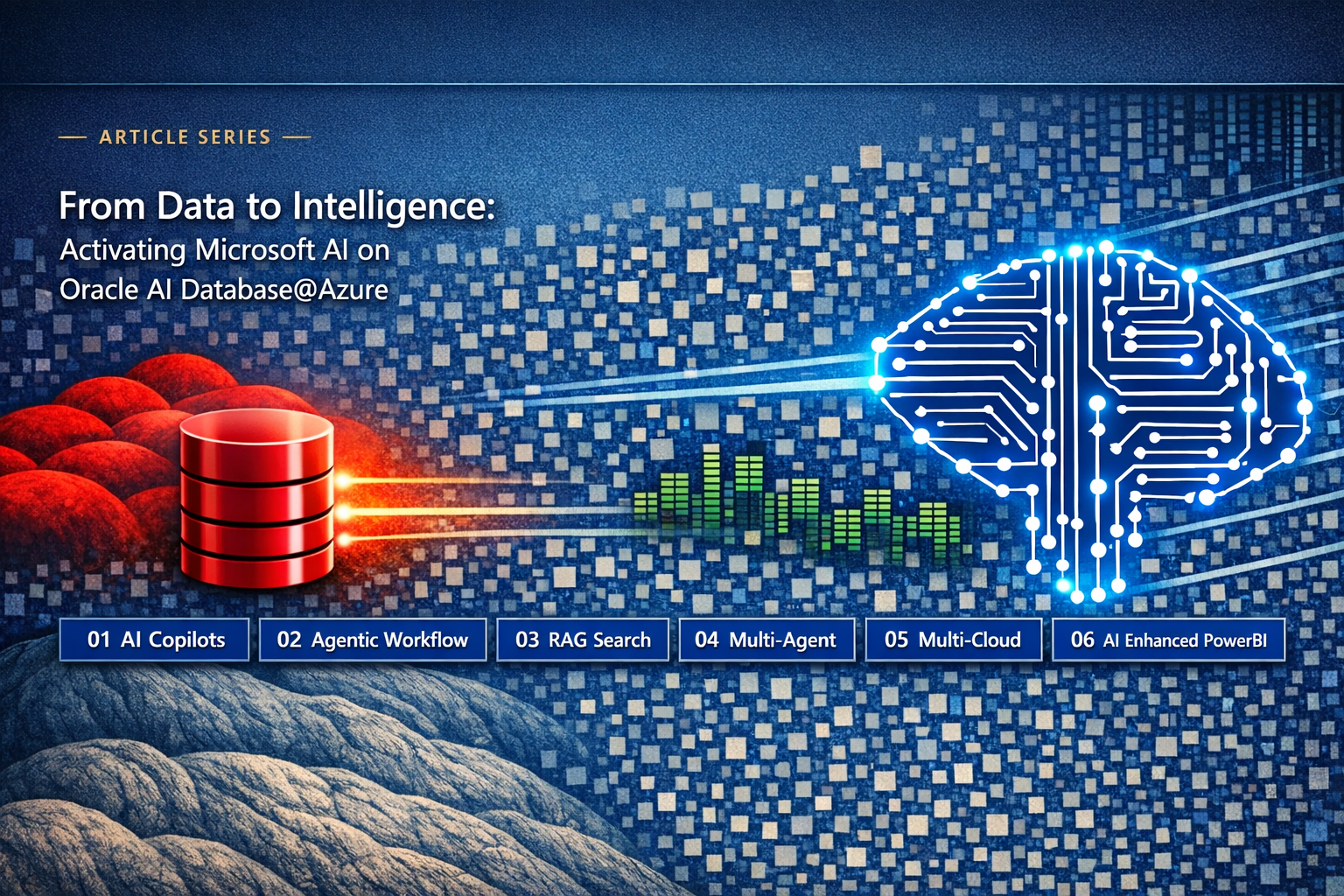
The new Oracle on Azure architecture post is nominally about Oracle AI Database@Azure and how it can connect to Microsoft Foundry, Azure OpenAI, Copilot Studio, Power Platform, Logic Apps, and agent workflows. The bigger point is sharper than the packaging. Microsoft is arguing that a lot of enterprise AI has not failed because the models are weak. It has failed because the data is too far away from the model, the control plane, and the user workflow.
That sounds obvious, but it is the kind of obvious truth the industry keeps trying to spend its way around. If your operational data lives in one place, your model endpoint lives somewhere else, your orchestration layer sits in a third service, and your identity or policy stack is stitched together after the fact, you do not have an AI system. You have a latency budget with delusions of grandeur.
Microsoft’s post makes the case with unusually concrete numbers. It says 200 to 300 milliseconds of cross-cloud or on-prem round-trip delay is enough to make real-time copilots, agent loops, and AI-enriched dashboards feel broken. That claim is easy to believe. In single-request chat, 200 milliseconds sounds survivable. In an enterprise workflow with retrieval, tool calls, SQL access, policy checks, and multiple hops, that penalty compounds fast. Add a few retries, a long-running business API, and a UI that has to feel interactive, and your “smart assistant” becomes an expensive spinner.
The part worth paying attention to is the physical deployment argument. Oracle AI Database@Azure is positioned as running in the same Azure region, on the same datacenter fabric, with zero egress between the Oracle database layer and Microsoft AI services. Oracle’s own service pages reinforce the commercial part of that story: unified Azure billing, MACC alignment, and Oracle database services ranging from Base Database Service to Autonomous AI Database and Exadata options. Microsoft’s post takes that infrastructure fact and turns it into an application thesis. Put the model, the data, and the orchestration layer next to each other, and a whole category of proof-of-concept failures stops being inevitable.
The useful part is not the partnership slide, it is the pattern catalog
What makes the article stronger than typical partner content is that it lays out six actual integration paths instead of hand-waving toward “seamless experiences.” Those paths range from the low-code end, such as Copilot Studio’s native Oracle connector, to more controlled pro-code setups like ORDS plus PL/SQL, JDBC-backed Azure Functions, Logic Apps orchestration, and Foundry agents connected through OpenAPI tools.
That matters because enterprise teams do not all need the same kind of AI. Some need a chatbot over live Oracle tables inside Teams. Some need deterministic access to a narrow set of stored procedures with row-level security and auditability. Some want Oracle Select AI handling natural-language-to-SQL inside the database boundary. Others need custom function wrappers because the workflow spans Oracle plus half a dozen other systems. Treating those as distinct patterns is more credible than pretending there is one blessed architecture for every workload.
Microsoft also deserves credit for highlighting the tradeoffs instead of hiding them. The Copilot Studio path is fast, low-code, and attractive for business teams, but it gives up some direct control over SQL generation and custom business logic. The ORDS plus PL/SQL route is slower to build, but far easier to defend in front of security and compliance teams because every query surface is explicit. The Select AI route is compelling for governed NL2SQL, but it depends on Autonomous Database and is not universally available across every Oracle deployment type. That kind of specificity is what separates an architecture note from marketing wallpaper.
Enterprise AI is increasingly about data adjacency, not model maximalism
The industry keeps talking as if enterprise AI competition is mainly about who has the best model. For practitioners, that is only half the story, and often the less important half. If the model is brilliant but the system cannot reach current business data quickly, safely, and repeatably, the user experience collapses anyway.
That is why this post is more strategically important than another catalog expansion inside Foundry. Microsoft is repositioning Azure AI around infrastructure geometry. The pitch is no longer just “we host many models.” It is “we can reduce the operational distance between your model, your data, and your governance stack.” That is a much more durable enterprise argument.
You can see the same logic in adjacent Microsoft documentation. Copilot Studio’s Oracle knowledge-source feature is built around real-time reasoning over external Oracle tables without duplicating the data. Foundry’s OpenAPI tooling is designed to let agents call external APIs using managed identity, API keys, or anonymous auth, which is exactly how you would expose ORDS or wrapped Oracle services into a controlled agent runtime. None of that is flashy. All of it is what serious teams eventually need.
The deeper implication is that Azure’s moat may come less from frontier-model exclusivity and more from boring integration leverage. Enterprises already have identity in Entra, governance expectations around Purview and RBAC, collaboration surfaces in Teams, analytics in Fabric or Power BI, and operational gravity around Azure regions. If Oracle data can now sit close enough to that stack to make AI interactions feel native instead of fragile, Microsoft does not need to win every model war. It just needs to make deployment less painful than the alternatives.
What builders should actually do with this
If you are an engineering leader or platform team evaluating AI over Oracle-heavy systems, the lesson here is not “buy more AI.” It is “design the path before you design the prompt.” Start by mapping which workflows truly need live operational data and which can tolerate replication, caching, or nightly pipelines. Then choose the integration pattern based on governance needs, not demo convenience.
For read-heavy conversational access with modest risk, Copilot Studio’s Oracle connector may be enough. For anything that touches money, regulated records, or high-consequence decisions, the safer default is closer to ORDS plus PL/SQL or OpenAPI-wrapped services, where you can enforce deterministic access patterns, version interfaces, and log every call. If your use case is natural-language analytics over Oracle and you already run Autonomous Database, Select AI is worth piloting, but only with tight object scoping and human review for the generated SQL behavior.
You should also test the parts vendors tend to wave past: tail latency under load, identity passthrough, failure behavior when a downstream Oracle endpoint slows down, tool timeout policies in Foundry agents, and schema-change blast radius. Microsoft’s latency thesis is probably right, but low average latency does not save you from ugly p95s or badly bounded retries. This is the difference between a good architecture diagram and a production service that survives quarter close.
My take: this is one of the better Azure AI stories of the month because it is grounded in a truth experienced teams learn the hard way. Enterprise AI usually does not die in the model. It dies in the seams. The more Microsoft can eliminate those seams, or at least make them explicit and governable, the stronger Azure’s position gets.
That is also why the Oracle angle is bigger than Oracle. Substitute SAP, ServiceNow, internal APIs, or a cranky line-of-business database and the same rule applies. If the data path is sloppy, the AI product is theater. If the data path is tight, governed, and physically close to the inference and orchestration layers, suddenly the boring enterprise stack starts to look like an advantage.
That may not be as fun as announcing another model. It is more useful.
Sources: Microsoft Tech Community, Oracle, Microsoft Learn (Copilot Studio), Microsoft Learn (Foundry OpenAPI tools)