NVIDIA's BioNeMo Framework Turns the Memory Wall Into a Scaling Opportunity

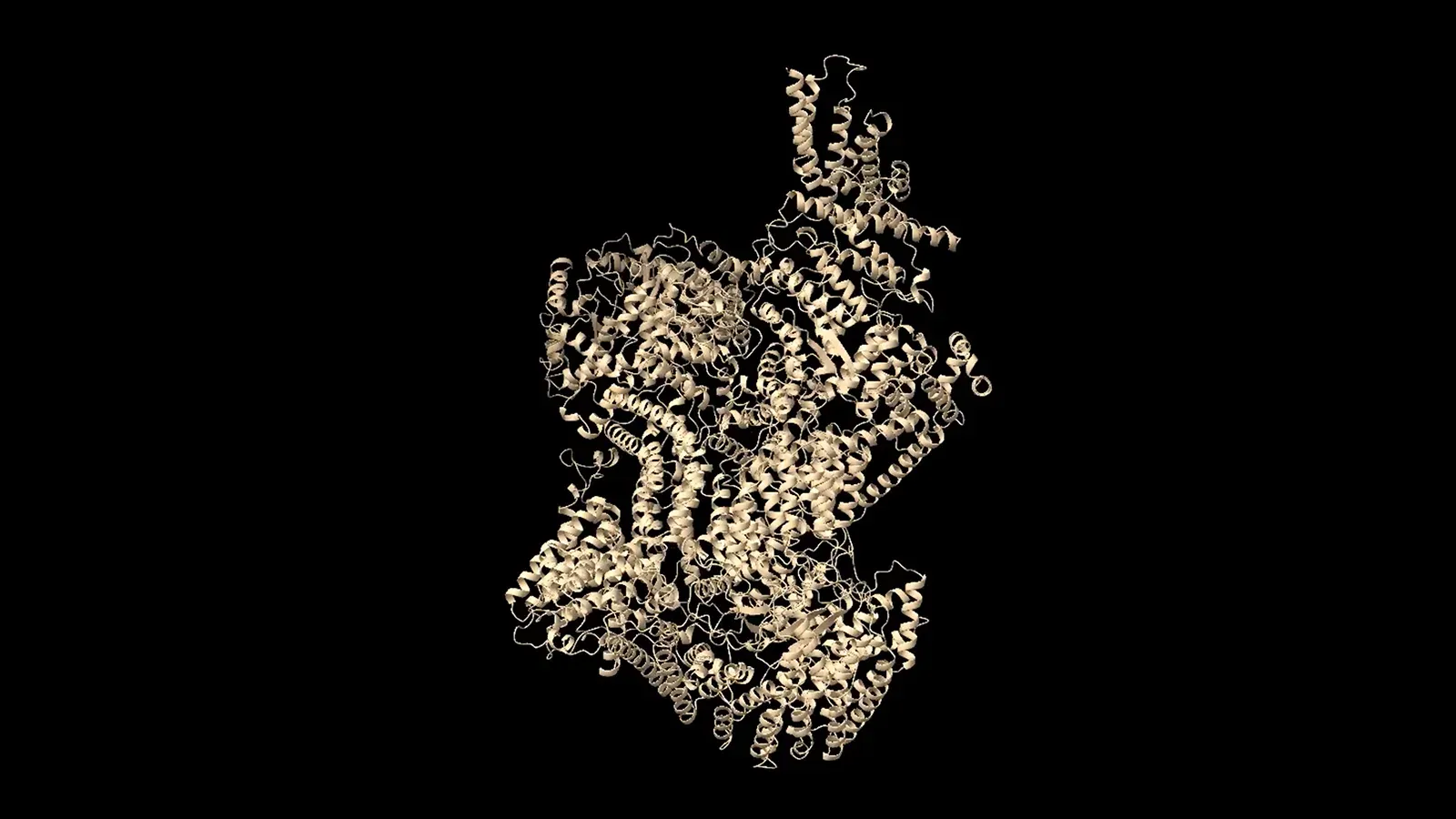
The memory wall is one of those problems that sounds like a hardware complaint until you look at how systems engineers actually solve it. The naive answer is to fragment the problem into pieces small enough to fit in GPU VRAM and accept the accuracy loss from losing global context. The smarter answer — which NVIDIA's BioNeMo team published this week — is to rethink the communication topology so the fragmentation is invisible to the algorithmic outcome while the memory pressure disappears entirely. That is the context parallelism story, and it is worth understanding even if you never fold a protein.
The Actual Problem With Protein Folding at Scale
Here is the biological version of the memory wall. A protein's structural state depends on interactions between every pair of amino acid residues — an N×N pairwise relationship matrix where N is the number of residues. For a modest 1,000-residue protein, that is a million pairwise interactions that all need to be simultaneously accessible to the model. For a 10,000-residue complex — which is the scale of many biologically interesting multichain systems — you are managing 100 million pairwise interactions. A single H100 GPU has 80GB of VRAM. That math does not work without fragmentation.
The field's traditional workaround has been to fragment proteins into manageable chunks, model each piece independently, and then try to reconstruct the global structure from the pieces. This works badly when the interesting biology lives at the interfaces between subunits — which is exactly where drug discovery targets tend to be. The fragment-and-reconstruct approach systematically discards the long-range structural contacts that are most likely to be therapeutically relevant.
The BioNeMo context parallelism framework takes a different approach. Instead of distributing different proteins across GPUs — the standard data-parallel approach — it shards a single large biomolecular complex across a GPU mesh. The key innovation is multidimensional tiling of the N×N pair representation matrix: for a 10,000-residue complex across 256 GPUs, each device handles a 625×625 tile instead of the full 10,000×10,000 matrix. The memory footprint per device drops from O(N²) to O(N²/P), where P is the number of GPUs. That is not compression. That is a different architecture.
The 2D Ring Communication Pattern Is the Core Insight
The tiling scheme alone is not enough. Once you partition the matrix across GPUs, you need a communication pattern that allows each GPU to compute local updates while still respecting the global structure of the problem. The BioNeMo implementation uses a 2D ring: a row ring and a column ring operating simultaneously, with GPUs exchanging boundary data as they sweep through their local tiles.
Concretely: a GPU computes a local update on its tile while asynchronously sending its row-boundary data to its left neighbor and receiving column-boundary data from its right neighbor. The computation and communication overlap, which means the GPU is never idle waiting for data it does not yet have. The result is linear memory scaling — double the GPUs, halve the memory per device, maintain the same end-to-end latency per sample.
This is the same communication-compute overlap strategy that distributed training systems use for ring attention in large language models, except here it is applied to inference on a single large sample rather than batch training across many samples. If your workload involves any task where the full context must be maintained in memory simultaneously — long-context reasoning, full-genome analysis, high-resolution image stitching, satellite video processing — this framing of "context parallelism versus data parallelism" is the transferable insight.
The Drug Discovery Numbers Are Concrete, Not Theoretical
The benchmark that matters most appeared in the NVIDIA post: a 3,605-residue four-chain protein complex (TTC7A/PI4KA/FAM126A/EFR3A) folded in under five minutes on four H100 GPUs, approximately 54 seconds per sample. The training crop size for Boltz-2 — the reference codebase — is 768 residues. This result exceeds that crop size by 4.7x while preserving all long-range inter-subunit contacts.
The partner results are the most commercially relevant signal in the post. Rezo Therapeutics reports greater than 3x enrichment of high-quality novel protein complexes discovered using context-parallelism-resolved predictions versus public-domain PPI-only predictions. Proxima embedded CP in its all-atom generative model Neo, enabling inference on assemblies up to 4,000 tokens. Earendil Labs extended input sequence lengths in their proprietary biomolecular foundation model. These are not courtesy mentions — they are named collaborators who contributed to the CP framework development, which suggests the architecture was validated by practitioners with real protein-complex workloads before the public post.
The token scaling data tells you where this goes next. Boltz predictions can now run on up to approximately 20,000 tokens using 256 GPUs, with further acceleration on B300 versus H100. That is not a marginal improvement. It is a capability expansion. The field has been limited to single-protein or small-domain modeling because that is what fits in GPU VRAM. CP changes the question from "what can I afford to model?" to "what is the actual biological system I need to understand?" That shift in question-framing tends to produce different scientific insights, because the interesting biology often lives at the subunit interface, not inside a single protein fold.
Why This Matters Beyond Biology
The memory wall is not a hardware problem. It is a systems design problem with a topology solution. NVIDIA is publishing the playbook, and the playbook is domain-agnostic.
Any ML engineer working with structured inputs that scale poorly in memory — long sequences, large graphs, high-resolution spatial data, multidimensional grids — faces the same fundamental constraint. The naive solution is to truncate, chunk, or sample your way to a smaller problem. The smarter solution is to distribute the full problem across a communication topology that preserves the global structure while making the memory footprint tractable. The BioNeMo CP framework is the most concrete published implementation of that solution in the computational biology domain, but the pattern is not biology-specific.
The 2D tiling + ring communication architecture is the implementation detail worth studying. Once you understand why ring communication in both row and column dimensions eliminates the all-to-all communication bottleneck that makes naive distribution impractical, you have a tool that applies wherever your problem has an N×N structure that exceeds single-device memory. The memory wall stops being a ceiling and becomes a signal about what topology to use.
The caveat is the familiar one for academic-computational work: the benchmark case is a proof of concept. Production drug discovery workflows involve larger complexes, more diverse structural states, and uncertainty quantification that is harder to validate at scale. The path from "we folded one complex fast" to "we routinely explore the entire structural interactome" is real but not automatic. But the framework is open-source, the collaborators are named and active, and the memory math is not handwaving. This is a credible research infrastructure story wearing a biology costume.
Sources: NVIDIA Technical Blog, arXiv: Fold-CP, GitHub: NVIDIA-Digital-Bio/boltz-cp