NVIDIA's Factory AI Push Looks More Like Infrastructure Procurement Than Another Robot Demo

The next time someone tells you that AI is mostly about chatbots, point them to an automotive wind tunnel or an electronics manufacturer with forty factory floors. The real AI revolution in industrial software is quieter, slower, and significantly more durable than anything that fits in a product launch demo—and NVIDIA is making its move right now, on the factory floor rather than the keynote stage.
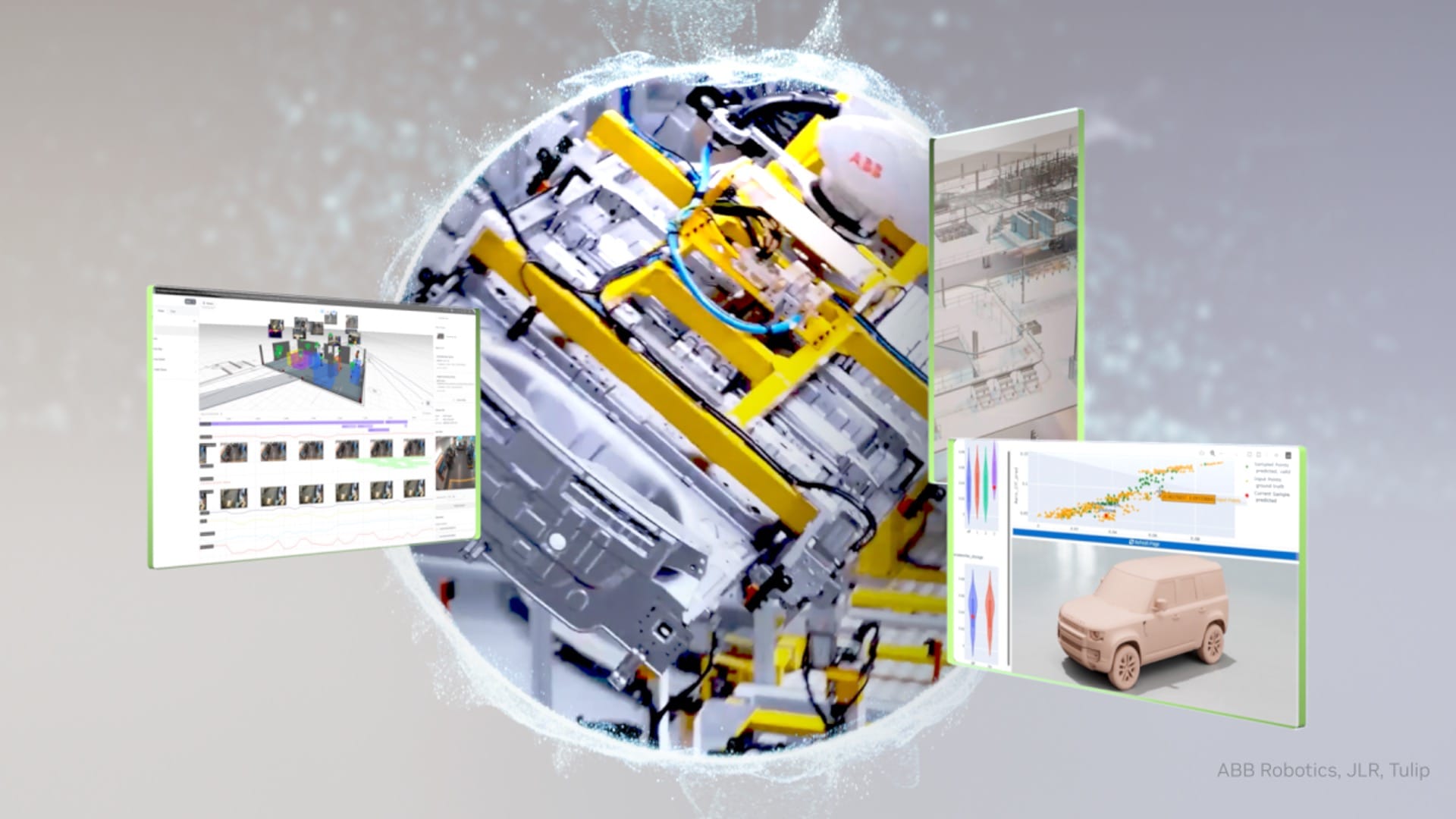
The story starts with a number that should make any manufacturing engineer pay attention: ABB Robotics says it is achieving 99% accuracy between its simulation environment and the physical robots that eventually run on the production line. Not 95%. Not close enough for government work. Ninety-nine percent. That threshold matters because it is the difference between simulation being a rough preview tool and simulation being a substitute for real-world testing—which is what the phrase "simulation-first" actually means when you strip away the marketing.
ABB's RobotStudio HyperReality platform, which runs more than 60,000 engineers globally, represents robot stations as USD files that execute the same firmware as the physical machines they model. When a new production line is being planned, engineers can train robotic movements, test part tolerances, and validate AI perception systems against a digital twin that behaves like the real thing—before a single physical robot has been unboxed. The company reports up to 50% reduction in product introduction cycles, up to 80% reduction in commissioning time, and 30-40% reduction in total equipment lifecycle cost. Those are not pilot numbers. They are procurement-ready metrics that any factory manager can put into a business case.
The second data point that makes this story worth telling is JLR—the company formerly known as Jaguar Land Rover—collapsing a four-hour aerodynamic simulation result into one minute. The mechanism is a neural surrogate model trained on more than 20,000 wind-tunnel-correlated computational fluid dynamics simulations across the vehicle portfolio, with 95% of aero-thermal workloads now running on NVIDIA GPUs. The Neural Concept Design Lab, built on Omniverse, lets designers adjust vehicle geometry and watch aerodynamic consequences render in real time, turning a sequential design-then-simulate cycle into a continuous iteration loop. This is not a future roadmap. It is a deployed system producing real cars.
OpenUSD Is Not Just a Rendering Format Anymore
What ties these case studies together—and what makes this a story for software builders rather than just factory procurement teams—is the infrastructure layer underneath. Both ABB and JLR are building on OpenUSD, and both are betting on SimReady as the content standard that keeps 3D assets from losing their physics properties and metadata as they move between CAD tools, simulation platforms, and AI training pipelines.
SimReady is NVIDIA's answer to a problem that has plagued industrial AI for years: when you take a beautifully engineered CAD model and move it into a simulation environment, then again into a machine learning training pipeline, the physics accuracy degrades at each hop. Surface normals get lost. Material properties get approximated. Semantic metadata—the "this is a robotic end effector" context that makes assets useful to AI systems—disappears entirely. SimReady is a specification, built on OpenUSD, that says: here is what a physically accurate, AI-ready 3D asset must contain, and here is the format it must be stored in to survive the journey from SolidWorks to Isaac Sim to your training data loader without rebuilding from scratch.
That might sound like a data formatting problem, which is not usually the kind of thing that gets tech press excited. But it is actually the same strategic move NVIDIA made with CUDA in the early 2000s. The chip was the product, but the library ecosystem and the standard APIs were the moat. SimReady is NVIDIA trying to own the content standard at the data preparation layer, before training and inference even start. If SimReady becomes the agreed-upon answer to "how do I move a 3D asset from my CAD tool into my simulation and then into my AI training pipeline without losing information," NVIDIA becomes mandatory infrastructure at the point where most industrial AI projects currently die—stuck in the glue code and custom converters that make the actual work survivable but slow.
The Terex Number That Should Worry Every Industrial Software Incumbent
The third case study in NVIDIA's post is the one that deserves the most attention from builders, even though it is the least dramatic in presentation. Tulip Interfaces deployed its Factory Playback platform at Terex—an industrial equipment manufacturer with over 40 plants globally—using NVIDIA's Metropolis VSS Blueprint and Cosmos Reason vision language model running entirely on-premises on NVIDIA GPUs. The system connects factory camera streams, machine sensor data, and operational context into a unified timeline. The expected outcome: a 3% increase in yield and a 10% reduction in rework.
Three percent yield improvement across 40 plants is not a rounding error. Depending on Terex's revenue and margin structure, that number could easily represent tens of millions of dollars annually. And it comes not from a breakthrough in robot control or a new foundation model, but from something much simpler: the ability to replay what actually happened on a factory floor and understand why quality deviations occurred. That is essentially a computer vision and video analytics problem, solved by an on-premises stack that does not require sending factory camera feeds to a cloud API.
The on-premises constraint is underrated as a product feature in this context. Factory operators have spent years being told that AI will transform their operations, but the fine print usually involves sending proprietary production data to a third-party cloud. The Tulip-Terex deployment shows a path where the AI inference stack sits inside the factory network, processing camera feeds locally, with the output being structured operational intelligence rather than raw data flowing outbound. That architecture is more complicated to build and sell, but it is also stickier and harder to displace once it becomes part of the operations tooling.
What Builders Should Extract From This
The practical takeaway for software engineers and technical leads is not "buy more NVIDIA GPUs"—it is that the simulation-to-production pipeline is now a first-class engineering problem with a reference architecture that did not exist two years ago. The components are: SimReady assets for physical accuracy, Omniverse libraries for the simulation layer, Metropolis for video and sensor intelligence, and Cosmos for vision language interpretation. NVIDIA is not selling these as separate products. It is positioning them as a stack that spans the entire development lifecycle from CAD to deployed factory AI.
For teams building in industrial automation, robotics, aerospace, automotive, or any domain where physical prototypes are expensive and simulation is valuable, this means the question is no longer "should we use simulation?" The question is "which layer of our simulation stack are we going to own, and which are we going to rent from a platform vendor?" NVIDIA is betting that the answer for most enterprise buyers will drift toward the latter, with SimReady and Omniverse as the path of least resistance.
The counterargument, and it is a real one, is that OpenUSD adoption has been slower than NVIDIA's projections for the better part of a decade. The industrial software landscape is fragmented, legacy-ridden, and politically complex—every major CAD vendor has its own preferred format and its own incentives to keep customers locked into its ecosystem. SimReady works only if the major asset creation tools support it, which means NVIDIA needs Autodesk, Dassault Systèmes, and Siemens to treat it as a priority rather than a threat. That coalition has not fully formed yet.
But the case studies from ABB, JLR, and Terex suggest the needle is moving in the right direction. These are not unnamed pilot partners or future roadmap claims. They are real deployments with real numbers, and they are using SimReady and Omniverse as the connective tissue. The factory is not becoming a simulation. The simulation is becoming the factory—and NVIDIA wants to be the operating system it runs on.
Sources: NVIDIA Blog, NVIDIA OpenUSD, SimReady Foundation on GitHub