NVIDIA’s New Science Stack Moves CUDA-X Into the Lab Control Loop

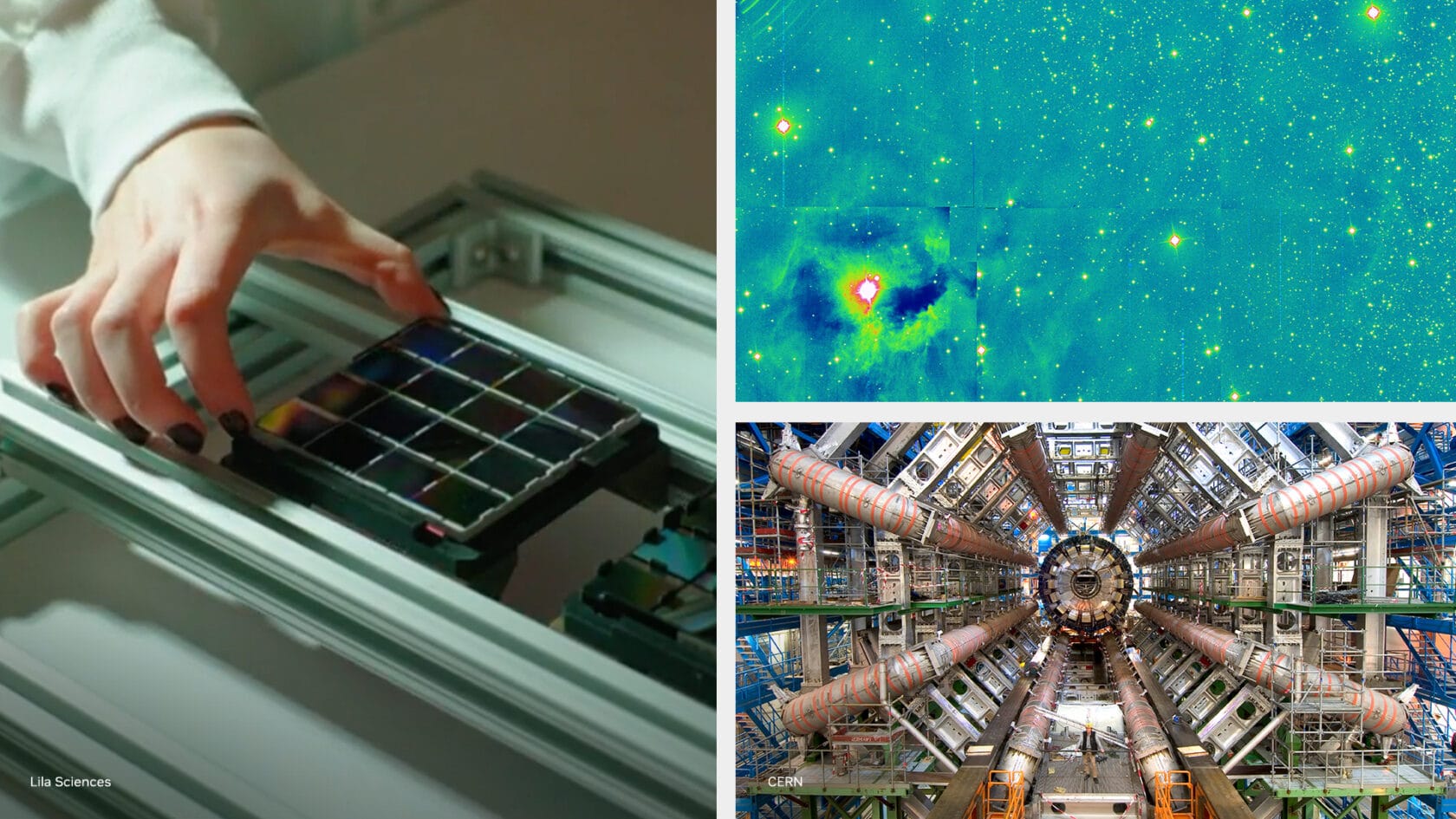
NVIDIA’s latest AI-for-science software drop looks small if you read it like a product announcement: three names, some benchmarks, a few lab examples. Read it like an infrastructure map and it gets more interesting. DAQIRI, ALCHEMI and cuPhoton are NVIDIA pushing CUDA-X out of the accelerator brochure and into the messy control path where scientific work actually happens: instruments, file formats, simulation loops, networking, inference and feedback.
That matters because “AI for science” has spent years sounding like a model-quality story. Better foundation models for chemistry. Better segmentation for microscopy. Better surrogates for climate. All true, all useful, and also incomplete. In a real lab, the model is rarely alone on the hot path. The hard part is getting data off an instrument before it is discarded, feeding simulations fast enough to make exploration cheap, and turning petabyte-scale observations into something a researcher or an agent can interrogate before the next experiment changes the question.
NVIDIA’s new stack is aimed at that unglamorous middle. DAQIRI — Data Acquisition for Integrated Real-time Instruments — is designed to stream high-speed detector and sensor data into NVIDIA software rather than forcing every workflow through fixed hardware or storage-first pipelines. ALCHEMI packages chemistry and materials workloads as domain-specific NIM microservices and GPU-accelerated toolkits. cuPhoton, expected this summer, targets multidimensional scientific data from telescopes, X-rays and laser experiments.
The interesting boundary is before the data lake
DAQIRI is the sharpest signal here. Its public GitHub README describes packet I/O into CPU and GPU memory at hundreds of gigabits per second per GPU, bypassing the Linux kernel network stack for low latency, with support for ConnectX-6 Dx and later NICs and GPUDirect zero-copy paths from NIC to GPU. NVIDIA’s benchmark notes on DGX Spark report raw Ethernet/GPUDirect at 105.5 ± 0.9 Gb/s with 4 KB packets and zero drops, socket/RoCE SEND at 102.2 ± 0.3 Gb/s, and TCP at 97.2 ± 2.8 Gb/s in the tested loopback setup.
Those numbers are not just benchmark garnish. They tell you where NVIDIA wants the model to live: close enough to the instrument that real-time decisions become possible. CERN, the University of Chicago and UCL’s A-GHOST project is the right example. NVIDIA says the project uses DAQIRI to run AI in real time on ATLAS collision data that would otherwise be rejected because storage cannot keep up; more than 99% of that data is normally discarded.
That is not “faster analytics.” It changes the experiment. If an AI system can inspect the stream before the event disappears, it can help decide what is worth keeping. The value is not merely lower latency; it is a different sampling policy for reality. Once you see it that way, DAQIRI starts to look less like a library and more like an argument: the next scientific agent cannot just read yesterday’s dataset. It has to sit in the acquisition loop.
ALCHEMI makes the simulation loop more agent-friendly
ALCHEMI is the same pattern applied to chemistry and materials. NVIDIA describes it as a collection of NIM microservices plus toolkits for atomistic simulation workflows: battery materials, catalysts, OLEDs and related computational chemistry problems. The initial ALCHEMI NIM microservices cover batched geometry relaxation and batched molecular dynamics; NVIDIA says a VASP microservice is expected later this summer.
The useful detail is batching. Scientific discovery workflows are usually not about one perfect simulation. They are about screening many candidates, rejecting most of them, and using the result to choose the next set. NVIDIA says running multiple VASP calculations on one GPU with Multi-Process Service gives a 3x speedup for geometry optimization. Lila Sciences reports a 50x acceleration in high-throughput materials screening with the ALCHEMI BGR NIM microservice, 30% faster magnetic-property calculations using early-access VASP support, 6x faster TensorNet training and inference, and 3x lower memory use.
A 50x screen does not mean a 50x discovery rate. Wet labs, synthesis constraints and validation still get a vote. But it changes which questions are economical to ask. If screening the next thousand candidates becomes routine instead of heroic, the human or agent steering the loop can explore differently. That is the practitioner takeaway: optimize for the cost of the next question, not just the speed of one answer.
There is also a deployment lesson hiding in the NIM packaging. Microservices are convenient for teams that want repeatable endpoints, versioned artifacts and a path from notebook to production. They are also a lock-in vector if teams stop validating numerical behavior. Chemistry does not care that the container deployed cleanly. Anyone adopting ALCHEMI should benchmark against their current codes on representative molecules and materials, track error and uncertainty alongside throughput, and version the full stack: model, kernel, CUDA, driver, input data and post-processing.
cuPhoton is about petabytes, not pretty telescope demos
cuPhoton rounds out the pattern by targeting large multidimensional scientific data. NVIDIA says early access cuPhoton accelerated loading and reading of FITS images from Rubin Observatory LSST data by 14,900x on GB200 NVL72 systems, and enabled up to 8,400x faster signal processing and analysis using 32 NVIDIA Grace Blackwell superchips.
That sounds absurd enough to invite skepticism, and good — benchmark claims deserve pressure. But the strategic point survives the usual caveats. Astronomy, X-ray imaging and laser experiments are file-format and pipeline problems before they are AI problems. Petabytes do not become useful because someone installed a chatbot on top. They become useful when the ingest, decode, transform, analyze and visualize path is fast enough that scientists can iterate while the question is still live.
This is where the stack starts to look like an agent substrate. DAQIRI moves data from instruments into GPU memory. cuPhoton makes high-dimensional scientific files tractable. ALCHEMI accelerates inner-loop simulation and screening. Put those together and NVIDIA is not simply selling acceleration; it is trying to own the interfaces where an autonomous research system observes, simulates, decides and acts.
Builders outside science should pay attention. Production AI systems increasingly resemble scientific instruments: high-rate streams, scarce storage, expensive inference, filtering under uncertainty, and feedback loops that decide what to collect next. Robotics, manufacturing inspection, observability and edge AI all run into the same shape of problem. Offline analytics is easy to reason about and often too late. Closed-loop systems are harder, and that is where the infrastructure moat forms.
The recommendation is practical: if you are building AI around real-world data streams, profile the boundary between acquisition and decision. Measure dropped data, queueing delay, host copies, serialization, file decode, batch formation and GPU idle time. If the model only sees what survived yesterday’s pipeline, you are not building an agentic system; you are building a very expensive report generator.
NVIDIA’s science software announcement is not flashy in the consumer-AI sense. Good. The important infrastructure rarely is. The real story is CUDA-X moving up the lab instrument pipeline, from “make this kernel faster” to “make the experiment steerable.” That is where AI-for-science gets interesting — and where the next bottlenecks will be brutally specific.
Sources: NVIDIA Blog, NVIDIA DAQIRI GitHub, NVIDIA ALCHEMI, NVIDIA ALCHEMI Toolkit GitHub