NVIDIA’s Telecom Agents Are a Preview of Production Autonomy With Guardrails

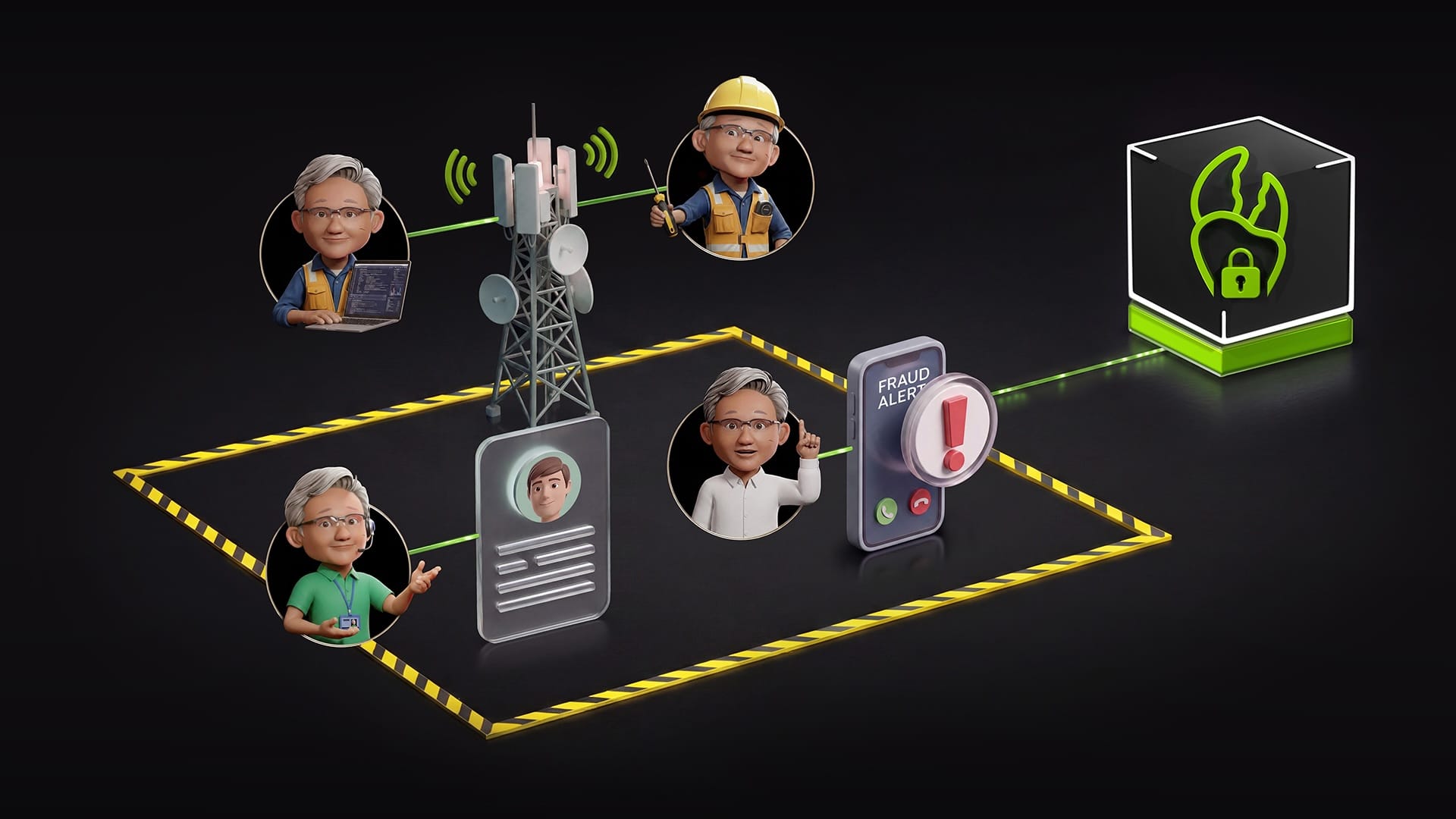
Telecom is where agentic AI demos go to become adults or die quietly. The networks are messy, regulated, latency-sensitive, full of legacy systems and allergic to improvisation. That is why NVIDIA’s DTW Ignite 2026 telecom-agent push is more interesting than the usual “AI agents will run the enterprise” slideware: it is built around the unglamorous parts that actually matter, including synthetic data, anonymization, simulation, secure runtimes, policy gates, audit trails and rollback.
NVIDIA is pitching a stack for long-running telecom agents that watch network health, reason over telemetry, validate actions in simulation and operate under governed execution. The cast list includes NeMo Safe Synthesizer, NeMo Anonymizer, Nemotron open models, NemoClaw blueprints, OpenShell secure runtime, NV-Tesseract time-series models, NVIDIA Agent Toolkit and digital-twin workflows from partners including SoftBank, AdaptKey, Amdocs, NTT DATA, ServiceNow, TCS, Forsk, VIAVI and KDDI. Strip away the product names and the architectural point is clear: agents should propose, simulate, escalate, execute within scope and leave evidence behind.
That is a better blueprint than giving a chatbot credentials and calling it autonomy.
The useful part is the control loop, not the acronym soup
NVIDIA says 54% of operators cite data-related issues as their biggest AI barrier. That tracks. Telecom data is sensitive, distributed, inconsistent and full of operational context that cannot simply be uploaded into a training pipeline because a vendor wants a better demo. SoftBank’s use of NeMo Safe Synthesizer and NeMo Anonymizer is therefore more than compliance theater: if synthetic datasets preserve the structure and distribution of real performance and configuration data without exposing customer or network-sensitive details, they become a practical path to tuning domain agents without turning privacy into an afterthought.
The partner examples show the shape of the system NVIDIA wants operators to buy. AdaptKey is piloting security-hardened long-running agents for self-healing 5G operations, where NemoClaw and OpenShell agents detect security and connectivity issues and submit scoped remediation requests into KeySmith for auditable execution. NTT DATA is using Nemotron open models with NemoClaw to build anomaly agents that track long-term performance trends and escalate relevant cases to research agents for deeper telemetry analysis. ServiceNow’s Project Arc pulls context from emails, logs and diagnostics for incident response while governing actions through OpenShell and ServiceNow AI Control Tower.
The common thread is not “model does network magic.” It is controlled delegation. Models translate messy signals and human intent into structured proposals. Time-series models and telemetry systems detect what changed. Digital twins and deterministic validators test whether a proposed fix is sane. Policy gates decide what can happen automatically, what needs approval and what should be blocked. Operators remain in the loop where the blast radius demands it.
That pattern is portable. You do not need to run a national telecom network to care.
Simulation-before-action should be the default for dangerous agents
VIAVI’s public closed-loop intent assurance blueprint is the most concrete signal in the batch. It describes LLMs proposing a canonical ChangeSet, deterministic digital twins validating it, policy gates deciding, operators approving, KPI monitoring for 60 seconds after deployment and HMAC-SHA256 signed audit envelopes. That is exactly the sort of boring machinery enterprise agents need if they are going to touch production systems.
The boring machinery matters because telecom is a high-blast-radius environment. A bad remediation can break connectivity for customers who do not care that your agent had a lovely chain of thought. A stale assumption about routing, capacity or radio conditions can turn a plausible recommendation into an outage. The architecture therefore needs to make unsafe actions difficult, visible and reversible. OpenShell secure runtimes and NemoClaw-style blueprints are NVIDIA’s answer to that trust-boundary problem.
There is a useful lesson here for developer platforms and internal automation teams: copy the control loop, not the telecom branding. Define canonical action schemas. Separate planning from execution. Bind tool access by policy. Require dry runs for risky changes. Validate against deterministic systems where possible. Generate audit envelopes. Force explicit approvals at risk thresholds. Measure post-action outcomes and roll back when reality disagrees with the plan. If you cannot explain which component authorized an action, what data it used, what simulation passed and who approved the high-risk step, you do not have production autonomy. You have a credentialed suggestion engine.
NVIDIA’s stack also makes a quieter point about where LLMs fit. The strongest role for current agents is not omnipotent operator. It is planner, researcher, translator and coordinator. Let the model search the space, summarize tradeoffs, convert intent into structured candidate actions and route evidence. Then let deterministic systems, policies and humans handle the final merge into production. That is less cinematic than “self-driving network,” but it is how serious systems get shipped.
GPU acceleration is the hidden enabler, not the headline
The infrastructure side still matters. Forsk says its AI-based radio propagation model reaches ray-tracing-level accuracy up to 200x faster than CPU-only baselines on NVIDIA RTX PRO 6000 Blackwell Server Edition GPUs. VIAVI is moving large-scale RAN simulations from CPUs to the same class of GPUs and reports order-of-magnitude simulation-throughput improvements. KDDI, NVIDIA, Keysight and Samsung Research America are building a high-fidelity RAN digital twin using NVIDIA Aerial Omniverse Digital Twin and Keysight emulation tools in KDDI AI data centers.
Those speedups are not just benchmark candy. Simulation only works as a guardrail if it fits inside the operational loop. If validating a network change takes hours, operators will bypass it during incidents or use it only for large planned changes. If it takes seconds or minutes, it can become part of normal remediation. That is the practical connection between GPU acceleration and trust: faster twins make safer workflows more usable.
The caveat is that simulation can become theater. A digital twin is only as useful as its fidelity, update cadence and failure model. A stale twin will bless bad changes with confidence. A policy gate that encodes vague governance language but not real operational constraints will either block too much or miss the dangerous cases. The hard work is not launching the agent. The hard work is keeping the validation environment aligned with the live network and making drift obvious before it becomes an outage.
The same warning applies outside telecom. If your coding agent “tests” a change against an incomplete fixture suite, the green checkmark may be decorative. If your cloud-ops agent plans against stale inventory, the recommendation may be technically coherent and operationally wrong. Simulation-before-action is powerful, but only when the simulation deserves trust.
NVIDIA’s telecom announcement is not important because telcos are getting chatbots. It is important because the architecture treats trust boundaries as the product. Synthetic data addresses the training constraint. Secure runtimes address execution. NemoClaw-style blueprints address orchestration. Digital twins address validation. Audit trails address accountability. Human approval addresses blast radius. That is the stack serious agents need.
The forward-looking take: telecom agents are interesting only if they are boring at execution time. Sandboxed, simulated, policy-gated, observable and reversible beats “autonomous” every day of the week. If NVIDIA can make that pattern work in networks, the rest of enterprise automation should steal it shamelessly.
Sources: NVIDIA Blog, NVIDIA Developer Blog, VIAVI Closed-Loop Intent Assurance blueprint, TM Forum autonomous networks taxonomy