Open Design Is What Happens When Coding Agents Become the Design Runtime

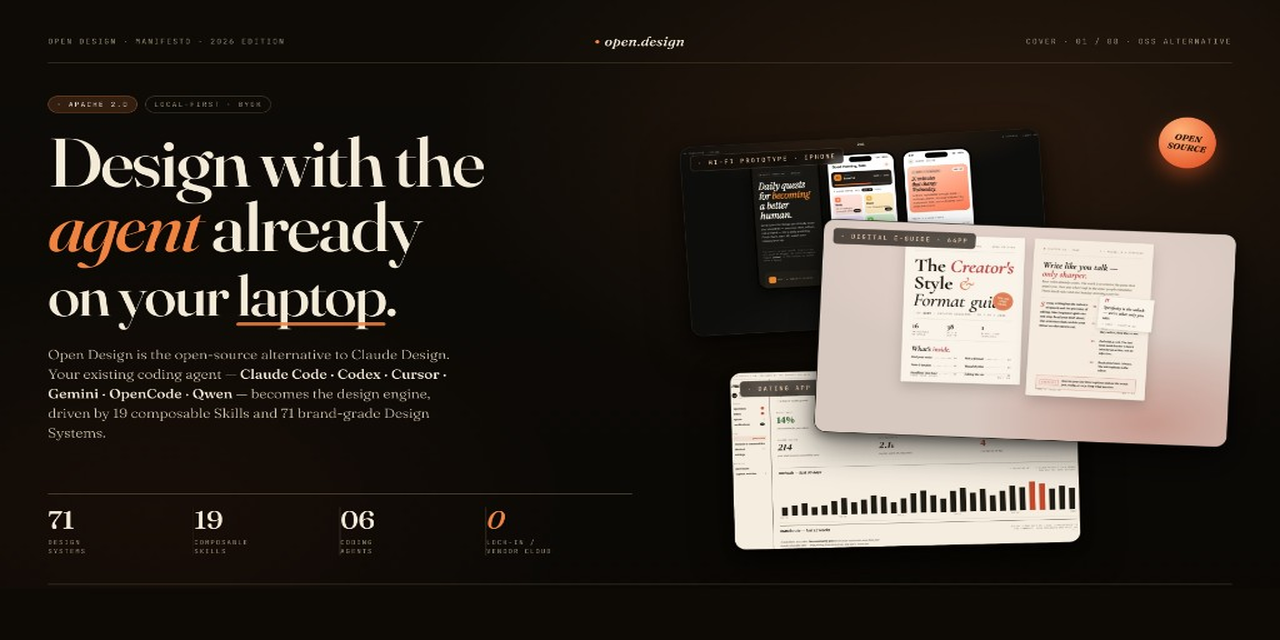
Open Design looks like a design-tool launch. The more important read is that it treats Codex, Claude Code, Cursor Agent, Gemini CLI, Copilot CLI, OpenCode, Qwen, and the rest of the coding-agent stack as interchangeable creative runtimes. That is the story: design work is being pulled into the same file-backed, agent-directed, reviewable loop that coding agents already use for software.
The nexu-io/open-design repository positions the project as a local-first, open-source alternative to Anthropic’s Claude Design. The repo was created on April 28 and, by the research pass, had crossed 43,500 stars, nearly 5,000 forks, and hundreds of open issues. Its public surfaces are moving quickly: the README describes 31 skills, 72 brand-grade design systems, and 16 coding-agent CLIs, while the live Open Design site advertises 131 skills, 150 systems, and 12 adapters. That mismatch is not a scandal. It is preview software moving faster than its own copy.
The 0.8.0-preview discussion is the more telling artifact. It reframes the desktop app as a thin wrapper around a headless engine, introduces a plugin architecture for design systems, slices, prototypes, exports, and legacy workflows like Figma, and says the same engine can run in Claude Code, OpenClaw, Hermes Agent, Lark, Discord, or Slack chat. The local daemon scans $PATH for installed agents, writes artifacts to disk, previews them in a sandboxed iframe, and exports HTML, PDF, PPTX, ZIP, and Markdown. In other words: the design studio is becoming an agent runtime with taste files.
The repo becomes the design workspace
That shift matters because product work has been artificially split across tools. Engineers live in repos, terminals, CI, and pull requests. Designers live in canvases, assets, design systems, prototypes, and review threads. Product managers live in docs and decks. Agents do not care about that old boundary. If a workflow can be represented as files, prompts, constraints, previews, exports, and review loops, an agent can operate on it — sometimes badly, sometimes usefully, always with new failure modes.
Open Design’s architecture makes that explicit. It does not ship its own model as the core product. It delegates to whichever agent runtime the user already trusts: Codex CLI, Claude Code, Cursor Agent, Gemini CLI, GitHub Copilot CLI, OpenCode, Qwen Code, and others. The design logic is pushed into skills, design systems, direction pickers, prompt choreography, deterministic palettes, preview surfaces, and export paths. That is a different bet from “our model designs better.” It is “your existing agent can become a design worker if the workflow around it is structured enough.”
There is real practitioner value in that. Many design tasks are not sacred blank-canvas exercises. A landing-page first draft, internal dashboard mockup, investor deck, social carousel, product runbook, pricing page, onboarding flow, or editorial microsite often needs to become “good enough to critique” quickly. Open Design’s stated loop — Detect, Discover, Direct, Deliver — is aimed at exactly that middle space. Ask structured questions before generating. Pick a visual direction. Write a real artifact to disk. Preview it. Export it. Iterate.
That is not the same as replacing a designer. It is replacing the empty canvas with a reviewable artifact. Good teams know the difference.
Local-first is not automatically private
The project’s local-first and BYOK framing is useful, but it should not lull teams into lazy security thinking. The daemon may run locally. The files may sit on disk. The selected agent may still send prompts, screenshots, brand assets, customer copy, or generated artifacts to a cloud model provider. Open source does not mean confidential. BYOK does not mean safe. A local daemon that can spawn CLIs, read and write project files, run adapters, and export artifacts is still a privileged process.
That does not make Open Design uniquely dangerous; it makes it normal for agent-era tooling. The same warnings apply to coding agents touching production repos. Run it first on non-sensitive work. Use separate API keys with spending limits. Inspect generated files before export or deploy. Keep design-system sources in version control. Watch which provider receives prompts and artifacts. Treat skills and plugins as code. If the tool can write files and call agents, its extension system is a supply-chain surface, not a cute customization panel.
The “plugins create plugins” idea is especially powerful and especially worth treating with suspicion. Agent-written plugins could make design workflows adapt quickly: brand kits, export targets, Figma bridges, accessibility checks, deck templates, media generators, localization passes. They could also become a mess of unaudited code that modifies creative workflows in ways nobody reviews. The correct future here looks like package signing, permission scopes, reviewable manifests, pinned versions, and clear install prompts. The wrong future looks like “the agent installed a plugin because it seemed helpful.” We have seen that movie in package managers. It did not get better with gradients.
Design systems are policy, not decoration
Open Design’s most interesting asset may be its design-system orientation. The site advertises portable Markdown systems for brands like Linear, Vercel, Stripe, Apple, Cursor, Figma, and others; the README describes deterministic visual directions with OKLch palettes and font stacks. Whether those systems are brand-grade enough for professional use is a separate question. The architectural point is right: agents need constraints before taste becomes useful.
A strong designer does not merely generate something pretty. They know hierarchy, accessibility, interaction states, content strategy, localization, brand boundaries, and where the edge cases live. An agent needs those constraints encoded somewhere. Skills and design systems become the equivalent of repo instructions, linters, and test suites for visual work. They do not guarantee quality, but they make quality reviewable. If a generated page violates spacing rules, color contrast, voice, or component usage, there should be a file to point at, not just a human saying “make it feel more premium.”
This is where Open Design connects back to the coding-agent comparison market. The question is no longer only which agent edits code best. It is which agents can serve as dependable runtimes for other tools. Can they run headless? Can they respect filesystem boundaries? Can they stream progress? Can they use approvals? Can they work against structured skills? Can they produce deterministic artifacts? Can they be swapped without rewriting the workflow? Codex versus Claude Code versus Cursor versus Copilot is becoming a runtime comparison, not just a model comparison.
That makes Open Design a useful stress test. If a tool can drive design generation through Codex today and Claude Code tomorrow, the abstraction boundary is the product. If it cannot — if each adapter behaves differently, approval semantics drift, file access is inconsistent, or outputs are hard to audit — then “bring your own agent” becomes a compatibility tax.
My take: Open Design is worth experimenting with and not yet worth trusting blindly. The demand signal is obvious. More than 40,000 stars in roughly three weeks is not normal background noise. But preview velocity, unsigned/young packaging surfaces, plugin ambitions, and cloud-provider ambiguity all argue for a cautious adoption posture. Use it for drafts, prototypes, decks, mockups, internal artifacts, and taste exploration. Do not feed it sensitive brand work or client material until you understand the data path, permissions, and plugin model.
The serious question is not “will agents replace designers?” That framing is tired and mostly useful for engagement bait. The better question is which parts of product design become file-backed, agent-directed, reviewable loops. Open Design’s answer is aggressive: more of them than Figma-era workflows assume. That may be too early. It is not obviously wrong.
Sources: Open Design GitHub repository, Open Design project site, Open Design 0.8.0-preview discussion, TechTimes, Anthropic Claude Design announcement