OpenClaw Finally Gave LanceDB Operators the One Maintenance Command They Actually Need

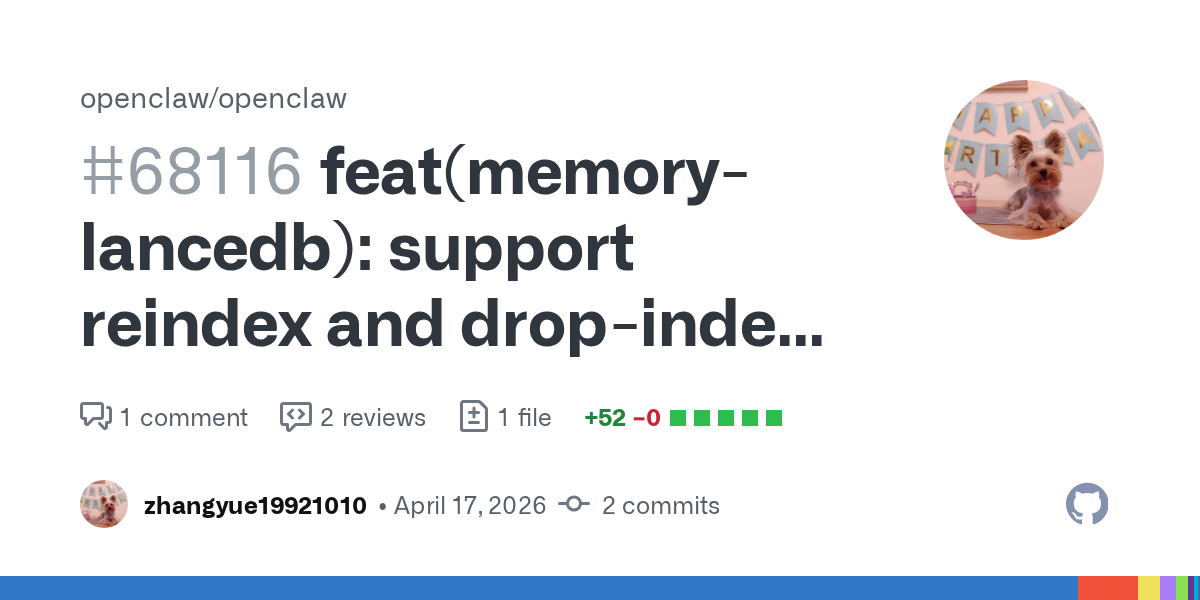
The easiest way to tell whether a project has crossed from feature demo into real infrastructure is to look at the maintenance commands nobody bragged about shipping. This week’s OpenClaw change to the memory-lancedb plugin qualifies. On paper, it is almost comically modest: ltm reindex now accepts a blocking timeout, and the plugin gains a ltm drop-index command. In practice, that is the sort of boring correction that determines whether operators trust a memory system enough to keep it in production.
Before PR #68116, OpenClaw’s LanceDB reindex behavior had a problem familiar to anyone who has operated stateful systems: it said “done” before the underlying work was actually done. The old ltm reindex path rebuilt the LanceDB vector index without waiting for creation to finish before printing success. If you are just experimenting locally, that is mildly irritating. If you are running durable memory on a real workload, it is a lie. Index creation is one of those steps where the difference between “command returned” and “system is ready” matters more than any changelog flourish.
The new command surface is clearer. ltm reindex --timeout <seconds> now defaults to 180 seconds and passes the value through as waitTimeoutSeconds so the operator can block until the index is actually ready. There is also a new ltm drop-index command, with deletion performed in deterministic sorted order. The implementation is compact, about 52 additions in a single file, which is usually a good sign. It means the team did not need a redesign to fix the operator contract. They needed to finally expose it honestly.
That honesty matters because OpenClaw’s memory story is changing under the hood. The project has spent the last week talking more explicitly about active memory, durable backends, imported histories, dreaming flows, and richer recall surfaces. The memory-lancedb plugin is part of that bigger shift. Once memory moves from “interesting plugin” to “stateful subsystem,” lifecycle work stops being hidden implementation detail. Reindexing, dropping an index, waiting for durability, and verifying readiness are now table stakes. Nobody running a serious database or vector store would accept a maintenance command that prints success while work is still happening in the background. Agent frameworks do not get a pass just because the UI feels more conversational.
The real story is trust in the ops surface
What makes this worth publishing is not the presence of a timeout flag. It is what the flag admits. OpenClaw is slowly growing into an agent runtime with actual operational state. The moment a memory backend can live on remote object storage, preserve index state durably, and participate in long-lived agent workflows, operators need tooling that behaves like storage tooling, not like a helper script. A command that says “reindex complete” when the index is still baking is not just a UX paper cut. It trains users to distrust the maintenance surface. Once that trust goes, everything else gets harder: automation, incident response, recovery drills, even basic release adoption.
The same-day review comments on the PR tell the story well. The most useful feedback was not “nice feature.” It was “what happens if someone types --timeout foo?” One review correctly noted that Number.parseInt("abc", 10) becomes NaN, which then gets forwarded into LanceDB’s wait path with undefined behavior. That is mature operator feedback. It means the audience for this feature is already thinking like infrastructure users: does the command block when it claims to block, and does it fail cleanly when the input is wrong? Those are not cosmetic questions. They are how maintenance tools earn credibility.
LanceDB itself is part of why this matters. The database is not marketed as a toy vector cache. It positions itself as a retrieval and multimodal data layer with versioning, schema evolution, vector search, and support for large evolving datasets. In that world, indexes are not one-time scaffolding. They are live operational assets. If OpenClaw wants to build a serious memory stack on top of LanceDB, it needs to meet operators where their expectations already are. That means commands should be explicit about waiting, explicit about cleanup, and explicit about failure.
Agent memory is becoming infrastructure, not personality
There is a second story here that I suspect a lot of the agent market still underestimates. Memory systems are often discussed as if they are mostly about UX: does the assistant remember your preferences, recall the right context, or feel personalized over time? Those questions matter. But underneath them is a much less glamorous truth. Persistent memory is a storage problem. It has indexes, schema drift, maintenance windows, remote durability, compaction, rebuild behavior, and operational failure modes. The product fantasy is “the assistant remembers.” The operator reality is “somebody has to manage the retrieval substrate.”
OpenClaw’s recent cadence makes that impossible to ignore. The project is adding more memory features while also exposing more of the maintenance plane. That is a healthy sign. Mature systems do not just add higher-level capability. They also admit the existence of lower-level chores. If anything, the criticism here is that the chore surface should have arrived earlier. Blocking reindex and explicit drop-index are not premium extras. They are the commands operators reach for the first time the memory layer gets slow, inconsistent, corrupted, or simply large enough that “maybe it finished” stops being an acceptable answer.
There is also a design lesson that travels well beyond OpenClaw. In stateful AI systems, asynchronous convenience often ages poorly. Developers love fire-and-forget workflows when they are building. Operators hate them when they are maintaining. If a task materially changes readiness, it should either block until complete or expose a first-class job model with inspectable state. Anything in between becomes folklore, shell glue, and eventually incident tickets.
What to do if you run memory-lancedb
If you already use OpenClaw with LanceDB, this is a good time to tighten your playbook.
Start by treating reindex as a real maintenance operation, not a casual helper command. Use explicit timeouts. Record how long rebuilds take on realistic datasets. If you are automating this in CI or scheduled maintenance windows, fail fast on suspiciously short completions and watch for follow-up fixes around timeout validation.
Second, test drop-index in a controlled environment before you need it in anger. Deterministic sorted-order deletion is a useful implementation detail because reproducibility matters when you are debugging stateful cleanup. But destructive maintenance paths deserve the same rehearsal as backup and restore, especially once remote storage is involved.
Third, update your mental model of OpenClaw itself. If you are still evaluating it as “chat UI plus models plus some plugins,” you will miss where the product is actually heading. Durable memory, cloud-backed indexes, reindex semantics, and explicit lifecycle tooling all point in the same direction: this is becoming an application runtime with operational state underneath. That is promising, but it also means the boring commands now matter as much as the flashy ones.
My take is that OpenClaw finally shipped the LanceDB maintenance command it should have had from the start. That sounds like faint praise. It is not. In infrastructure, honest maintenance semantics are a bigger milestone than one more shiny capability. Features attract users. Commands that mean what they say keep them.
Sources: OpenClaw PR #68116, OpenClaw v2026.4.15 release notes, OpenClaw Active Memory docs, LanceDB docs